Chronotopic Cartographies
After London
After London; or, Wild England is a book of two halves joined, as the ‘or’ of the title implies, not altogether harmoniously, particularly in terms of temporality. The first part, ‘The Relapse into Barbarism’, is a natural history of a post-metropolitan world set in a future that has regressed to a feudal state. The second, ‘Wild England’, is a pseudo-medieval quest narrative.
The attention to detail and highly specified spatial descriptions in After London might lead us to define it in terms of the ‘Correspondent World’ of spatial type 1. There is, however, a key difference. Where (according to Bakhtin) realist novels treat nature as a fixed backdrop against which characters/society changes, in After London Jefferies inverses, or redresses, this balance so that character and incident form the milieu and narrative focus hones in on the environment to such an extent that it becomes the foreground.
Our range of maps demonstrate this tension between the influence and reversal of realism. On the one hand the book is a classic Bildungsroman following Felix as he transitions from boy to manhood. But, as the complete and the syuzhet maps make clear, it is far more concerned with the 'Bildung' of the external world. The familiarity of sites such as 'England' and 'London' is offset by qualifying adjectives such as ‘old’, ‘wild, ‘after’, and made more alien as they morph into invented places like 'Wolfstead' and 'Thyma'.
Complete Map
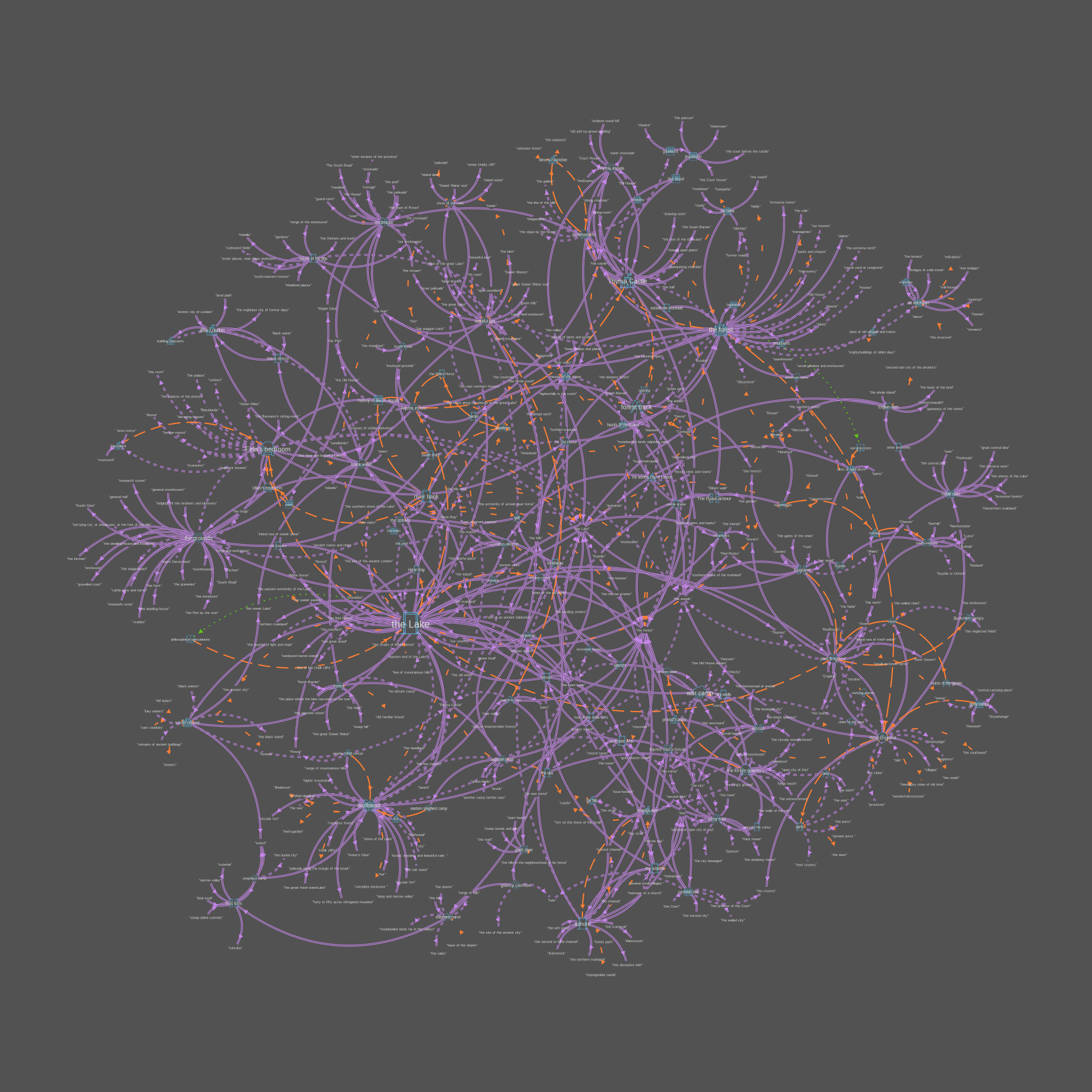
The duality registered in the title of After London is realised in the (almost unreadable) complete map. Here, the sites of the first half of the book sit on the right, those of the second on the left. This also maps the contrast in scale between the macro time-spaces of geological epochs without human character and the micro time-spaces of Felix’s world. The largest and most connected topos is ‘the Lake’ and its chronotopic value of the 'threshold' speaks for how it joins past and present, and links the text’s two halves. Considering both the Lake’s centrality and the proliferation of waterways, rivers, inlets, streams, marshes, moist places, the novel might just as accurately be named 'Watery England'. Even the land, on Felix’s arrival at ruined 'London', is shifting and volatile, its black water leading to black strands and masses of visible blackness. This abundance of fluid is key, demonstrating the fundamental lack of fixity at the centre of the novel. Nothing is certain – the past is distant, unrecorded, unknown and the future world occupied by the narrator is unspecified and open-ended. Spaces, too, are ungraspable; their literal fluidity echoed in the unfixed naming systems in which 'Oxford' is also 'Sypolis'. Here, then we see that any bridges to the ‘real’ offered by the toporefs – 'Northumbria', 'Chester', 'Ireland' – are contested/distanced by their position in the undetermined future history of the first narrative.
Syuzhet Map
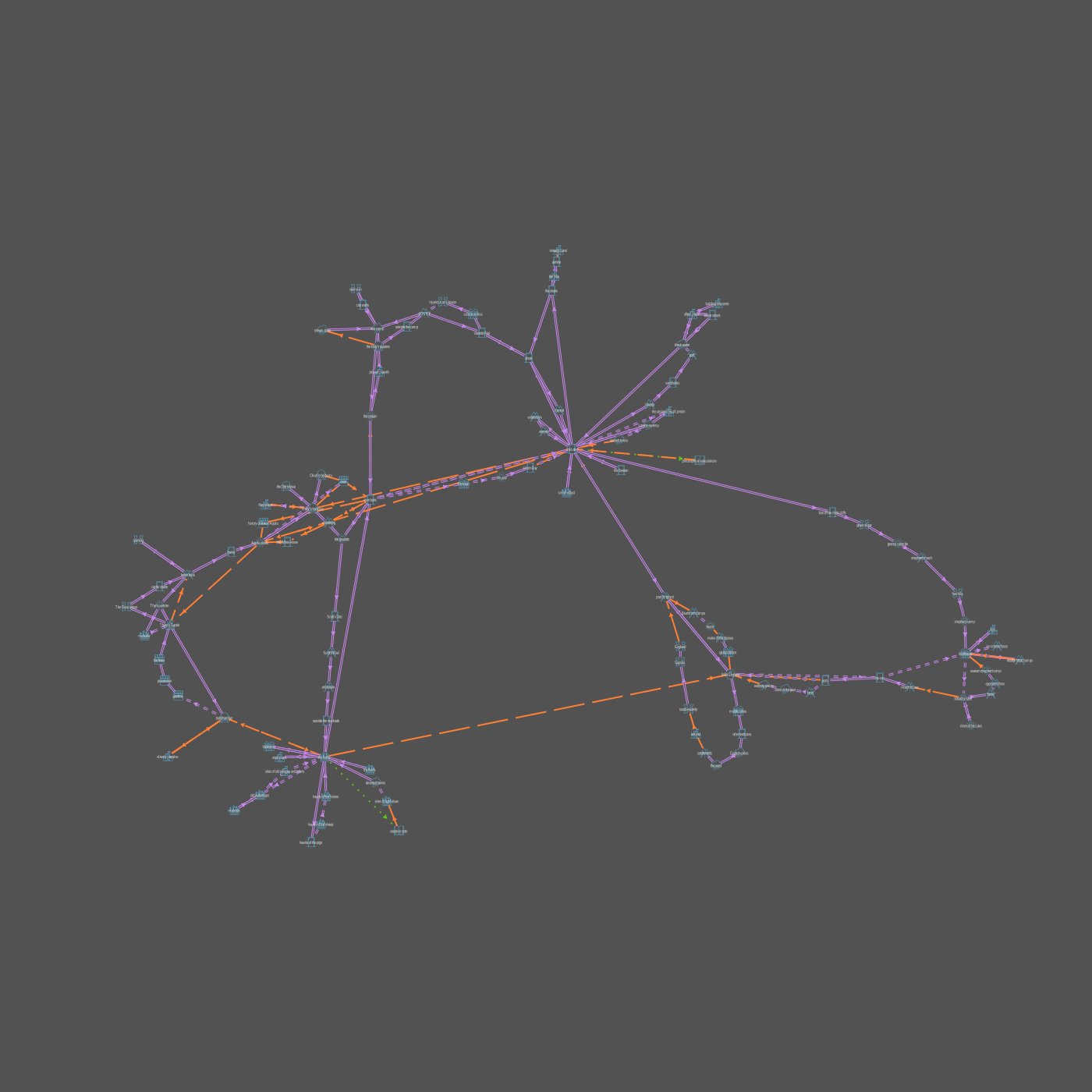
In the spatialisation of narrative for After London Jefferies makes 'time visible and take on flesh' in just the kind of ways Bakhtin refers to in his definition of the chronotope. The syuzhet map shows how the past is a place that can be visited and plotted. Part One, in its ‘Return to Barbarism’ retells a destruction and the recreation myth in miniature. Centring on the forest spaces of Wild England and past England, the narrative moves from sites defined by the past – ruins of old civilisations – through those of natural reclamation – the 'forest', haunts of the horses and pigs – to those of partial humanisation – 'Bushmen camps', 'enclosures'. Part Two continues this retelling of history through place, this time via a quest romance set against a feudal world of castles, baronies, feasts, and arbours. The bulk of the narrative maps Felix’s journey across the 'great Lake' into the unknown wilderness, the lands of warring tribes, and site of the ruins of 'London'. In this novel, the past really is a foreign country, or an ‘other’ place at least: the temporalised city of ‘after London’ is a toxic wasteland, set apart from the main narrative focus on ‘Wild England’.
The relative simplicity of the syuzhet map when compared to other novels of a similar length is due, in part, to the narrative structure and impulse. Each part of the book adopts a distinct perspective, first that of the historian, then Felix. Both perspectives embody restless forward-moving compulsion, and share a world-building impulse, and this is imaged in the frequently uninterrupted direct movements from place to place. But the way the map combines these two perspectives in one main loop is at odds with the readerly experience and the novel’s form, where Part One supresses the human aspect, and the narrative is driven by something other than character or incident, and Part Two is centred around Felix.
Deep Chronotopes Map
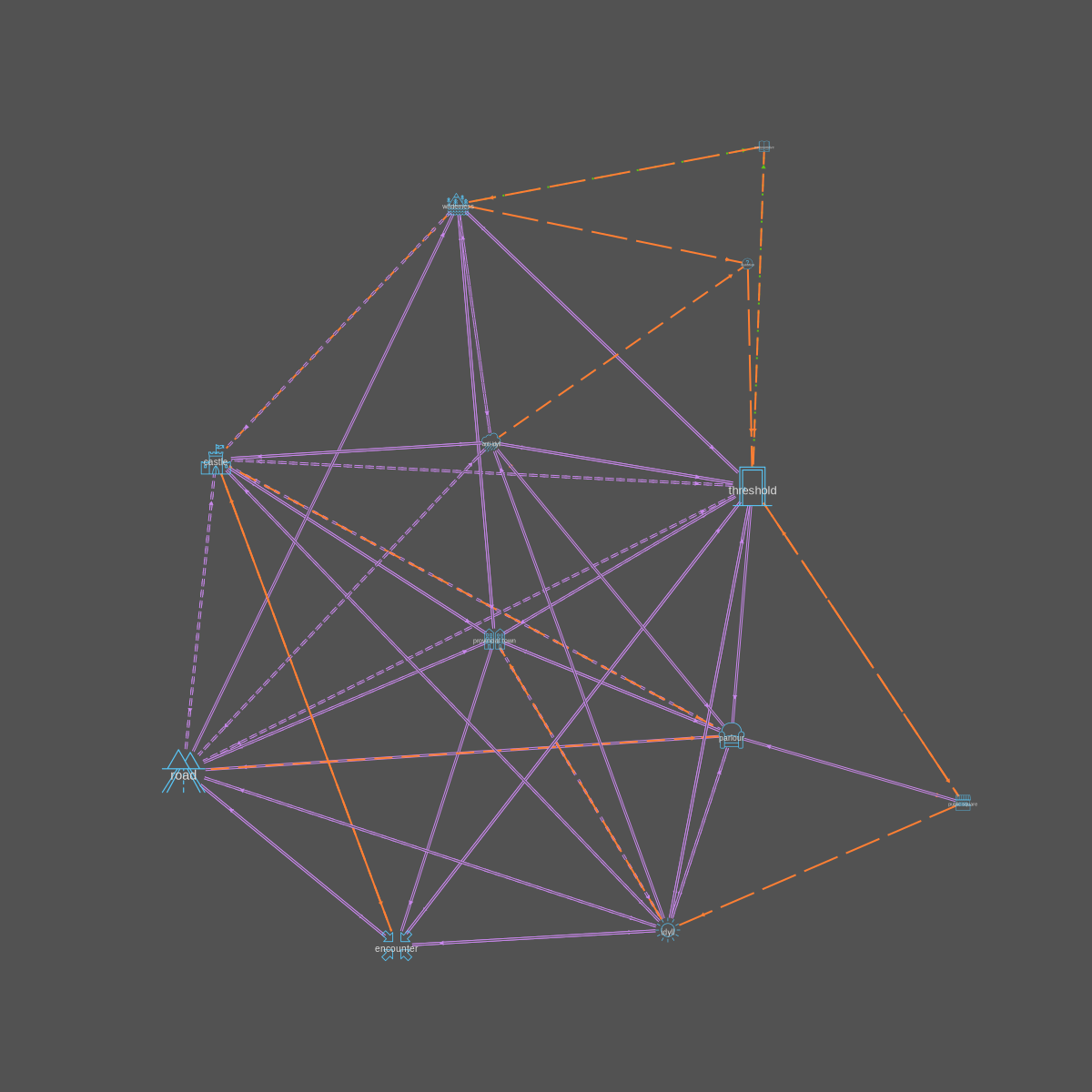
The deep chronotopes map shows that, unusually, the novel contains all the possible chronotopes. This multiplicity is created by the novel’s dual and often contesting generic and spatio-temporal character combining: dystopian, post-apocalyptic future history, nature writing and the quest romance, while also travelling through wilderness and facing adversity in the name of love. The three dominant chronotopes – 'threshold', 'road', 'encounter' – suggest that overall After London; or, Wild England isn’t only, or even mainly, about the wild but rather the human journey through it. In the deep chronotopic map ‘wilderness’ is directly connected (via a solid purple line) to ‘anti-idyll’ registering how the world of the novel is an afterwards, an uncultivated, dehumanised landscape of empty wilderness, and, as the novel’s open and inconclusive ending registers, the idyll denied. Besides, the idyll’s pastoral impulses rely on spatial and temporal contrasts – the rural past, the urban present – whereas here London and the city is the past.