Chronotopic Cartographies
Barchester Towers
If spatial type 3 is all about 'nested' imaginative spaces – the careful situating of the fictional close by, or within travelling distance of, real-world cities – then Trollope is the ultimate example of this, gradually enlarging his fictional totality out from a small spatial core. His first book, The Warden is set in the tightly knit world and small-minded power-play of the Cathedral Close in Barchester (loosely based on Salisbury cathedral). With his second novel, Barchester Towers, Trollope enlarges the space of the fictional world to encompass Barchester itself and the Bishop’s Palace – which remains the central focus of Volume I. The old Bishop having died, a new progressive Bishop is installed to the disgust of the Archdeacon who had hoped to be given the post. As the novel unfolds, it also enlarges from Barchester to Barsetshire and incorporates the separate sites of Plumstead rectory (where the Archdeacon lives) in Volume II; and finally nearby Ullathorne (home of Mr Arabin) in Volume III. Spatial connections are also ecclesiastical and familial – emphasising the internecine nature of the in-fighting and petty quarrels that characterise the novel.
Trollope’s Barsetshire contains links to a world that exists at arm’s length from the main action. Characters may once have lived in London or in Italy, but the centripetal force of the provinces (and the provincial novel) demands that all action must occur in the nested world-within-a-world. Barchester/Barsetshire is what it is precisely because it is not London, or Italy. Provinces lend themselves nicely to Bakhtin’s chronotopic categories. The provincial novel, as part of the larger realist novel genre, is eminently ‘mappable’ – giving strict detail of places and their relations.
Complete Map
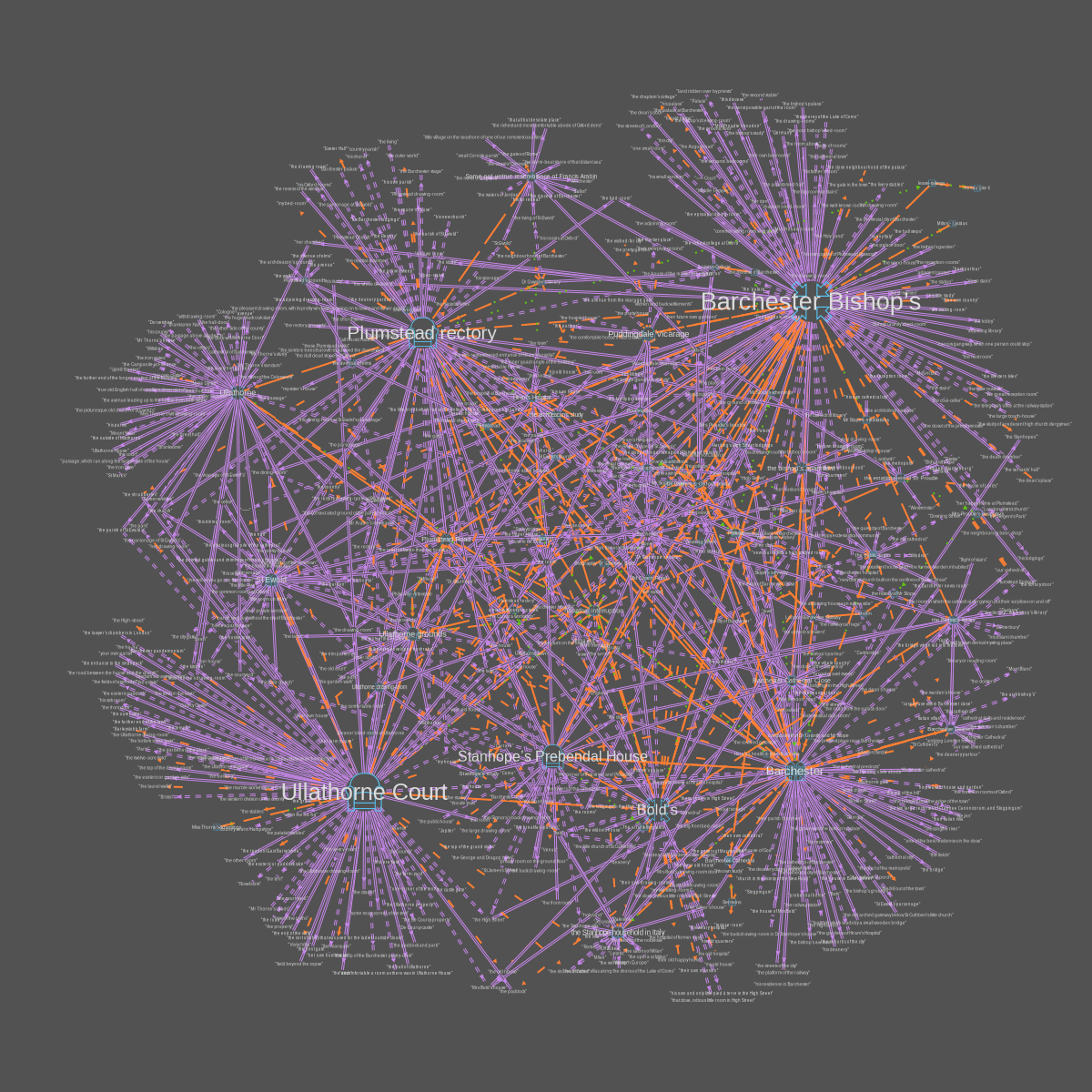
The complexity of the complete map aptly registers the interconnectedness at the heart of the novel, and the Barsetshire series as a whole. In both Trollope creates and peoples a dense and composite world – 'Barsetshire' – nested in a wider space that corresponds with mid-nineteenth-century England. The novel’s four key settings are imaged in the clear spatial clusters – 'Barchester' and the 'Bishop’s Palace' on the right, 'Plumstead rectory' and 'Ullathorne Court' on the left. These in turn, register the novel’s central tensions: between old and newer orders, between ecclesiastical and domestic, between high and low church. The toporefs reveal horizons and perspective. 'Barchester'/'Barchester Bishop’s' is widely inward-looking, dominated by either self-referential or ecclesiastic spatial allusions. 'Ullathorne', on the other hand, looks outward, to 'Wiltshire', 'Paris', 'the Colosseum'.
Topoi Map
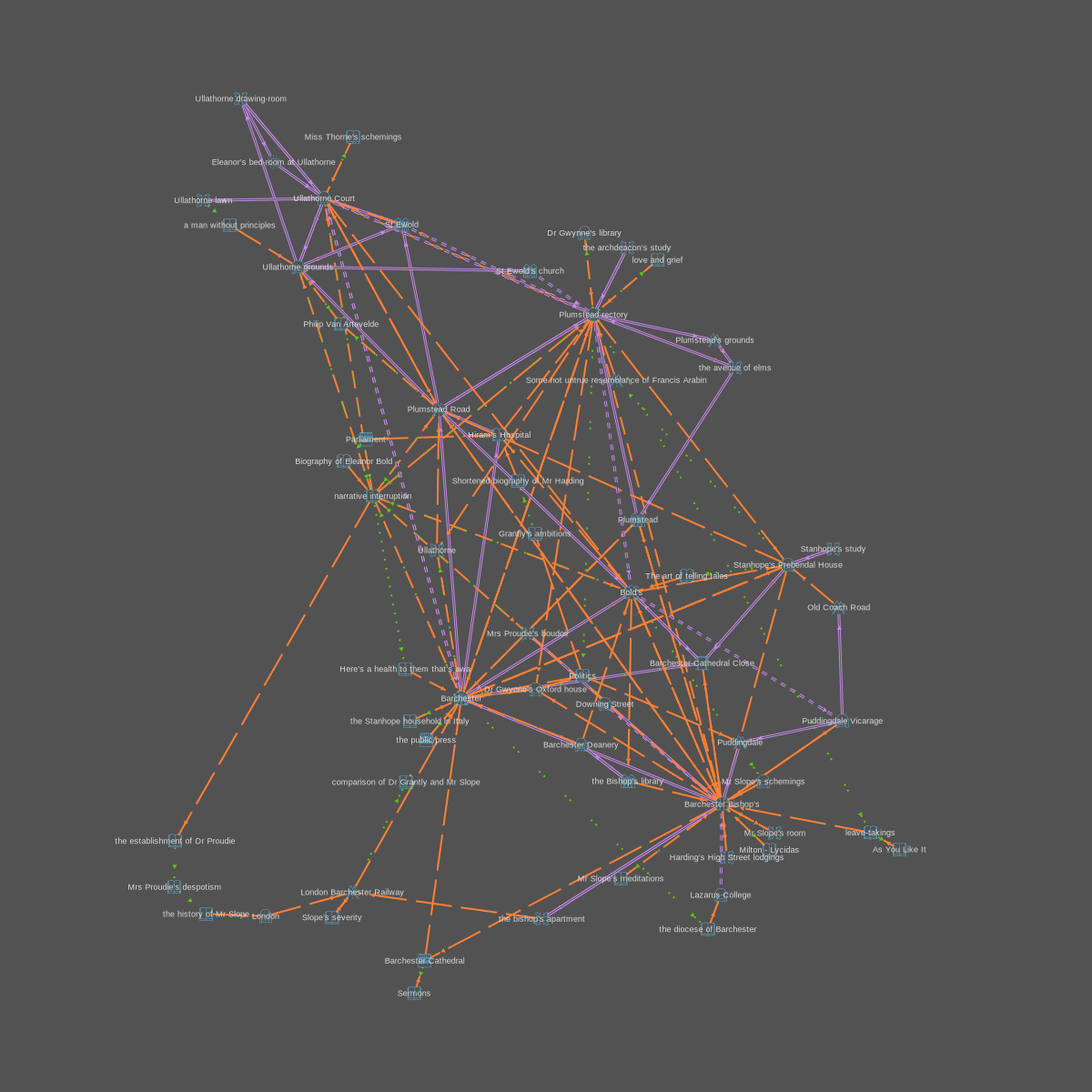
Barchester Towers is a complex text to map because of its narrative structure – switching between framing sites of the sophisticated ‘real’ world (London, Italy), the nested sites of Barsetshire ('Plumstead', 'Barchester') and the metanarratological spaces of narrative reflection and explanation by a self-conscious narrator. As a result, the novel’s spatiality could be said to embody three distinct scales. The nested fictional world occupies the main body of the topoi map, directly and indirectly interconnected. The other places, which constitute the reflexive and larger world, loop and jut out, connected to the hub via orange jumps and green narratological edges.
Places outside 'Barchester' – 'Italy', 'London' and 'Oxford' – are past places and feature in the narrative at a temporal remove, as seen in the connections (jumps and interrupts) rather than the more direct spatial connections between sites in Barsetshire. This demonstrates the sense of a contained world distanced from the outer or ‘real’ world that encloses it, and heightens the sense of contrast between the two spaces. But, conversely, the influence of the nesting world (London – ‘public press’ and London politics – ‘Downing Street’) is also strongly felt.
Syuzhet Map
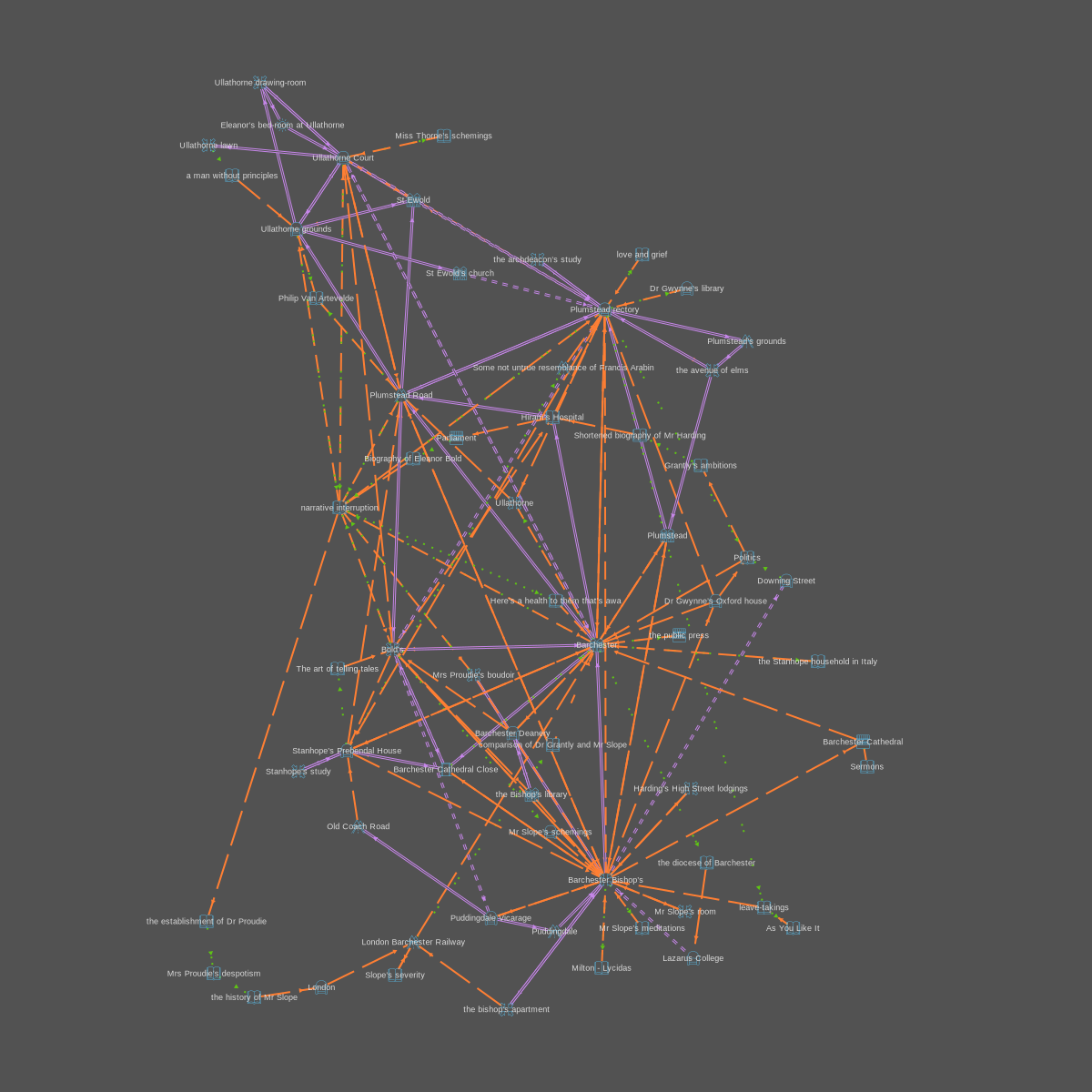
In the text, the novel’s three-volume structure and corresponding divergent narrative focus are spatially realised. The shift from the Bishop’s Palace in the centre of Barchester – ‘Barchester Bishop’s’ (with the places associated with Mrs Proudie, the Bishop, Mr Proudie and Mr Slope), the Cathedral and its environs (the 'Close' and 'the Prebendal House') – to 'Plumstead' in Volume II ('The Grantlys') and 'Ullathorne' in Volume III (The Thornes and Mr Arabin) is figured in the graph. The spaces of Volume I dominate the bottom of the graph; Volumes II and III the top. The centripetal movement from centre to periphery also constitutes a move from the civic politics of the ‘public square’ to the private, more domestic politics of the ‘parlour’. The move outwards, then, can also be read as a move inwards. Connections between Barchester settings are characterised by 'jumps' and 'interrupts', the Plumstead ones by 'direct' and 'indirect'. Also, the vast swathes of 'metanarrative' spaces and, for a realist novel, the relatively high occurrence of meta- and intratextual connections, register how the plot mechanisms are both highly controlled and unconcealed by the narrator.
Deep Chronotopes Map
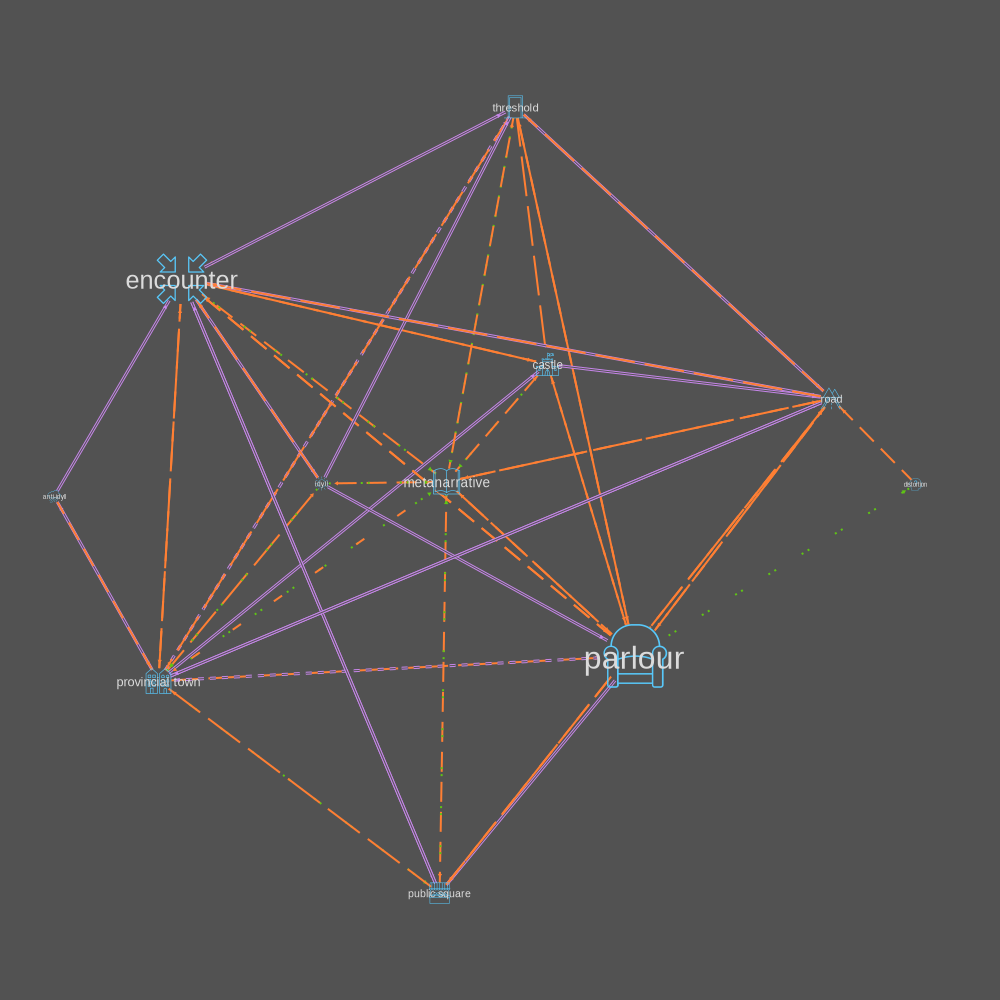
The complex shape of the deep chronotopes map is created by the novel’s remarkable chronotopic variety (containing ten of a possible eleven) and the connectedness of these chronotopes. The external, or public, chronotopes ('encounter', 'road', 'provincial town', 'public square') frame an inner star of more internal or private chronotopes ('castle', 'idyll', 'metanarrative' with 'parlour' figuring in both). 'Metanarrative' is located at the middle of the map and is by far the most interconnected chronotope. Its centrality calls attention to the ways the fiction is crafted. Characters are rarely on the road; the narrative dwells little on journeys and is focussed far more on encounters in key places This focus is registered in the dominance of the 'provincial town' chronotope as we would expect for a provincial novel.