Chronotopic Cartographies
Childe Roland to the Dark Tower Came
Childe Roland to the Dark Tower Came
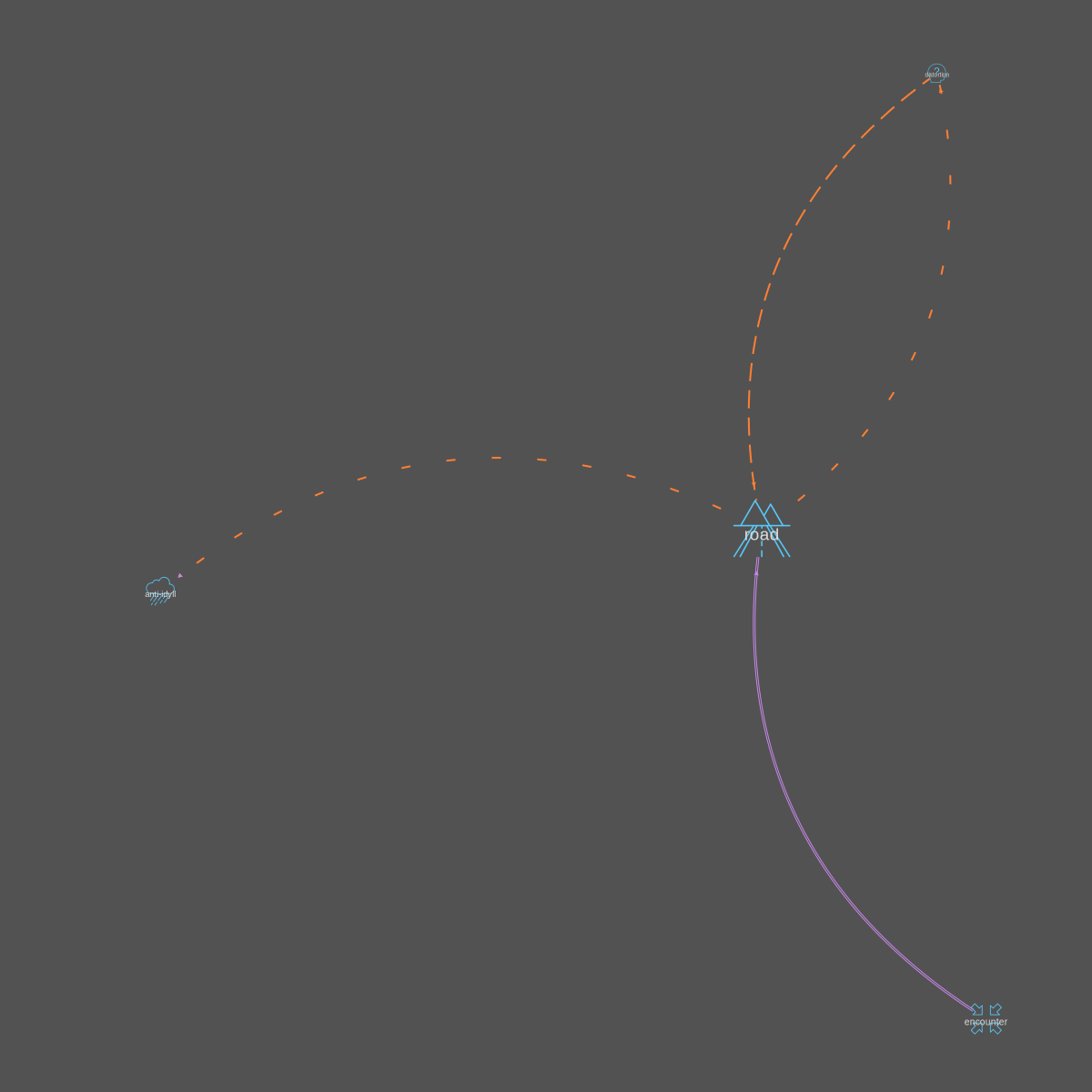
'Childe Roland to the Dark Tower Came' is a major dramatic monologue in Robert Browning’s collection Men and Women (1855). Following the form of a dramatic monologue, which dominates that collection, the poem is an ironic exposure of the self. It is also an inversion of the traditional quest narrative, evoking a world divested of stability. Because the poem is as much a journey in as a journey out, it is a perfect fit for Spatial Type Two. The landscape is filtered through the speaker’s paranoia, internal and external combine leaving everything – self and surroundings – out of focus and uncertain. In fact, it is this very fuzziness that characterises the poem; the speaker is held between a bleakness within and a bleakness without, and the two are so interwoven as to become indistinguishable.
The maps for the poem illustrate this perfectly. For a poem of over 200 lines, they are markedly simple. This is because so much of text is concerned with the internal landscape, that places (topoi) and place references (toporefs) are limited by the highly subjective stance of a speaker both linked to yet repulsed by his surroundings. The maps’ simplicity also highlights a key justification of our chronotopic approach. The structure of the poem is symbolic, and meaning accumulates through imagery. Our method extracts the underlying forms, seen with particular clarity in the syuzhet (plot) map, exposing a chronology and connections not immediately apparent through reading.
Complete Map
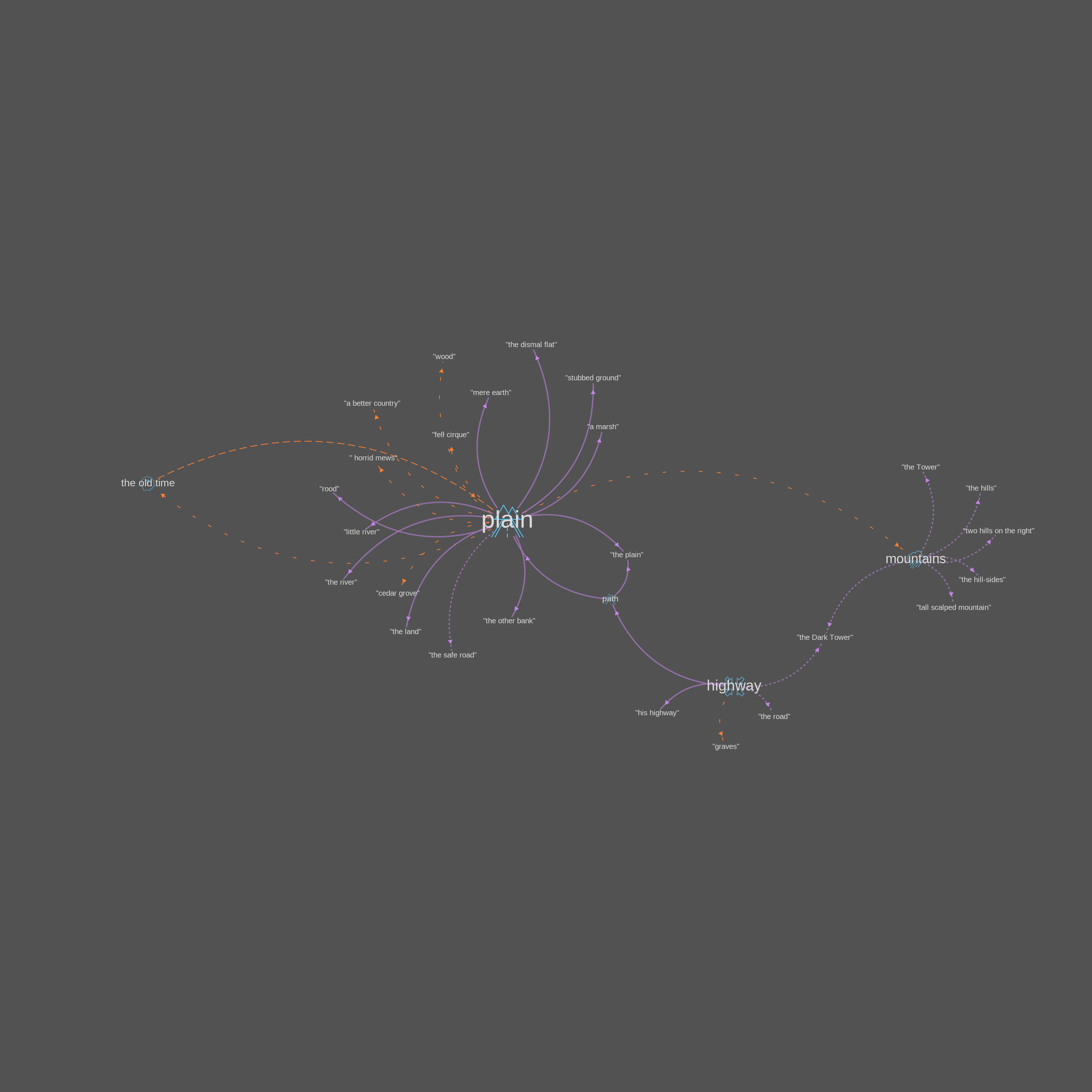
In 'Childe Roland to the Dark Tower Came' the poem (and Roland’s journey) ends at the mountains and, with reference to 'the Tower', back where it began. Structural repetition is registered by underlying spatial form. As we could also ask of 'The Ancient Marinere': does the poem actually go anywhere? The toporefs of the plain, where the bulk of the poem occurs, suggest emptiness and stasis. The descriptive adjectives – 'dismal', 'stubbed' and 'mere' depict a place where growth and action are stunted; a vast, featureless blank. Each topos is full of self-references and reiterations that question whether there is a world outside the speaker’s perception. This registers the poem’s form: as a dramatic monologue it is self-orientated. The 'fell cirque' and 'horrid mews', symbols of confinement and hostility, are only mentally present, a spatialisation of the speaker’s inner landscape.
Topoi
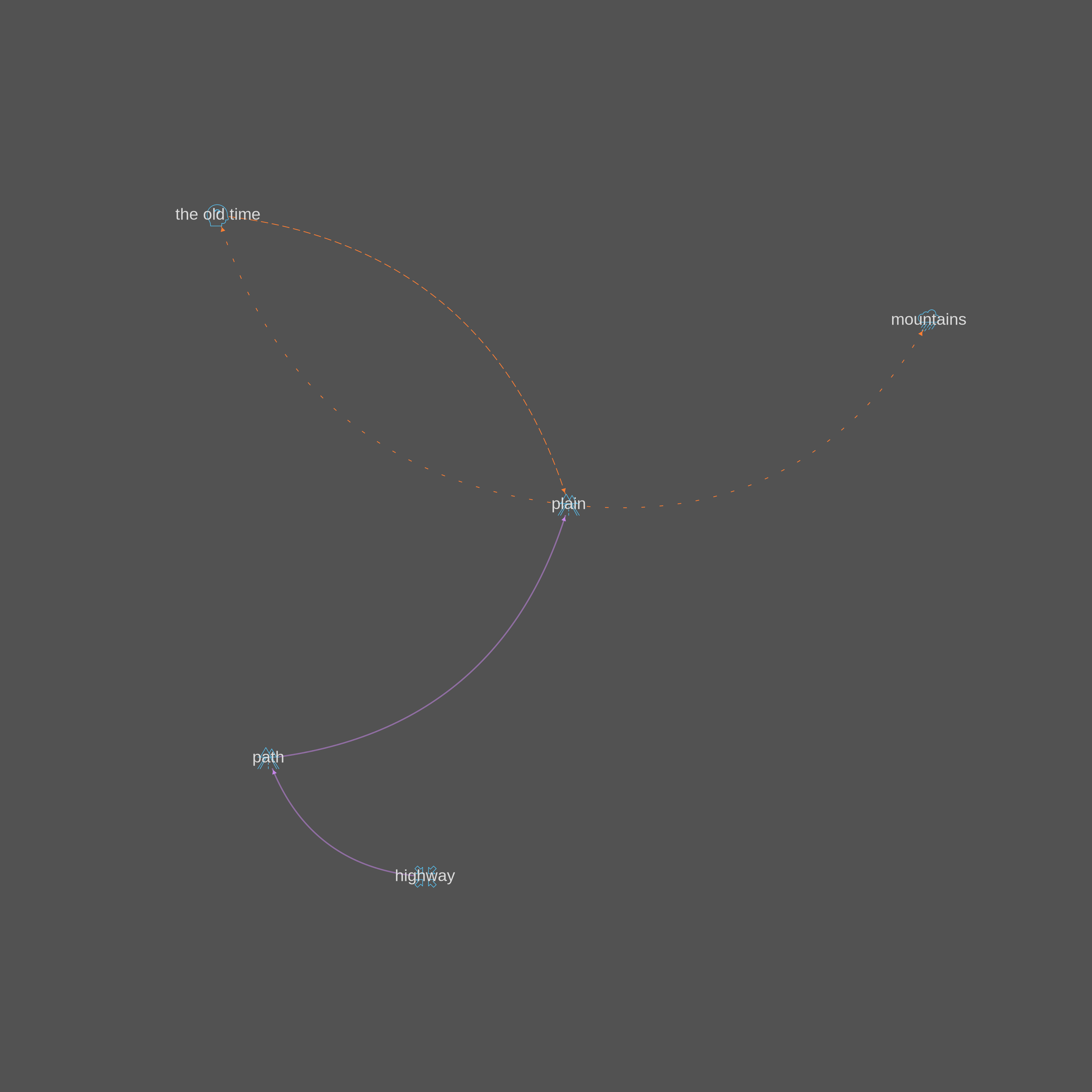
Much like the complete map, the topoi map begins as a journey, with the narrative moving directly from one concrete place to another. But, unlike the spatial variety of other journey narratives such as Pilgrim’s Progress, Utopia or Gawain, the topoi are limited. Once the narrative has jumped into and looped back from the imagined 'old time', it is clear that it was never supported by tangible reality or a world outside the poem. The narrator may make claims that his quest is complete, but the poem concludes open-endedly with a disembodied quote from King Lear: 'Childe Roland to the Dark Tower came'. The maps make explicit the embedded irony of the poem: the quest is all a guise.
Syuzhet
The syuzhet map of 'Childe Roland to the Dark Tower Came' is extremely stark and correlates with the spatial form of a pilgrimage or quest narrative. The poem progresses from place to place, moving from the highway across the plain to the mountain. But, like the lighthouse in To the Lighthouse, in 'Childe Roland', the eponymous site is not a key setting. This is the first clue that this is a peculiar sort of quest. As the poem consists of only one episode told chronologically, the fabula and syuzhet maps are identical. Also unlike the traditional quest, 'Childe Roland' has no clear objective, it begins and ends on the journey.