Chronotopic Cartographies
The Chronicles of Narnia
C. S. Lewis’s Chronicles of Narnia is a classic work of Twentieth Century British children’s literature. Here we compare two of the novels - The Voyage of the Dawn Treader and The Magician's Nephew. Though the books contain events which happen initially in the ‘real’ world that is recognisably that of London, England and the British boarding school, they are principally set in the fantasy world of Narnia. They represent classic examples of a 'bridged' text (in spatial terms) in which the fantasy world is entered through a portal that takes the children away from real world place and space, but this is also returned to at the end. As such they present a straightforward challenge to literary geography, in that the majority of the places which they describe cannot be mapped in the conventional sense.
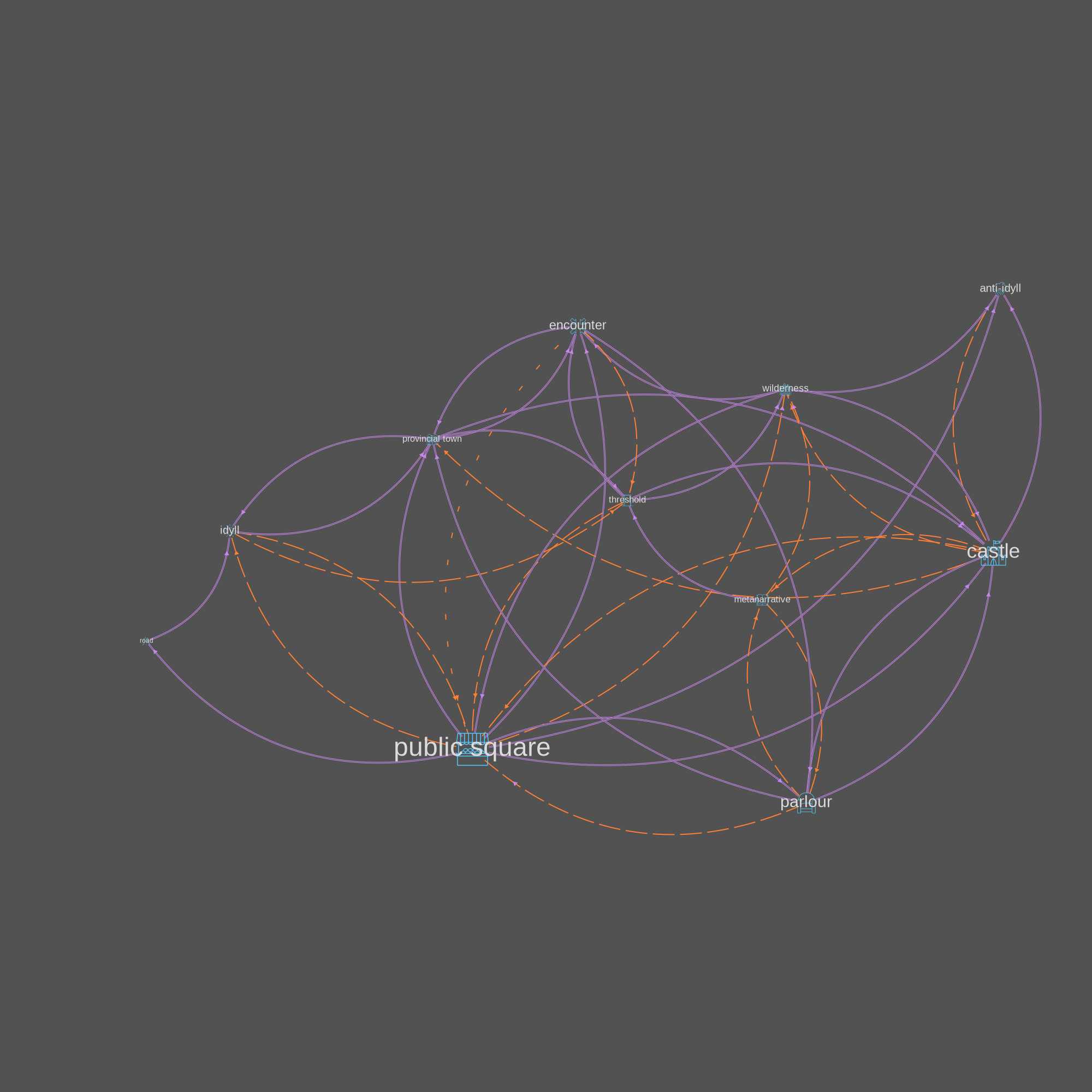
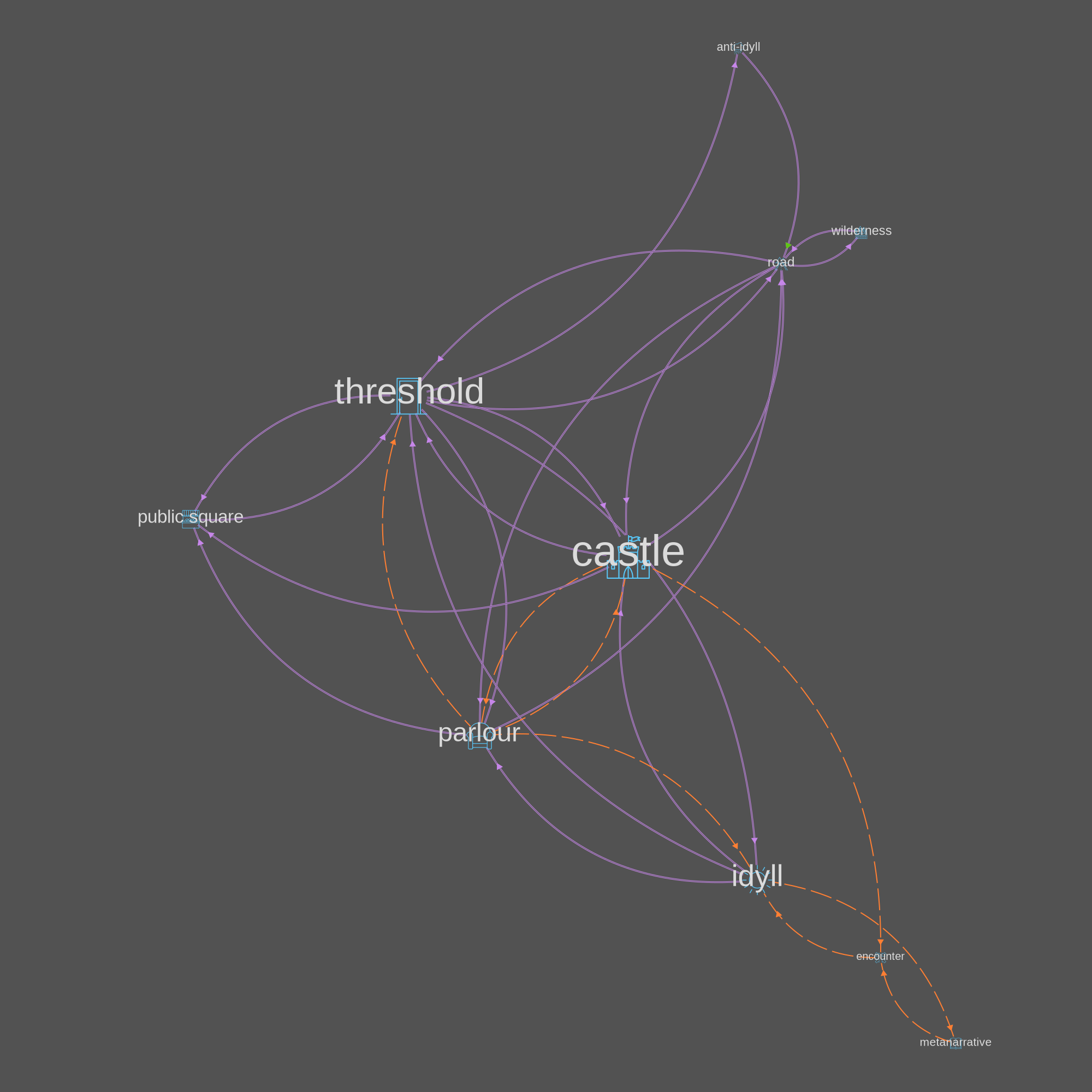
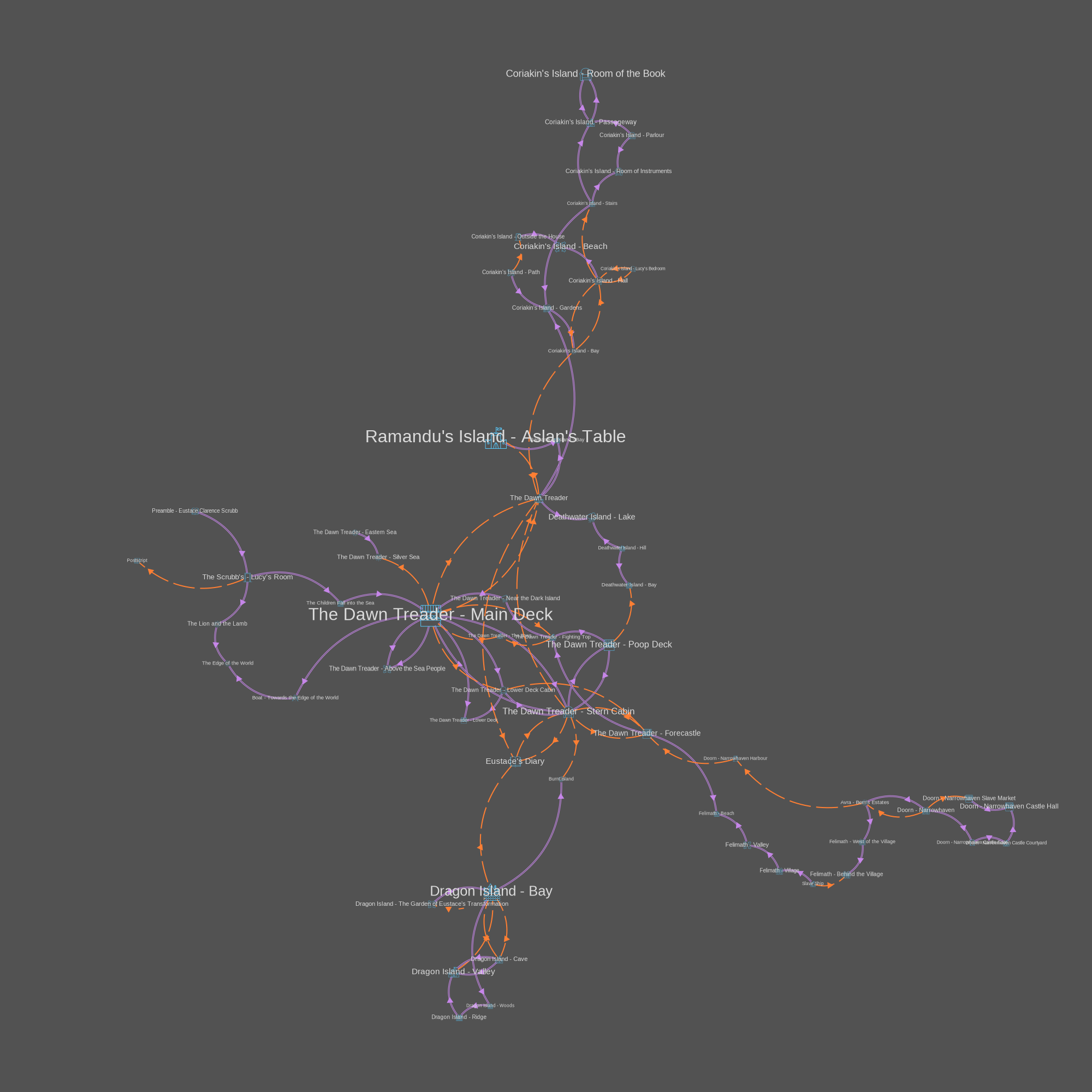
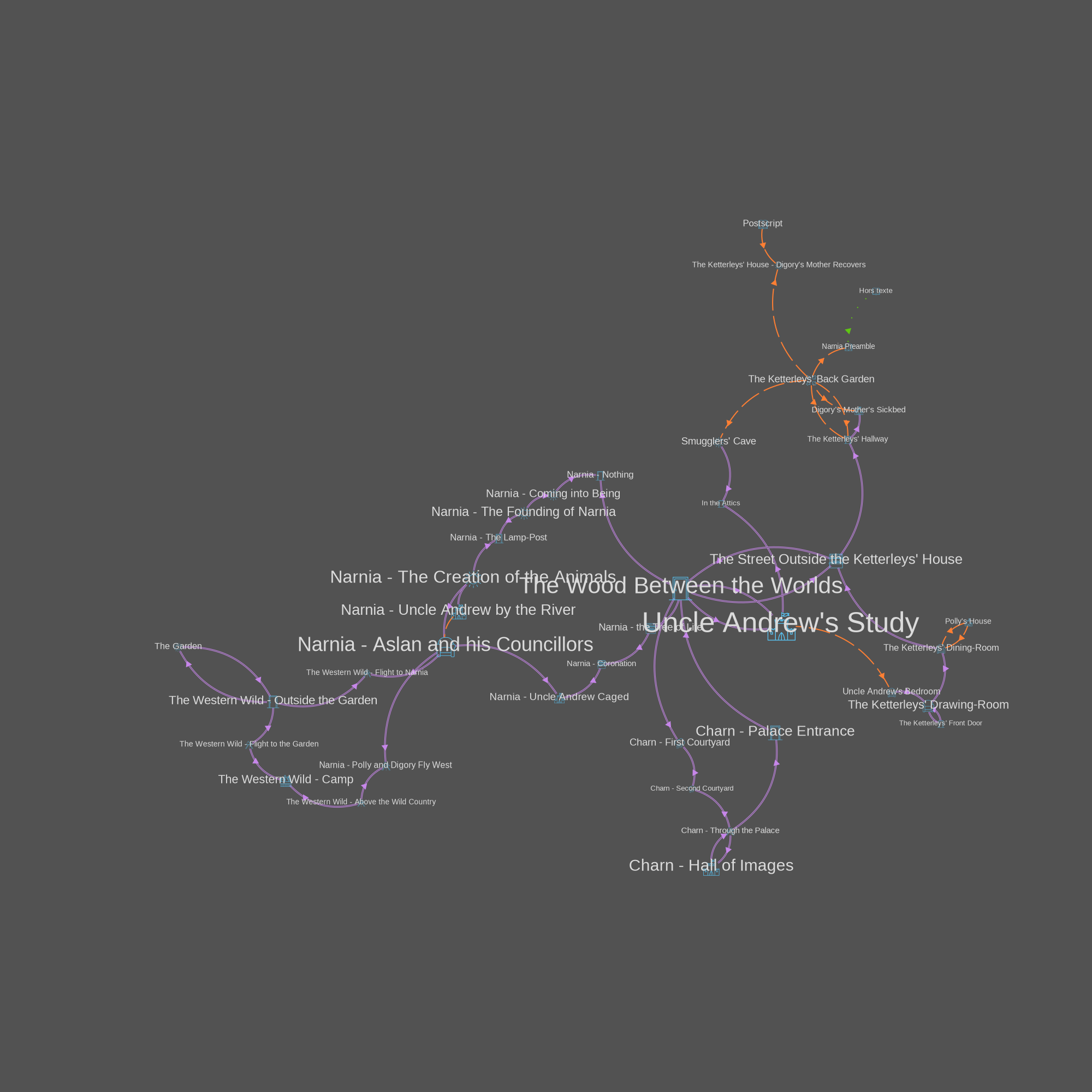
As the visualisations of The Magician’s Nephew and The Voyage of the Dawn Treader show, they are highly spatial texts. Both books describe journeys. The Magician’s Nephew, as the origin story for the series, depicts one real and three fantasy worlds as the children find their way from London to the suspended space of the 'The Wood Between the Worlds' and from there to Narnia. The Voyage of the Dawn Treader, as the name suggests involves an ocean expedition away from Narnia itself to the edge of the world. Though the journeys they describe are very different, these visualisations demonstrate the importance of interstitial or liminal spaces to each narrative.
Topoi Maps
Visualised, the spatial/narrative structures of the two works are surprisingly similar for the topoi map. The Magician’s Nephew consists of three looping ‘petals’ off the central space of 'The Wood Between the Worlds'. These correspond to London/England; Charn (the decaying home world of the White Witch); and the new-born world of Narnia. The petals are centred on the Wood Between the Worlds, a liminal space which serves as the gateway between the three dimensions, and (in conjunction with some magic rings) is the means by which the novel’s protagonists, Polly and Diggory, visit them.
As a journey narrative, away from land and into the unknown ocean, one might expect the topological structure of The Voyage of the Dawn Treader to be linear. However, on visualisation, a similar flower-like structure emerges, centred on the ship itself and its component spaces. In rendering the ship as static, its chronotopic function (analogous if not identical to the Wood space in The Magician’s Nephew) is made visible. Both function as the interstice which makes the episodes which compose the body of the novel possible.
Toporefs and Chronotopes
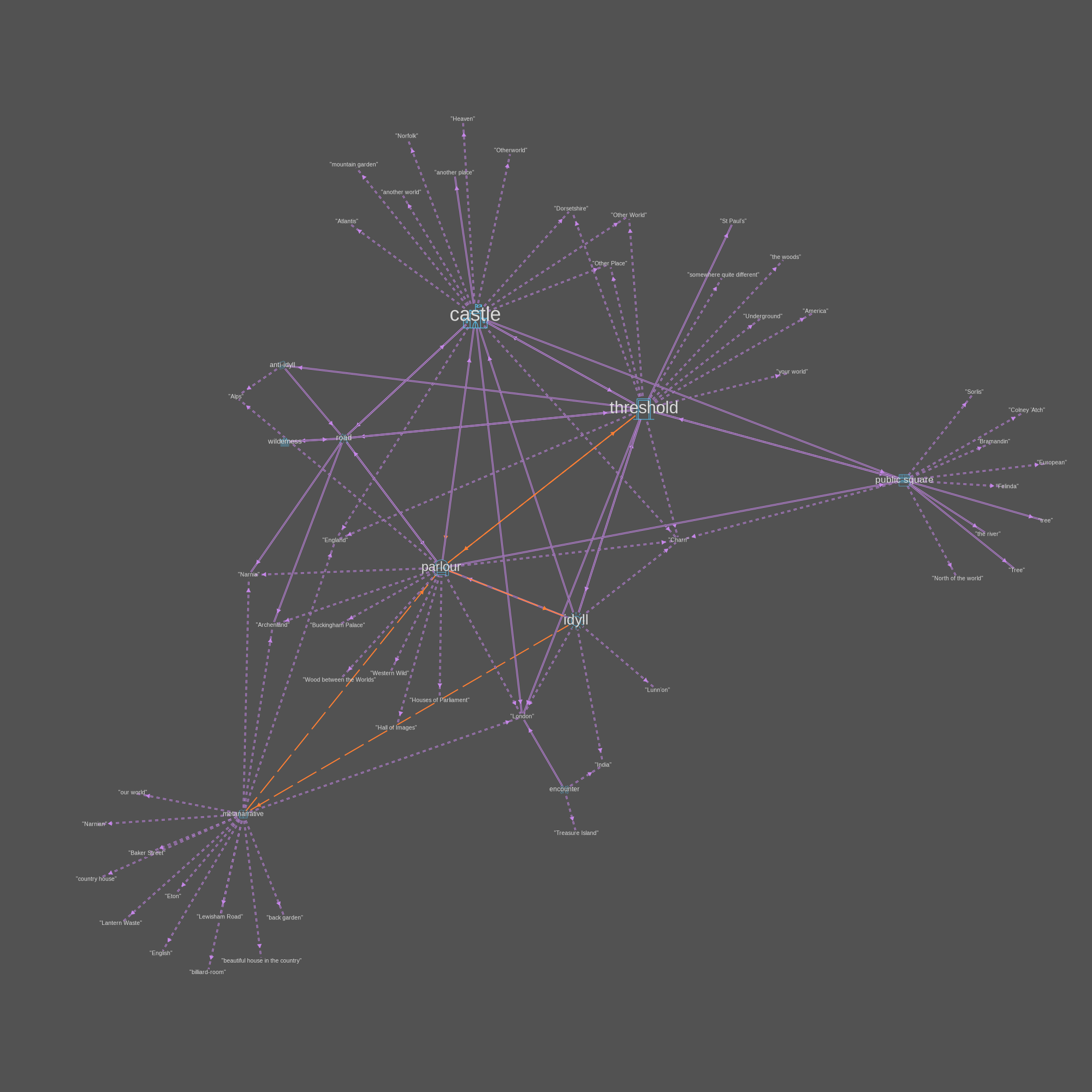
The Magician’s Nephew shows an interesting balance between fictional and real-world locations when visualised to show the chronotopic archetypes and topographic references. At the bottom left-hand corner of the visualisation, the metanarrative spatial type (corresponding with the preamble and postscript to the novel) has a cluster of named spaces associated with it. ‘Lewisham Road’ and ‘Baker Street’ are, in this context, intertextual: gesturing towards E. Nesbit’s The Treasure Seekers and the Sherlock Holmes stories by Arthur Conan Doyle respectively. The story tells ‘how all the comings and goings between our own world and the land of Narnia first began’ (p. 1). As such, of all the Narnia books, it deals the most explicitly with the relationship between fictional and realist spaces and the movement between the two. These references to other works, presented as ‘real’ in the diegesis, therefore serve to situate the narrative within a fictional continuum of other children’s literature.
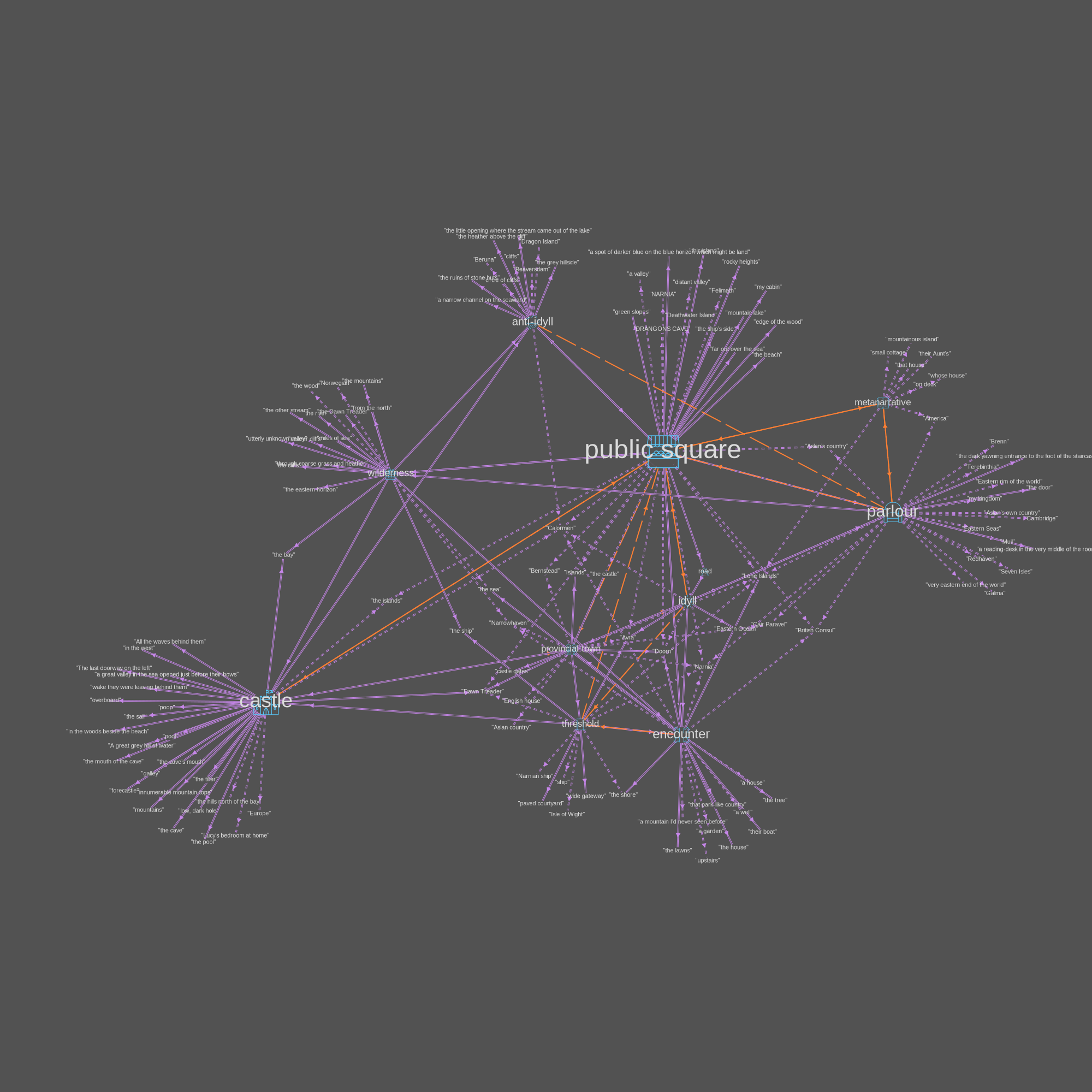
This specifically intertextual spatial referentiality is absent from The Voyage of the Dawn Treader, though the play between fictional and real remains ('America', 'Europe', and the 'Isle of Wight', for example, are all referred to from the world of Narnia). More revealing of the quest structure of the narrative, however, is the way in which references to countries in the fictional world — notably 'Calormen' and 'Narnia' (which is both the name of the world and a country within it) but also 'the Lone Islands' — occur from multiple spatial archetypes. Stitched through the text, these references to places never visited serve to give the world it depicts spatial coherence, despite its fantastical nature.
Deep Chronotopes Maps
In The Magician’s Nephew a large number of chronotopic spaces are in play. The chronotopes of 'threshold', 'castle', and 'idyll' dominate, followed by the 'public square' and 'parlour', (with 'encounter', 'metanarrative', 'wilderness', 'road' and 'anti-idyll' taking subsidiary roles). Thresholds are of great importance since they correspond to portals between different spaces and worlds. This is as true of the realist attic space that allows Diggory and Polly to crawl between houses to the door that traps them in 'Uncle Andrew’s study', as it is of the more fantastical 'Wood Between the Worlds' (or the pools it contains that allow one to drop into other universes). Chronotopic 'castles', in this reading, include 'the Hall of Images' in which Diggory awakens the ancient Queen Jadis (who becomes the White Witch when transported to Narnia), 'Uncle Andrew’s Study', and Uncle Andrew’s subjective experience of Narnia, which he finds unbearable. 'Idylls' constitute Narnia, as yet (mostly) untouched by Jadis’s evil.
The Voyage of the Dawn Treader, conversely, shows a marked bias towards the 'public square', followed by the 'castle' and 'parlour' chronotopes. The prominent role of the 'public square' is because much of the action takes place on the Dawn Treader itself – with the ship functioning as this social space for a range of characters and voices from across Narnian society. This also goes some way to explain why, despite the fact that the novel is a quest narrative, the road plays a relatively minor role, and reinforces the common narrative function of the core space that hosts the episodic adventures: the ship in The Dawn Treader and 'the Wood Between the Worlds' in The Magician’s Nephew.