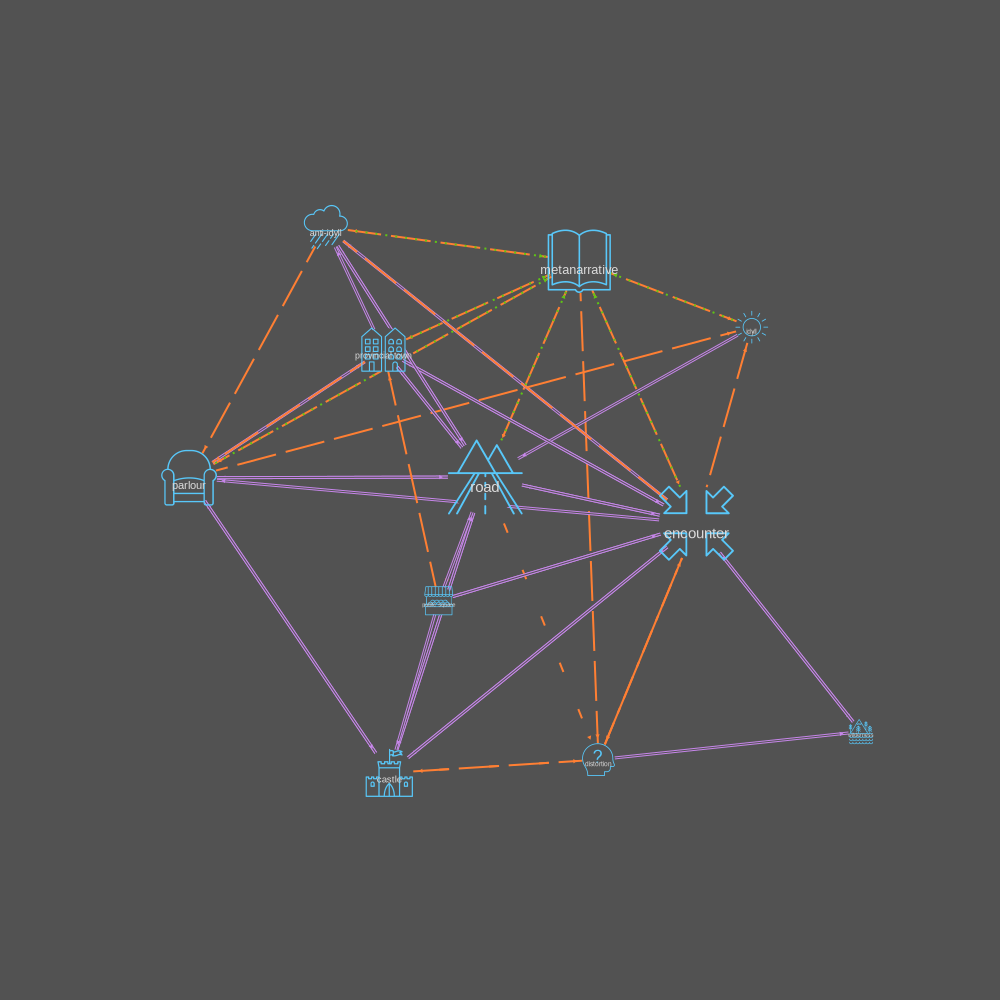
Chronotopic Cartographies
Frankenstein
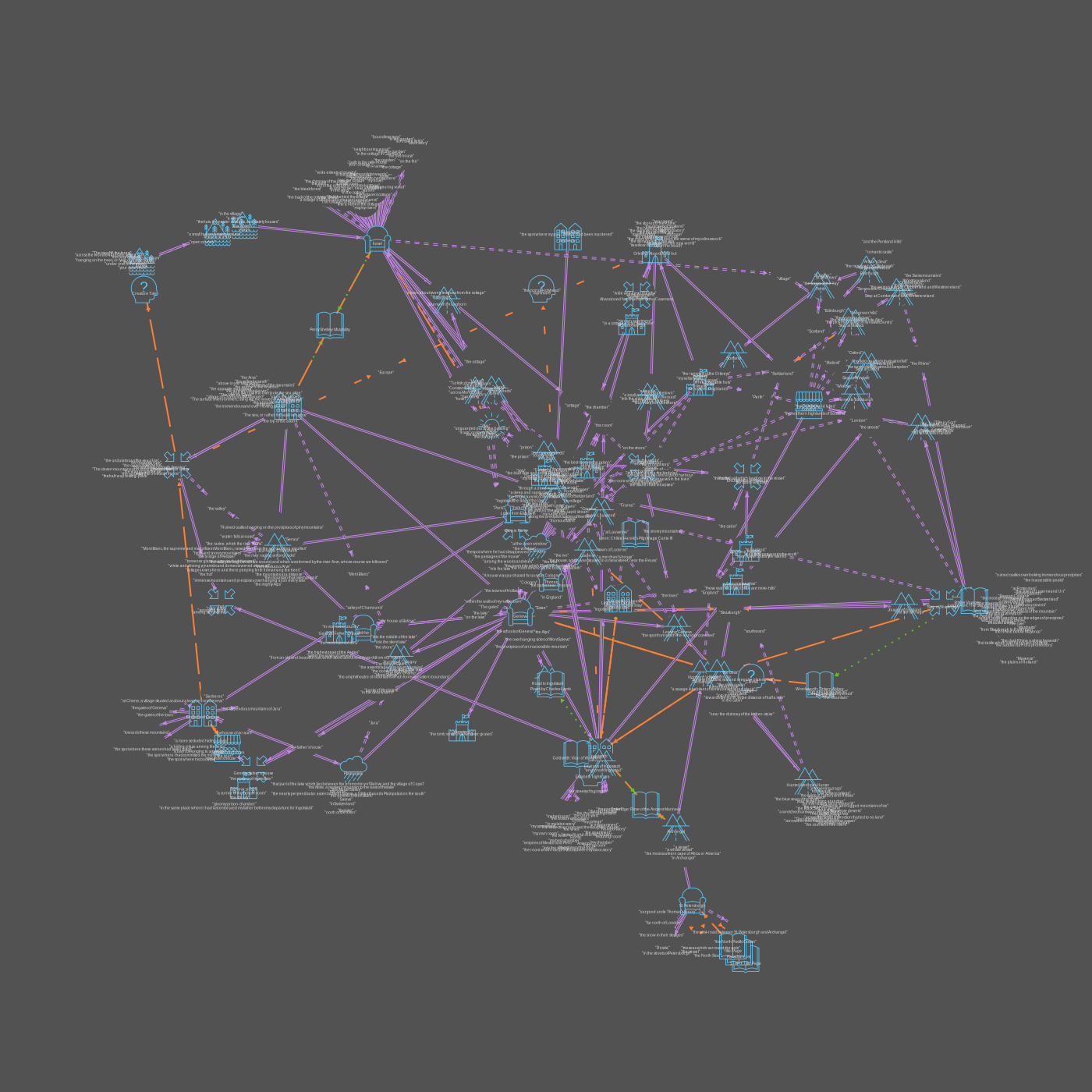
For Mary Shelley’s Frankenstein (1818) the complete map is hard to read. As with many nineteenth-century novels the spatial complexity of the whole is too rich to enable easy total understanding. The form of the map creates a star shape at its centre and when we focus in on this (see detail) we see that it corresponds to Geneva to some extent – as Frankenstein’s home town to which he and the Creature repeatedly return – and to the chronotopes of the 'prison' and the 'road' which dominate the centre of this map.
Complete Map and Creature's Tale
What is perhaps needed for a work like Frankenstein is the separation of the text into discreet narrative elements. One problem with the graph as generated from the entire text is that this distorts spatiality when different parts of the text are narrated by different narrators or the narrative is essentially embedded (a popular structure in the Romantic period). For Frankenstein the narrative is told respectively by: Walton; Frankenstein; The Creature; Frankenstein; Walton. Ideally the complete map should be broken up into the sections of text told by each.
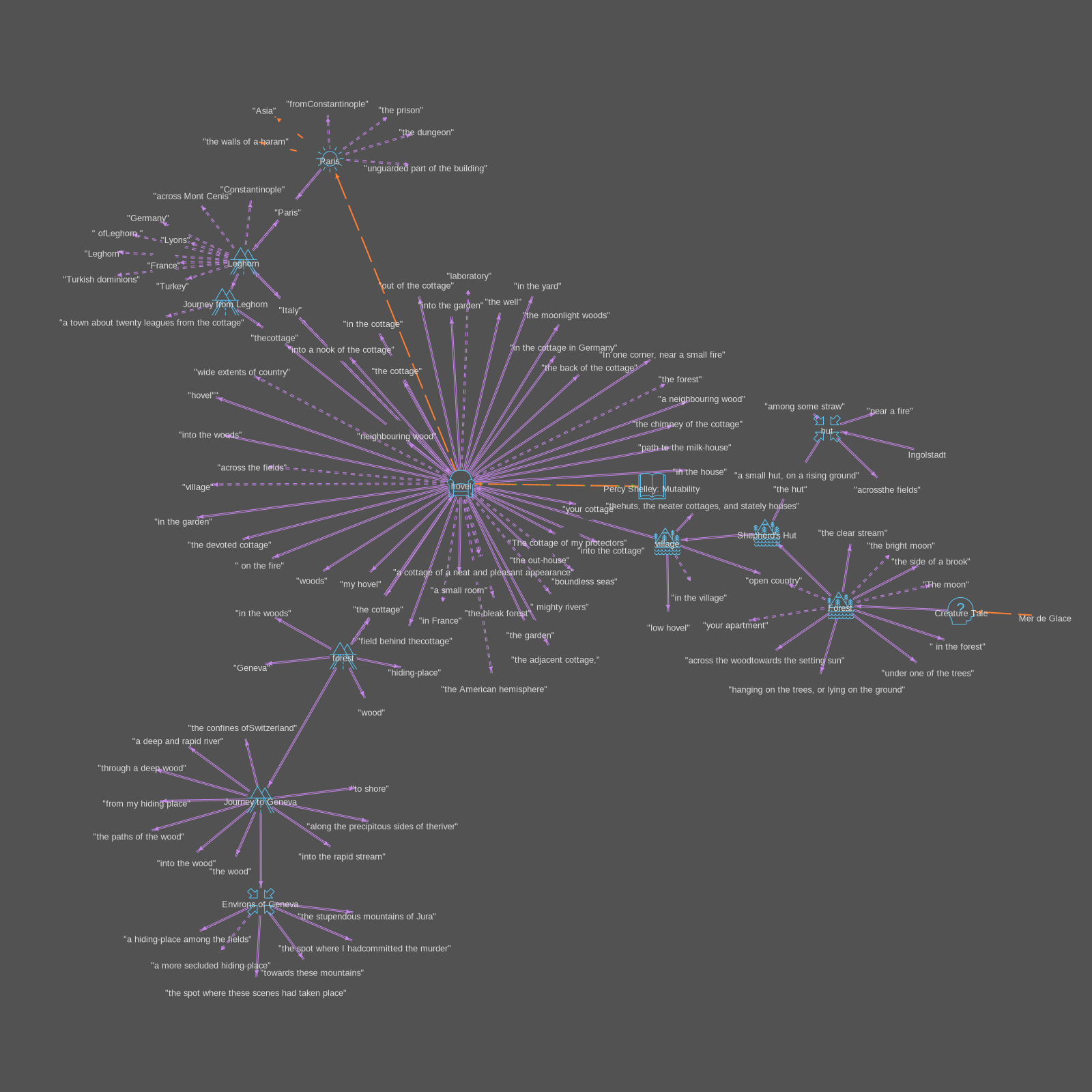
The partial map for the creature’s narrative is immediately far more readable and useful. It shows very clearly the centrality of the hovel as the creature’s main place and also makes clearer that other spaces such as “Leghorn” and “Constantinople” relate to other characters and not to the creature’s own story. Clear chronotopes emerge in relation to a particular character and section of narrative and allow for comparisons to be made within the work.
Topoi
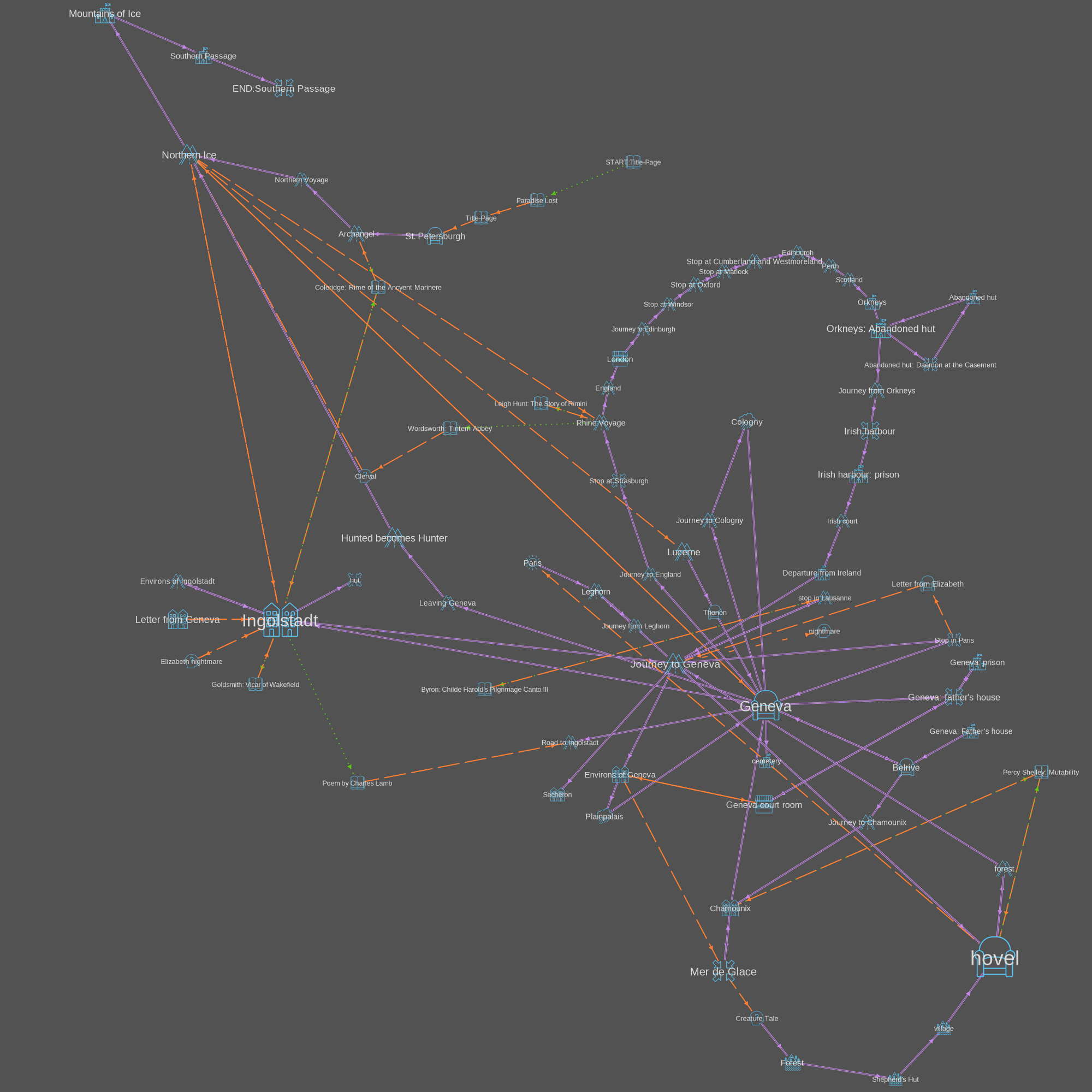
In the case of Frankenstein the 'topoi' map is the most illuminating in relation to spatial meaning and interpretation of the text. Three distinct spatial forms interconnect on the map, relating to the three narrators. What it makes absolutely explicit is the way in which Frankenstein’s movements occur as a series of interlinked “tours”. Of course the novel was written whilst Mary and Percy Shelley were themselves on tour – visiting the Swiss Alps and staying in Geneva –and this forms the backdrop to the novel. However, what is often half-hidden by the focus on other elements of the narrative is just how “touristic” the spatial structure is in relation to Frankenstein himself. In the Topoi map this shows up most clearly for the Journey to England which generates as a large loop or wheel consisting of a straightforward series of stopping points along the touristic route as Frankenstein and Clerval travel down the Rhine, to London, Windsor, Oxford, Edinburgh and finally to the remote Orkneys just below the top of the wheel. This dominant shape contrasts with two other spatial forms. The centrality of Geneva (bottom right) shows up in the form of a spider as a place repeatedly returned to by Frankenstein and the Creature. Counter to this – top left – is the spiky stalagmitic form of Walton’s (and the others’) end-journey into the most remote of places: the Mountains of Ice in the frozen North. [The Syuzhet map for Frankenstein looks very similar to the Topoi map so is not given here].
Toporefs and Chronotopic Archetypes
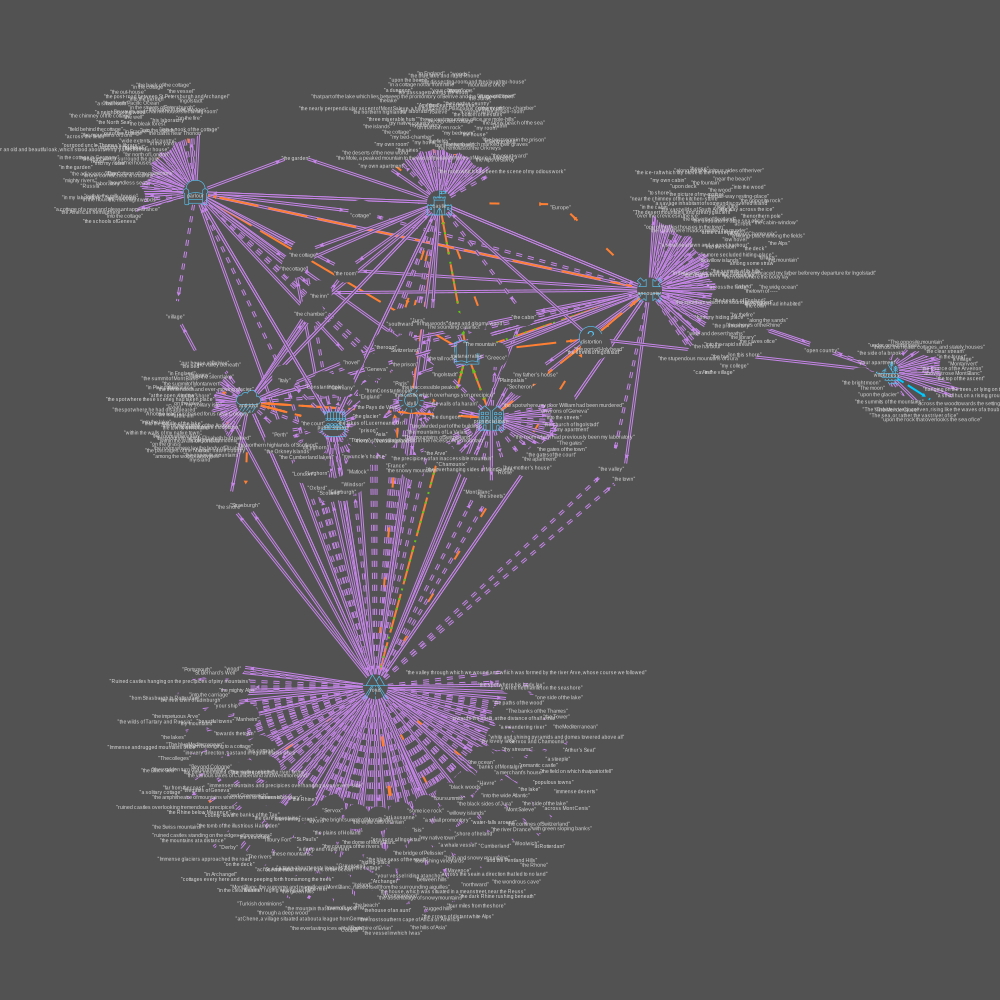
My personal favourite map for Frankenstein is this one, which I think of as the “jellyfish” map. In truth it is subject to the same problems of unreadability as the complete map but it is far more aesthetically pleasing. Also since this map connects the chronotopic type (e.g. 'road') to the toporefs which are generated within that particular chronotope it offers easier local analysis of a specific chronotope or of two different chronotopes within the same text.
So, for example, we can compare the oppositional chronotopes of 'the road' and 'the castle' by focussing on these in detail. 'The castle' is often a rich chronotopic space because of its psychological dimension. So, it also is often a site of change (what was previously a pleasant space becomes a place of entrapment). For Frankenstein we see that although many of the 'castle' spaces are interior this is also true of various external places that we might not normally think of in such terms – such as deserts, beaches and mountains. Frankenstein’s sense of self-alienation extends from himself into the world around him.
'The road' clearly emerges on this map as the dominant chronotope and makes clear again how much of the novel is concerned not only with movement but with the recording of details along the route that again feels strongly touristic but also makes that route eminently re-constructable. It partly works therefore to (falsely) ground the fantastic in the real – and as such is a crucial factor in the lasting power of this work.
Deep Chronotopes
The deep chronotopic map merges the chronotopes of all three narrators. As a result, the most significant chronotopic types for the work as a whole emerge as 'the road' and 'the encounter'. Again though, as with the tours of the topoi map, this is slightly counter to our experience of reading the novel where some of the most powerful scenes concern enclosed interiors (the laboratory and the creation of the creature; the bedroom of Elizabeth’s murder; the Orkney hut and Frankenstein’s attempt to create a wife for the creature).