Chronotopic Cartographies
Goblin Market
Christina Rossetti’s poem 'Goblin Market' is centred on the relationship between the two female characters and sisters – Lizzie and Laura – one of whom falls subject to the rich sensory temptations of the goblins while the other seeks them out to save her sister when her need for their fruit threatens to destroy her. The poem is strongly centred around places of safety and risk with the brookside where the girls go to gather water representing a 'threshold' space from which the calls of temptation can be heard. The spatial model straddles spatial types 4 (fantasy) and 2 (indefinite), but the symbolic roles of the hyperreal dreamspaces provided sufficient justification for the poem's inclusion in the former.
Complete Map
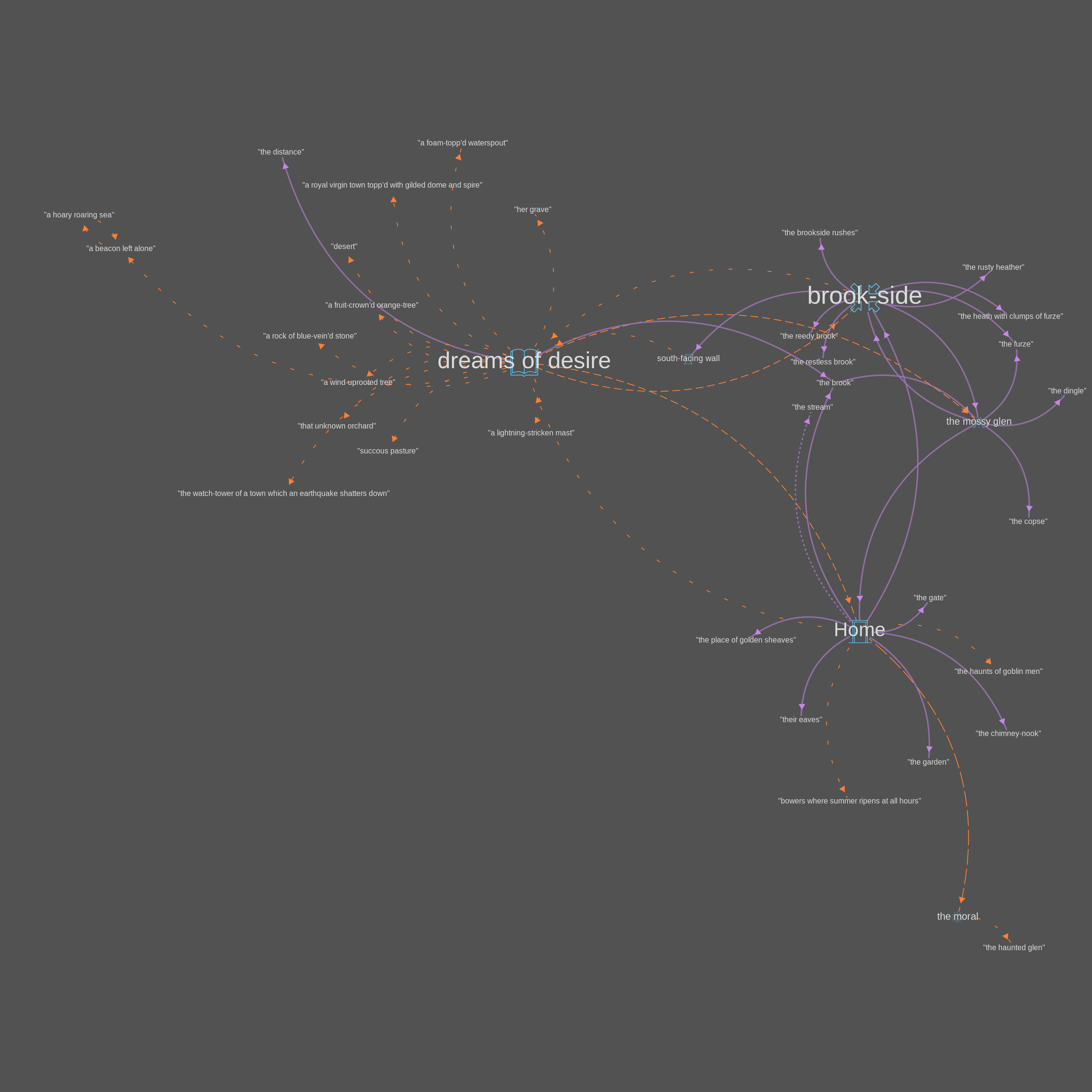
The complete map shows how the topological map form works with otherwise unmappable spaces. Here the inner space of 'home' remains grounded in the real and safe, the outdoor 'brookside' allows for the attraction of danger and 'dreams of desire' represents the loss of self. The spatial map of the poem mirrors the journey of dangerous self-discovery that straying from the familiar might bring about, that lies at the heart of the narrative. The map shows a number of minor sites (such as 'a south-facing wall' and 'the chimney-nook') that are of importance to both the characters and at a symbolic level, but would not scale or relate well on a traditional geographic map. The central role of the reedy brook as the site of encountering forbidden temptation, Bacchic revelry, frustrated desire, and subsequent recovery is reflected in its topographical placement between the two other extremes (safety / danger) at the heart of the map.
Chronotopes and Topoi
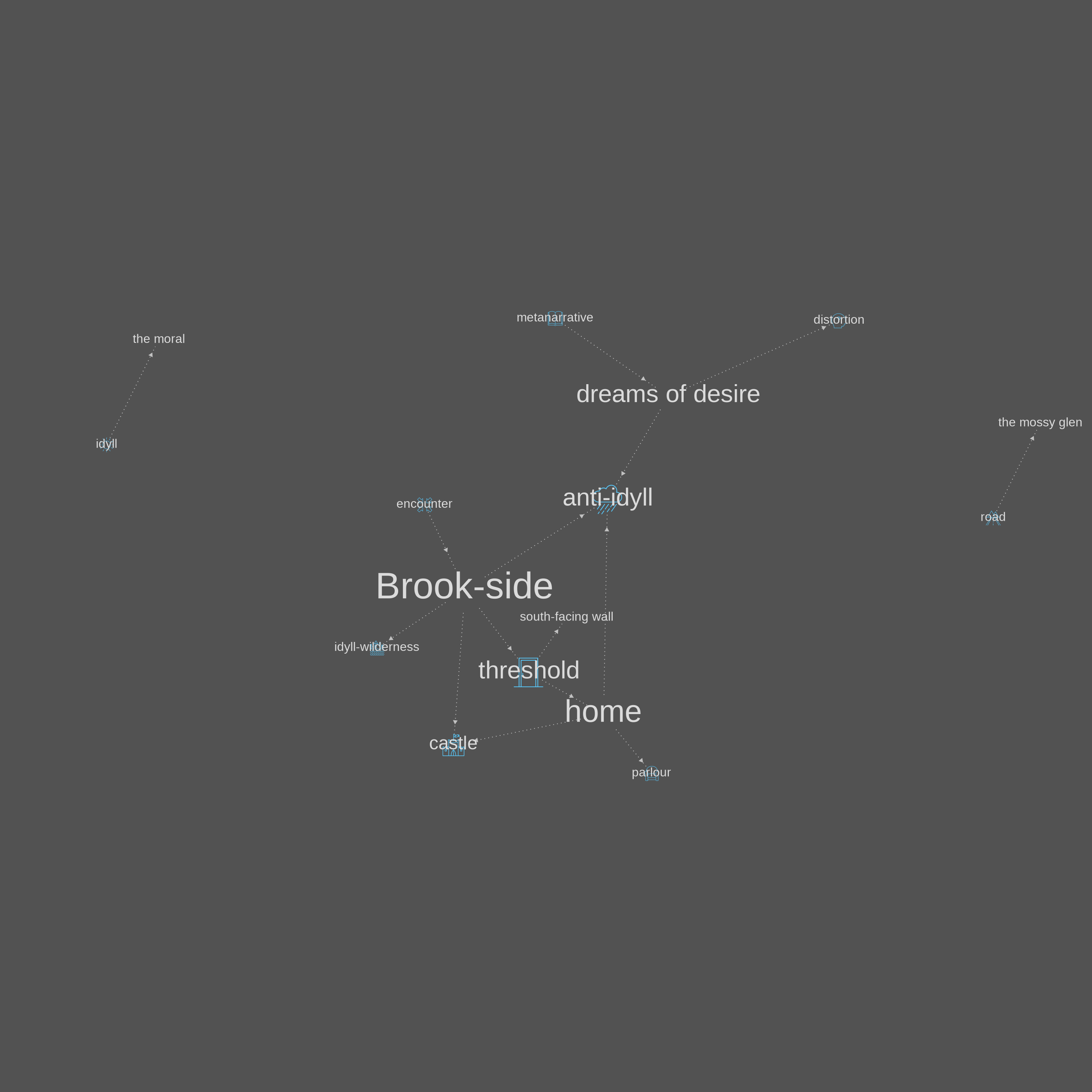
The chronotopes and topoi map shows the extent to which chronotopes change across the text or connect to each other. Here again we see the centrality of 'brook-side' as a place of temptation and danger that is both 'encounter' and 'threshold'. This is the dominant chronotopic space of the poem. We also see how central the spatio-temporal state of 'anti-idyll' is as a link place between the three main sites and the underlying psychological states they represent.
Toporefs and Chronotopic Archetypes
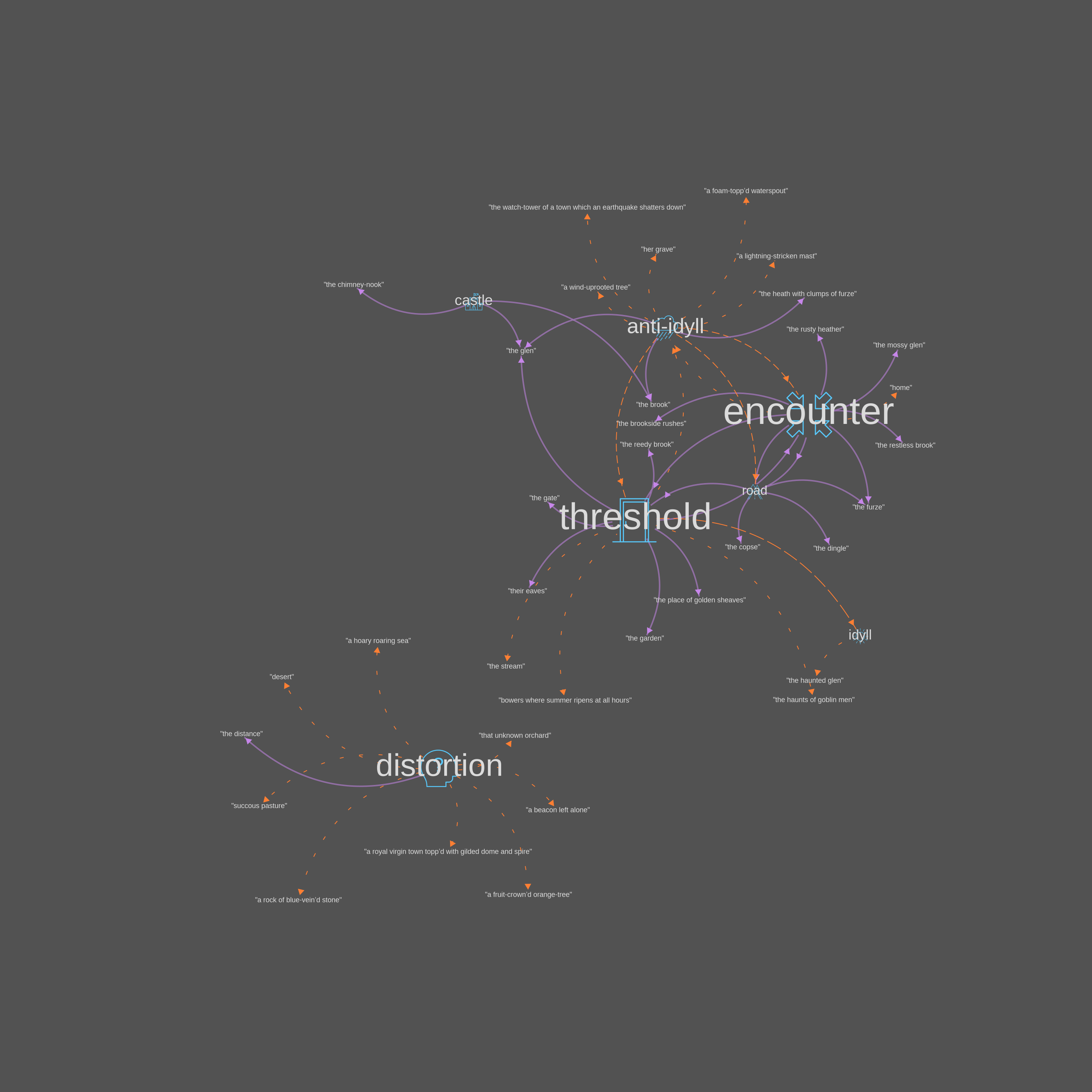
The purple ('direct') and orange ('indirect') connections on the toporefs and chronotopic archetypes map depict a clear break between the realms of fantasy and the real through the associated toporefs. The mundane sites of the familiar ('direct') contrast with the grand vistas of fantasy ('projections'), which demonstrates the importance of defining the connective role. Just as the complete map identified three key locations, so too do the chronotopic forms highlight a relation between three central 'states' – this trio present a very different display of narrative priorities, as the euphoric dream-state is de-emphasised and the idea of crossing thresholds and boundaries instead forms the interpretative core. The three key forms beget and perpetuate each other, leading to a cycle that is only broken by a loving intervention. The sensory triptych observable here runs counter to the expectations of the spatial frames. The home – rather than providing the expected security and comfort – becomes instead a site of suffering, of withdrawal from a longed-for state. Here the need to generate a distinct map series for each character (Lizzie/ Laura) is strongly felt since both engage with the same spaces but one does so in order to give into temptation whilst the other resists it.