Chronotopic Cartographies
Home at Grasmere
'Home at Grasmere' is a highly spatial, autobiographical text about William Wordsworth’s decision to return to his native region (The Lake District) and set up home there with his sister Dorothy in 1799. Place, person and poetry are all vitally interconnected. The poem begins with the poet recalling his own first vision of Grasmere as a boy running over the hilltop from Hawkshead and seeing the valley below him. The decision to return home is a hopeful and optimistic one (albeit shot through with self-doubt and anxiety about his ability to live up to his own expectations) and the maps of the poem to a large extent reflect this. All maps are strongly centred on a single core location and a dominant idyllic mood and state.
Complete Map
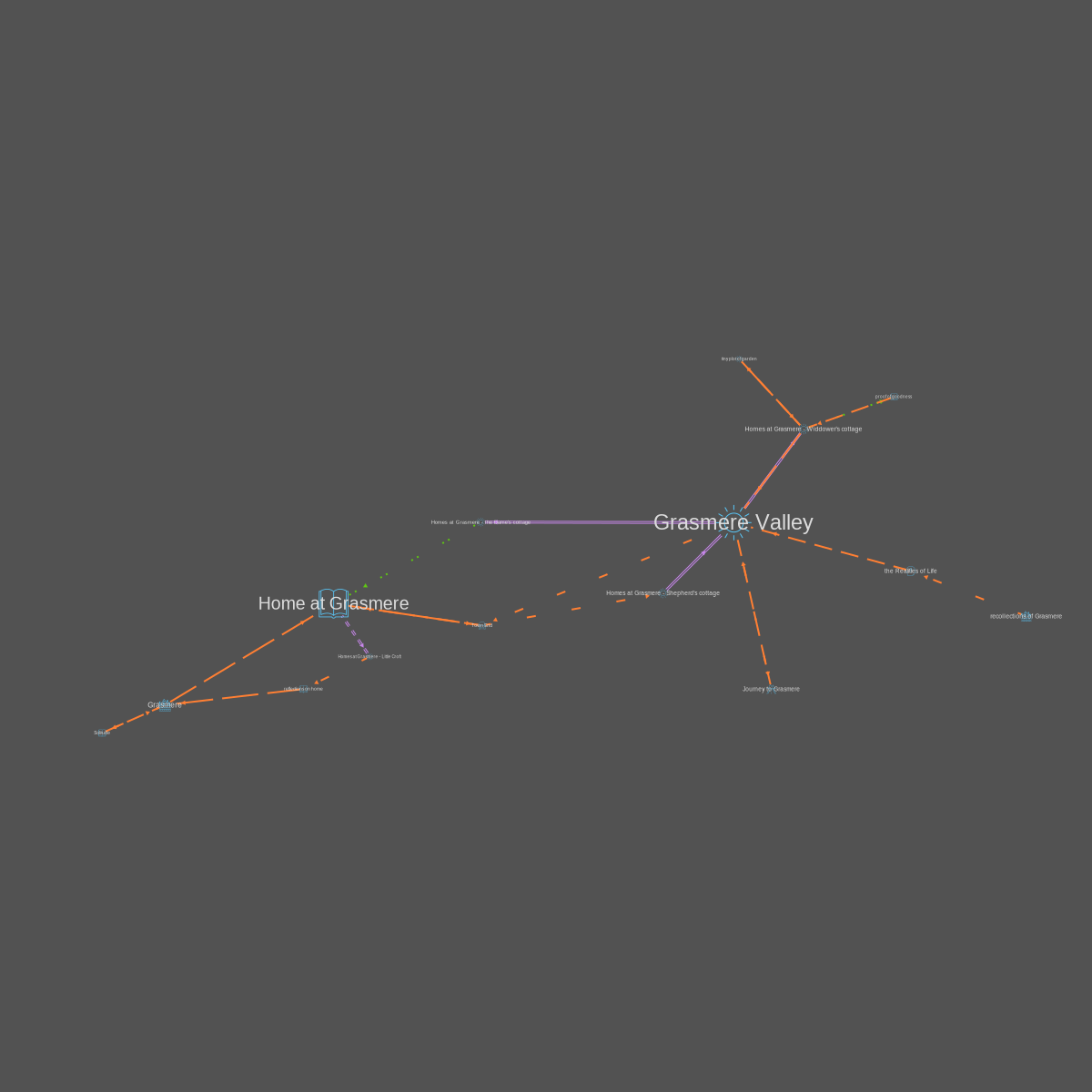
In the complete map, the dominant node – 'Grasmere Valley' – is a larger space that encompasses the others: the more spatial 'Grasmere', the more conceptual 'Home at Grasmere', and space and concept combined in the 'Home at Grasmere – Widower’s Cottage/the Dame’s Cottage' subnarratives. At the top the orange lines between the Grasmere nodes register the fact that moves between spaces are abstract rather than physical, as the narrator recalls, for instance, his 'Journey to Grasmere' on foot in the snow. That Grasmere embodies an amalgamation of the tangible and the symbolic is also registered in the jumps between physical spaces and narratorial reflections, captured here in the metanarrative nodes.
Chronotopes and Toporefs Map
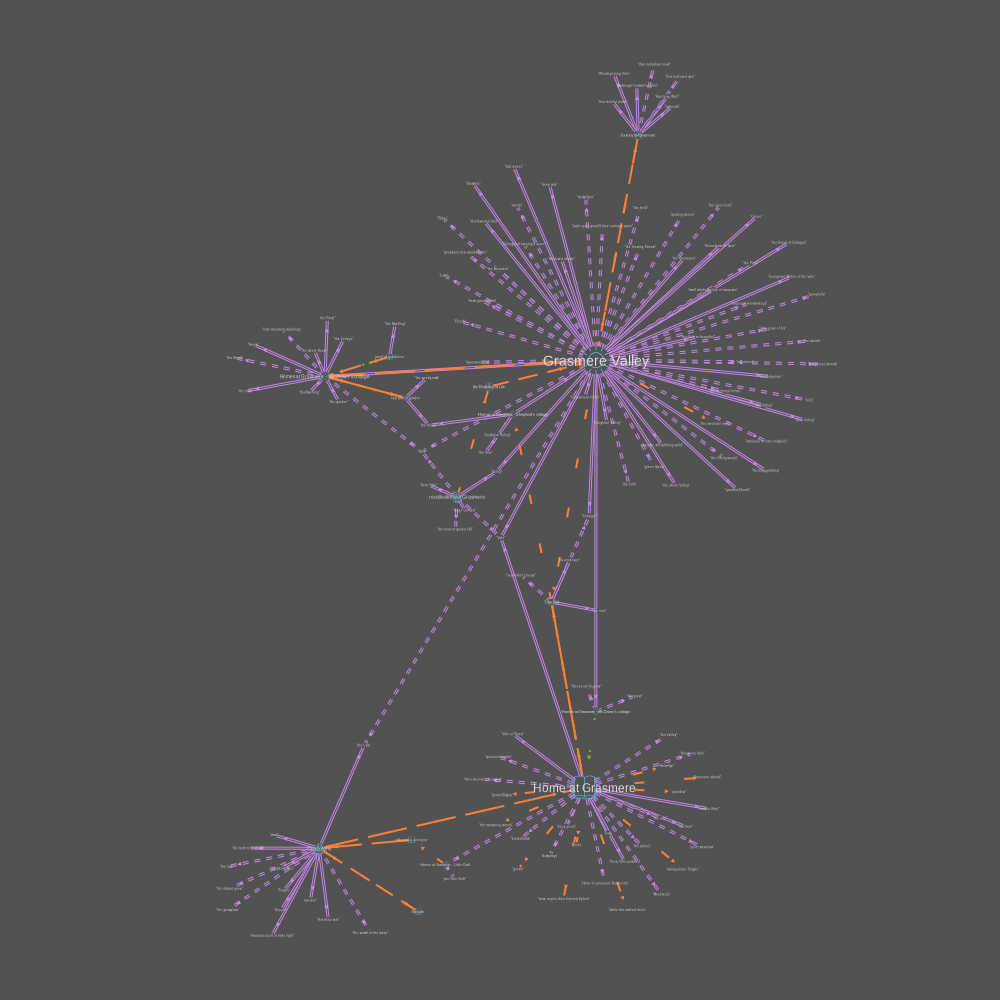
The chronotopes and toporefs map, like the deep chronotopes map, is dominated by the core chronotopic form of the 'idyll' which determines the dominant mood and hopes of the poem as a whole. The sub-naming of places by means of toporefs – creating the dandelion-clock effect of the topology – strongly reinforces this core mood and setting. We are given a vision of Grasmere as the perfect rural dwelling-place: 'sunny hills', 'Dear Valley', 'loved abode', 'last retreat'. The dominance of the form means that it only ever really morphs into a wilder version of itself: idyll-wilderness.
Syuzhet Map
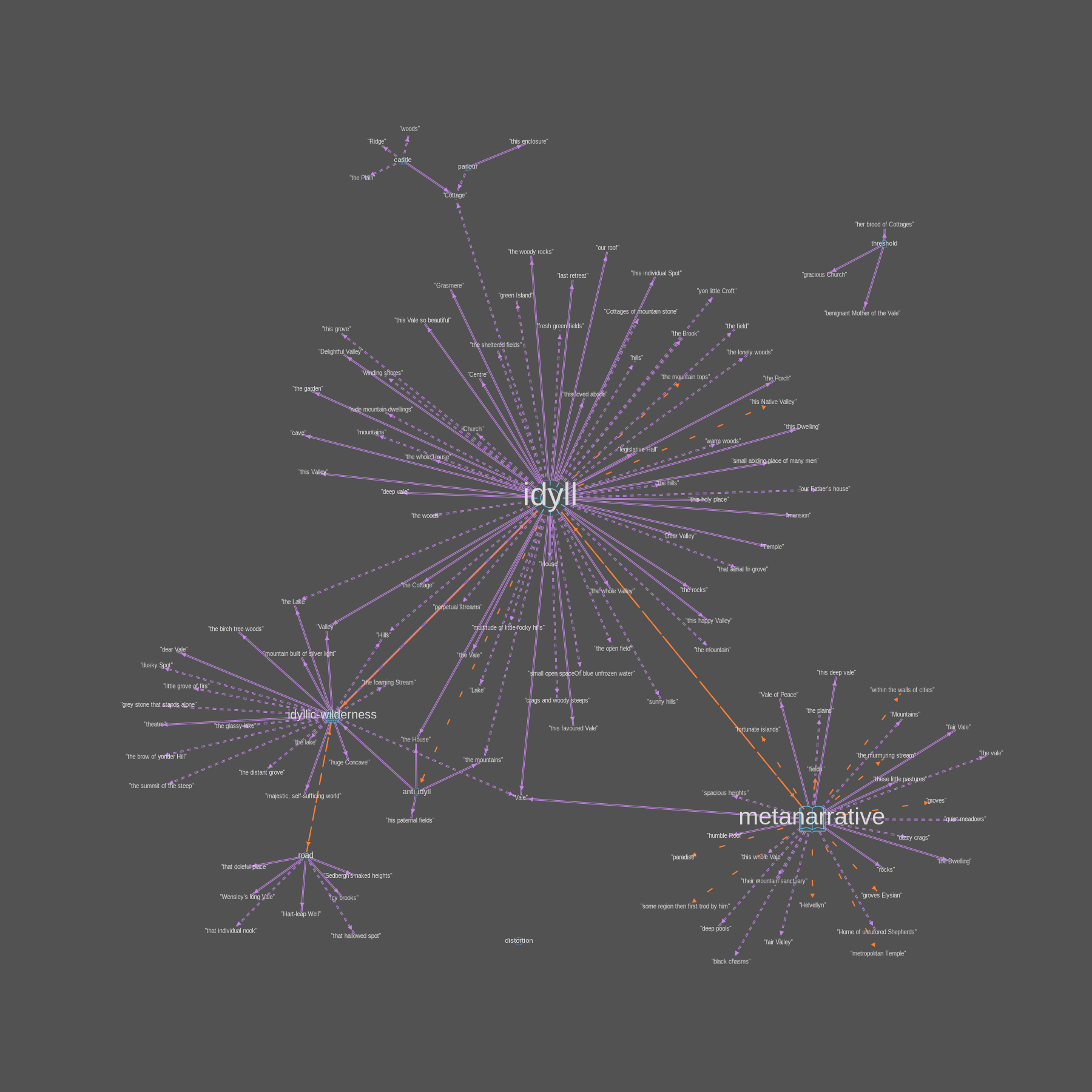
In terms of location it is unsurprising that the two dominant nodes for the syuzhet map of 'Home at Grasmere' are those of the title itself and of 'Grasmere Valley'. The place of the poem is strongly centred upon this nook at the heart of the Lake District. At the same time, however, the map is telling in that it also immediately shows how much of the time and space of the poem is not of the 'now'. Instead much of the poem functions in either retrospective or anticipatory time and space and so is represented in orange lines that deviate from the (purple) actuality of present time and place. The poem recalls multiple arrivals in this place ('journey to Grasmere') and dwells in reflection or recollection more than it does directly on home-making. Swirling around the location itself are the hopes and fears of the poet who has returned triumphantly but must now prove himself to himself and validate that decision.
Deep Chronotopes Map
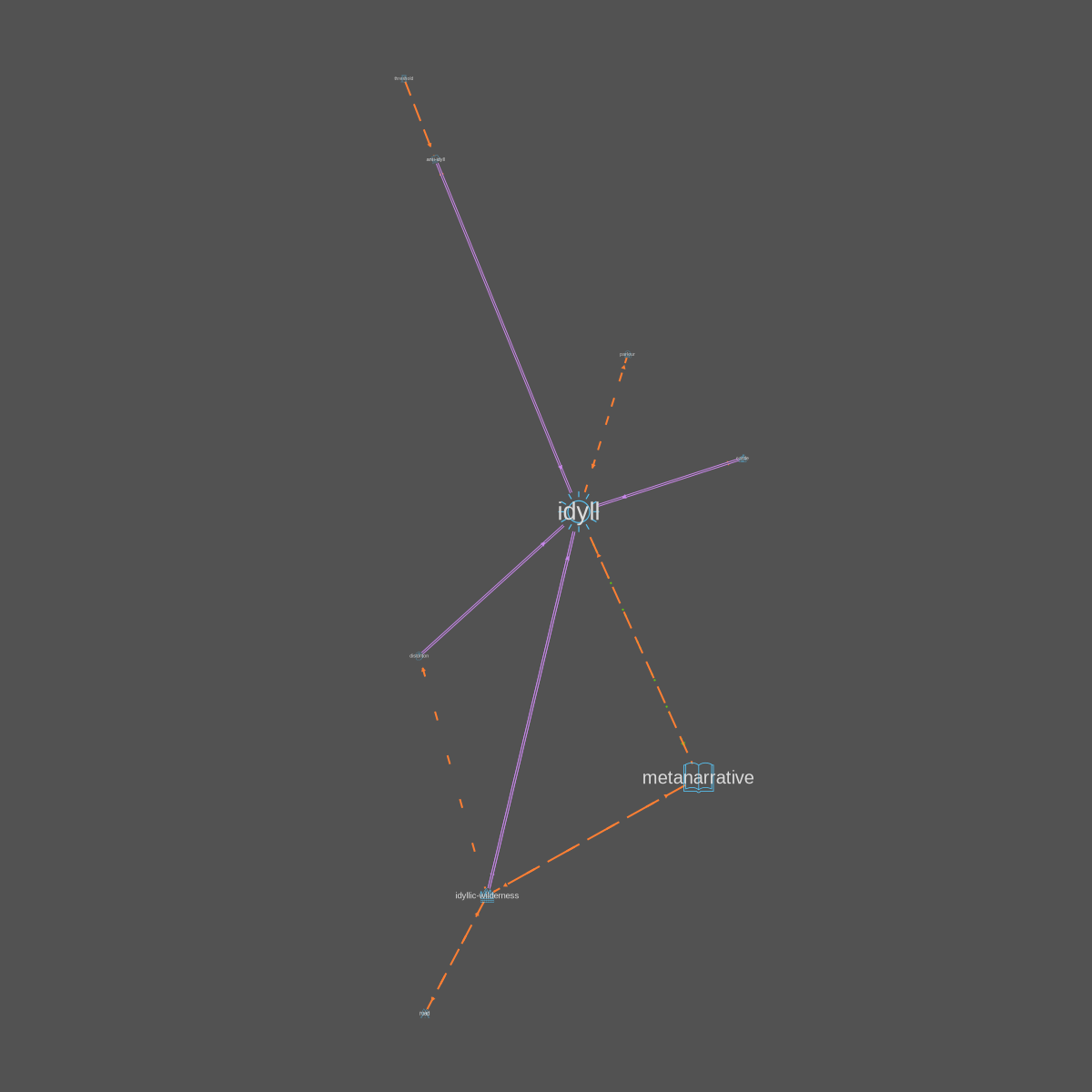
The deep chronotopes map for 'Home at Grasmere' is quite sparse and loose. The dominant time-space is unequivocally that of the 'idyll' – the freedom of an open untouched and autonomous paradisal space which the poem explicitly articulates from the start: 'paradise before me'. The wholeness of the vale as 'a Centre, come from wheresoe’er you will' a 'blended holiness of earth and sky' is registered here. At the same time, however, whilst it has a clearly identifiable chronotopic core, other chronotopes attach to this space in different directions that do not reconnect with each other to form a tight whole as we might perhaps expect. Instead, 'idyll' morphs into 'idyll-wilderness' below and 'anti-idyll' above it with other spaces figuring in minor ways ('parlour'; 'road'; 'castle').