Chronotopic Cartographies
The Idiot Boy
Like Coleridge’s 'Rime of the Ancyent Marinere' Wordsworth’s poem 'The Idiot Boy' also appears in the first edition of Lyrical Ballads (1798). 'The Idiot Boy' thus provides a second example of a Romantic ballad form to compare with Coleridge’s and functions as a kind of comic, mock-epic, counter-model to the 'Rime'. Both poems are concerned with responsibility / agency or the lack of it and both tend towards circularity: neither poem goes anywhere. In the 'Rime' the Ancyent Marinere spins a yarn so unbelievable that it raises questions as to whether any of it happened outside the space of his own head. In 'The Idiot Boy' the poem draws attention to subjectivity with the unknowable exterior and interior experience of young Johnny brought to the fore. This is a good example of how, when we generate maps to visualise the text, we begin to see that certain poetic genres generate particular spatial forms. The ballad tends towards the circular and/or a figure of eight which emerges strongly here in the Fabula/ Syuzhet maps.
Complete Map
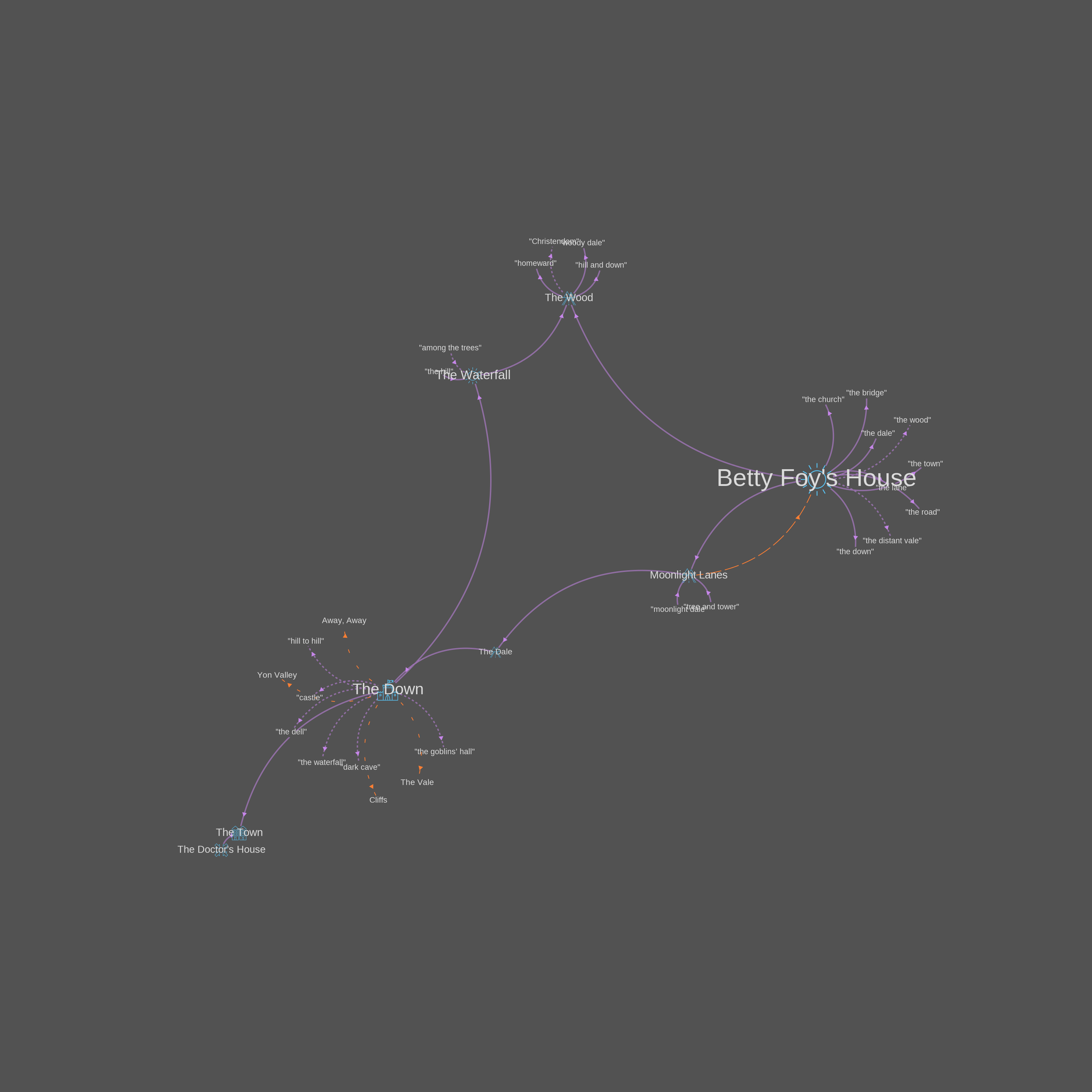
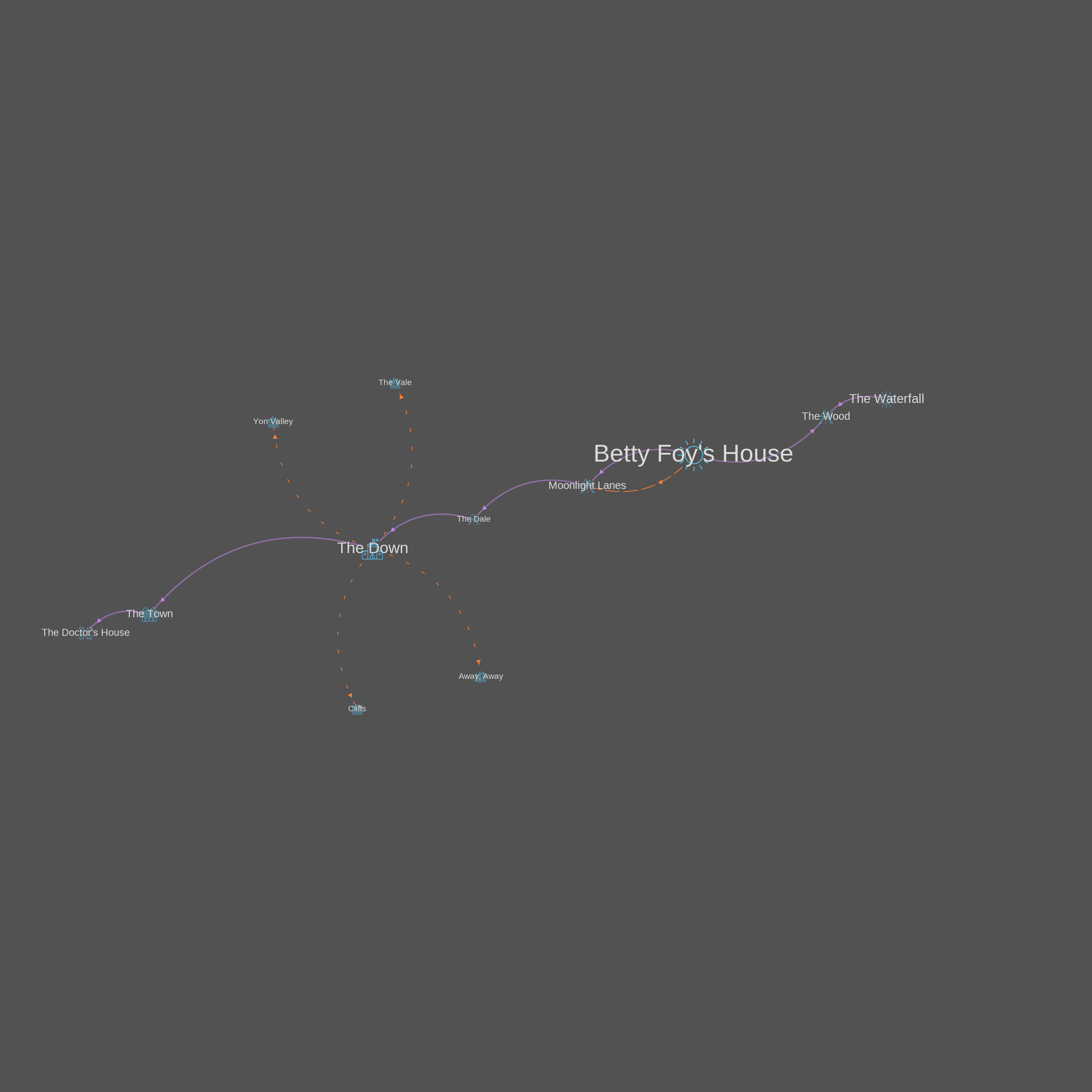
The complete map shows very clearly the way in which the ballad form is circular and loops round and back upon itself. The key sites of the poem are simple and connected by the need for help to be brought from the town back to Betty Foy’s house (where Susan Gale is ill and requires a doctor). Offset against the urgency of the journey that should be happening, undertaken by Johnny on the horse, is the actual route that the horse takes as it wanders through 'the wood', 'the waterfall', 'the down' before safely delivering Johnny home again. His quest is unfulfilled but the need for it has been alleviated in his absence anyway.
Fabula and Syuzhet
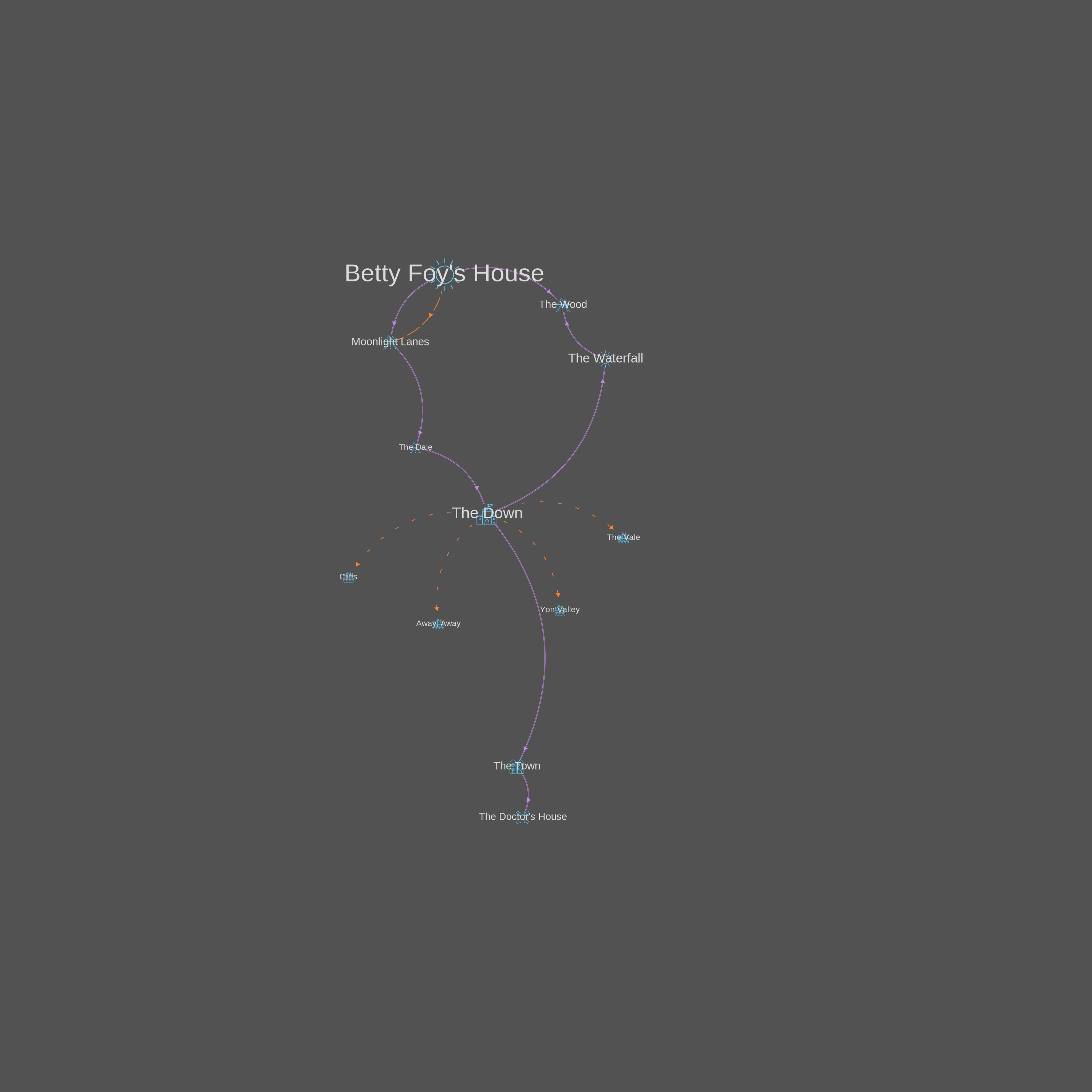
As with 'The Rime of the Ancyent Marinere', so for 'The Idiot Boy' we have generated two maps that correspond to a core narratological distinction between the telling of the tale (syuzhet) and the order in which events occur (fabula). The poem narrates a journey that should be one of urgent rescue but ends up without purpose or direction, as horse leads master. The poem intertwines three different subjective and spatial experiences (Betty Foy; Susan Gale; Johnny) and plays them off against each other as one character retraces another’s route and imagines alternatives. For the syuzhet map this results in a series of linear spatial jumps that are offset by Johnny’s wanderings at right-angles to them. The noose-like shape of the fabula map works in a similar way but with a clearer looped sense of the safe return home.
Deep Chronotopic Maps
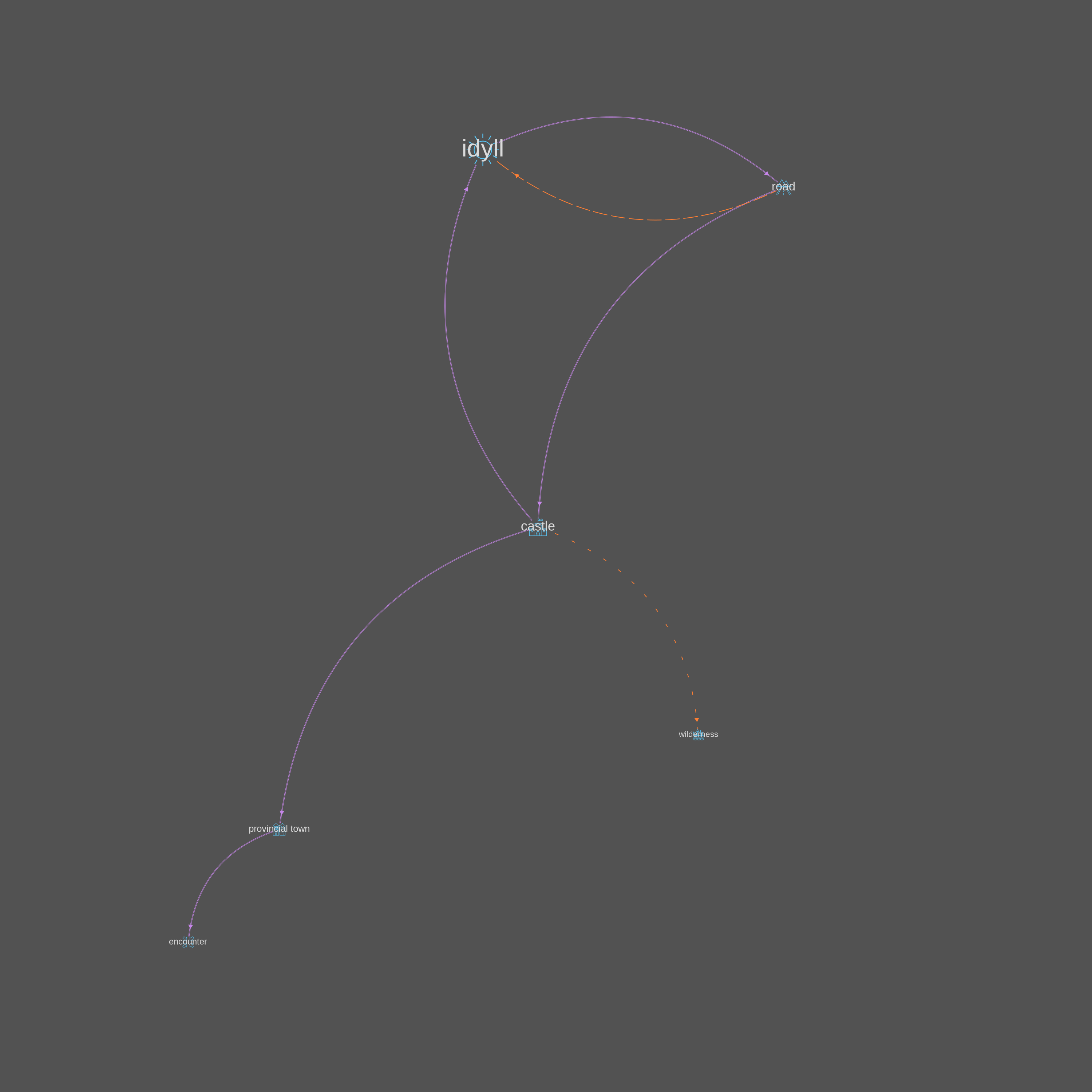
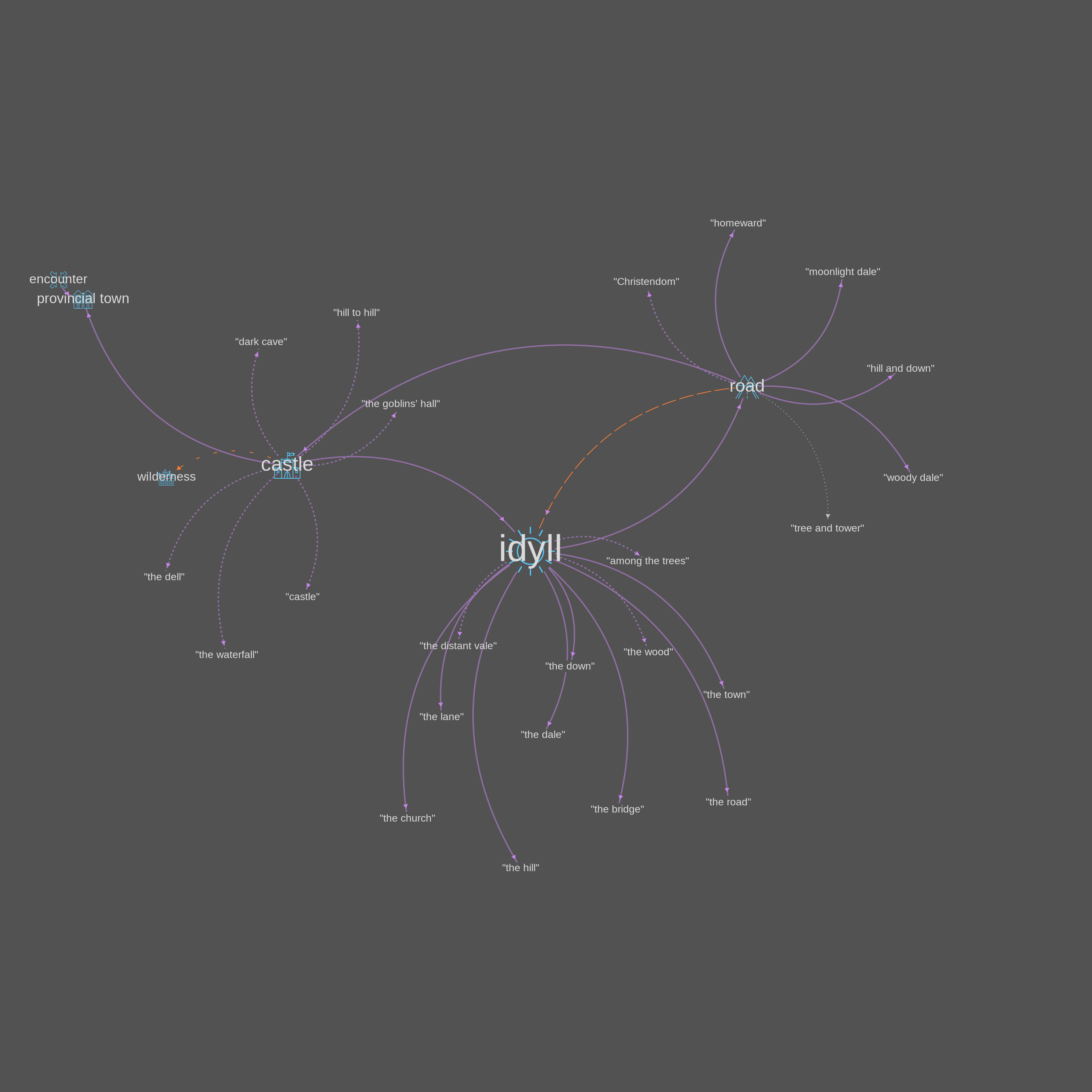
The stylistic simplicity of the underlying deep chronotopic map for the poem without toporefs makes explicit the way in which 'idyll' is the dominant time-space – even clearer in the map with toporefs. This fits with the mood of comic epic that the poem communicates – nothing too serious is really going to happen. That very simplicity also points to another spatial and interpretative fact about the poem: nothing much actually does happen.