Chronotopic Cartographies
Jekyll and Hyde
The Strange Case of Dr Jekyll and Mr Hyde (1886), with its historical and geographical correspondence to nineteenth-century London, is an apt text for Spatial Type One. But the London portrayed is often an allegorical one. Like the novel’s focal character, the city has a dual identity: respectability hides a darker side of the same entity. The metaphorical also arises from the sense of an artistic or imagined London, it integrates the fog-ridden city of Dickens with Stevenson’s experience of another city – the novel might ostensibly correspond to London, but it is one informed by Edinburgh. As the deep chronotopic map highlights, the novel’s form is also multiple, amalgamating the Gothic, the detective story and sensation fiction. Like sensation fiction, it brings the mysteries and fears of Gothic fiction closer to home.
Complete Map
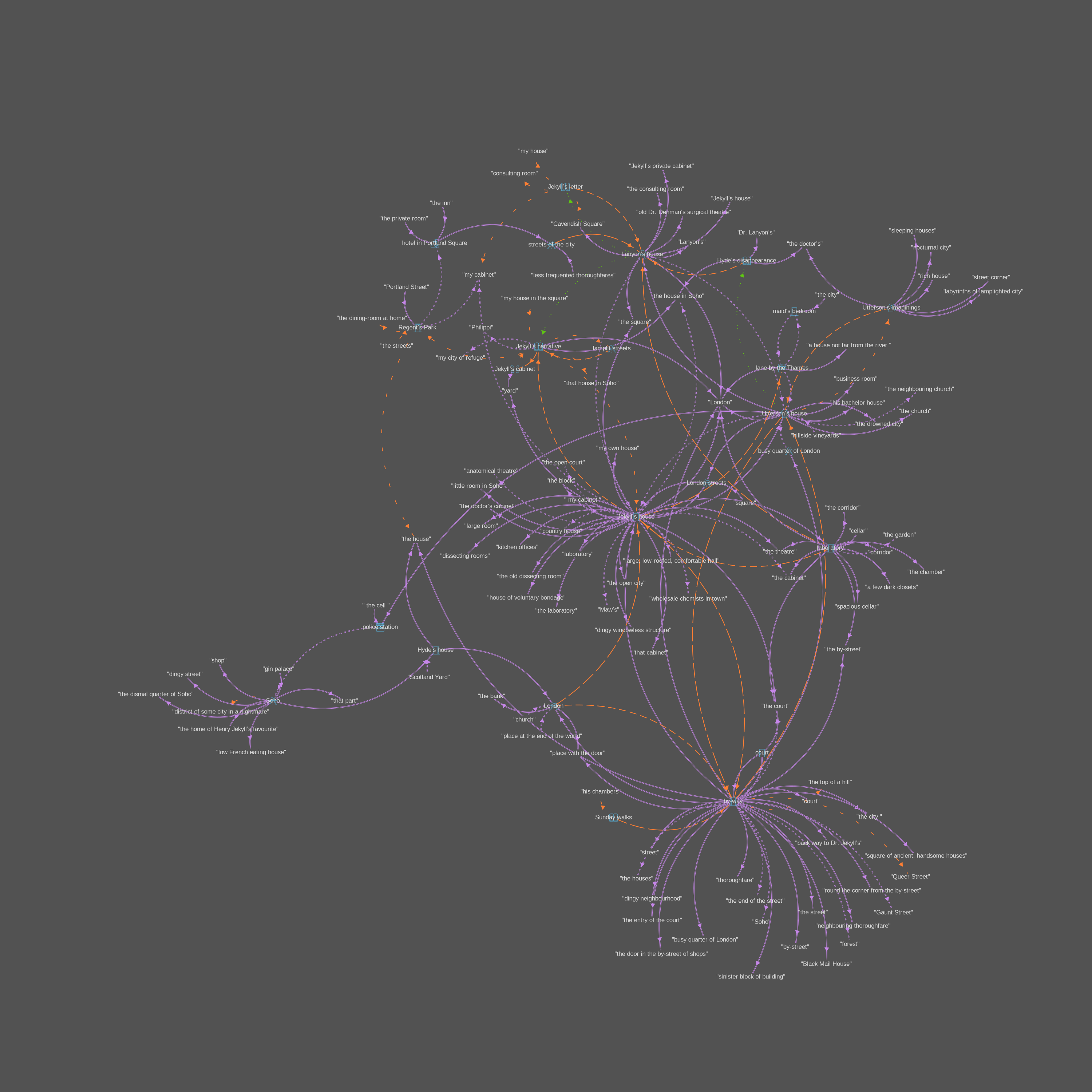
The complete map demonstrates the duality of London registered by the novel. The respectable West End sits alongside sordid Soho, making visible the spatial immediacy of the two halves. This proximity is condensed in Jekyll’s house, with its professional and gentlemanly front directly connected to the rundown ‘by-way’ at the rear and its ‘dingy neighbourhood’. Respectable London, somehow, seems to lead into places emblematic of the East End slums. The novel’s action occurs in a small, circumscribed area of inner north-west London. There are very few references to places outside the city, or – indeed – outside the immediate vicinity of the plot (seen only in metaphorical allusions to ‘Philippi’, ‘the ends of the earth, and vague ‘hillside vineyards’).
This introspection, which increases as the story progresses, displays the increasing reduction of places: the by-way becomes a court, Jekyll’s house a laboratory, the laboratory a cabinet. What happens in space also happens in the text: the spatial and linguistic multiplicity of the third-person narrative (seen in the crowded toporefs of the by-way) reduces at each narrative shift. By the end of the text – Jekyll’s cabinet and Jekyll’s narrative – this spatial variety has all but departed, with the few toporefs metaphorical and indirect.
Syuzhet
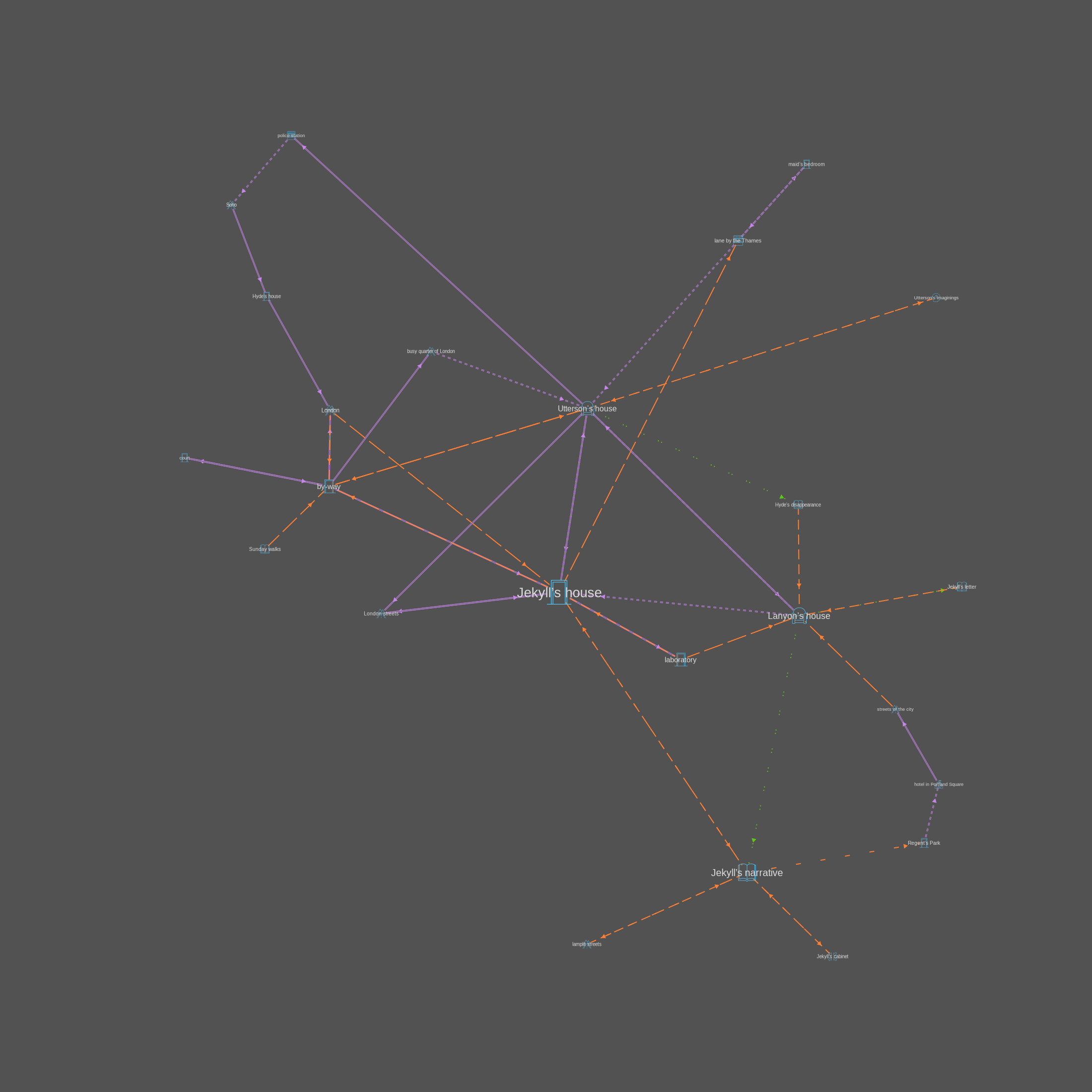
The novel narrates a tale of secrecy, crime and investigation, moving backwards towards Jekyll’s confession. It has at least three narrators – the would-be detective Mr Utterson, Dr. Lanyon and Dr. Jekyll – whose subjective and spatial experiences are in contention as discovery is deferred. In the syuzhet map this results in a series of loops as each narrator tells their tale, and lines of enquiry are frustrated or obscured.
At the start of the novel, as Utterson moves between sites in ‘real-time’, the map is dominated by direct connections between physical places. Then the passage into Jekyll’s narrative is dominated by jumps, demonstrating the narrative shift into psychological exploration and revelation of past happenings. But the dual pattern or mirroring in the map connects rather than separates the narratives and narrators. This suggests an affinity between investigator and investigated, between Utterson’s movements and those of Jekyll/Hyde. It is this association of the respectable façade and its dark underbelly that most concerns the novel. Utterson’s scrutiny of Hyde, for instance, causes him to brood ‘awhile on his own past, groping in all the corners of memory’; he sees himself, or past self, in Jekyll.
Deep Chronotope Map
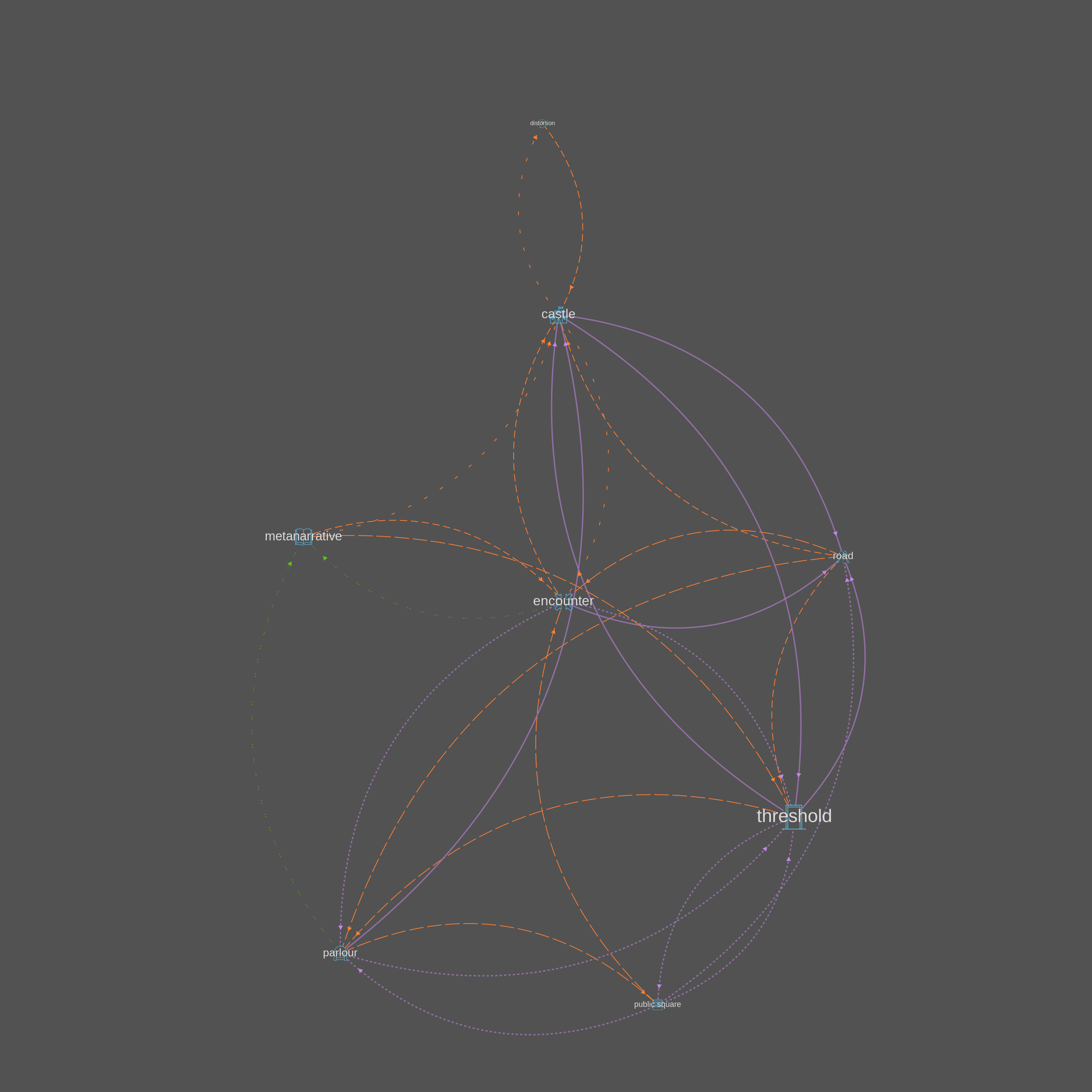
As is typical of complex, multi-consciousness narratives, especially in comparison to simpler forms such as the ballad, the novel’s deep chronotopic map is fairly dense. Not only does it contain 8 of the possible 12 chronotopes but also these nodes have multiple connections. Unsurprisingly for a novel about contrasts, and concerning the extremes of the human psyche, the key chronotope is the emotionally-charged threshold. In many ways, the novel itself occupies a threshold– between genres, narrators, and forms. Threshold is closely followed by encounter, castle and metanarrative. The high occurrence of metanarrative points to the novel’s form which amalgamates the impersonal third-person narrator with a series of letters, newspaper articles and reported narratives. Its multiple connections show the frequent narrative shifts that leave the reader in semi-ignorance and prolong the mystery.
It is, after all, the ‘strange case’ of Jekyll and Hyde – the encounters (meetings, records, clues, documents) of detective fiction are met by the inexplicable mysteries and castle-like claustrophobic terror of urban gothic fiction.