Chronotopic Cartographies
To the Lighthouse
To the Lighthouse (1927) is Virginia Woolf’s fifth novel. It is set in a large house, the holiday home of the Ramsey family, on the Hebridean island of Skye. Although the book’s setting could be described as a displaced ‘nesting’ – Talland House of Woolf’s childhood placed within an imagined Scottish setting – To the Lighthouse falls into Spatial Type 1. This is because, despite this creative relocation, the book’s places purport to correspond to the ‘real’. Nevertheless, traditional literary mapping approaches would be of little critical use in reading and analysing the spaces of this novel since so much of the book is concerned with moving between various small-scale locations in one house and its grounds.
The house, as the syuzhet map neatly demonstrates, provides the grounding for the plot, connecting the novel’s three distinct sections together. Our method not only allows such scaled-up mapping (seeing an area in greater detail) but also circumnavigates the critical minefield of setting (of why Cornwall is superimposed onto Scotland). This is because it takes the text on its own terms. It also allows for the book’s spatial structure and preoccupation with the internal. Our method both allows for and distinguishes between inward and outward spaces. Our graphs, that display spaces and chronotopes relatively, also correspond to the book’s narrative method of depicting the ‘merging and flowing and creating’ of consciousness.
Complete Map
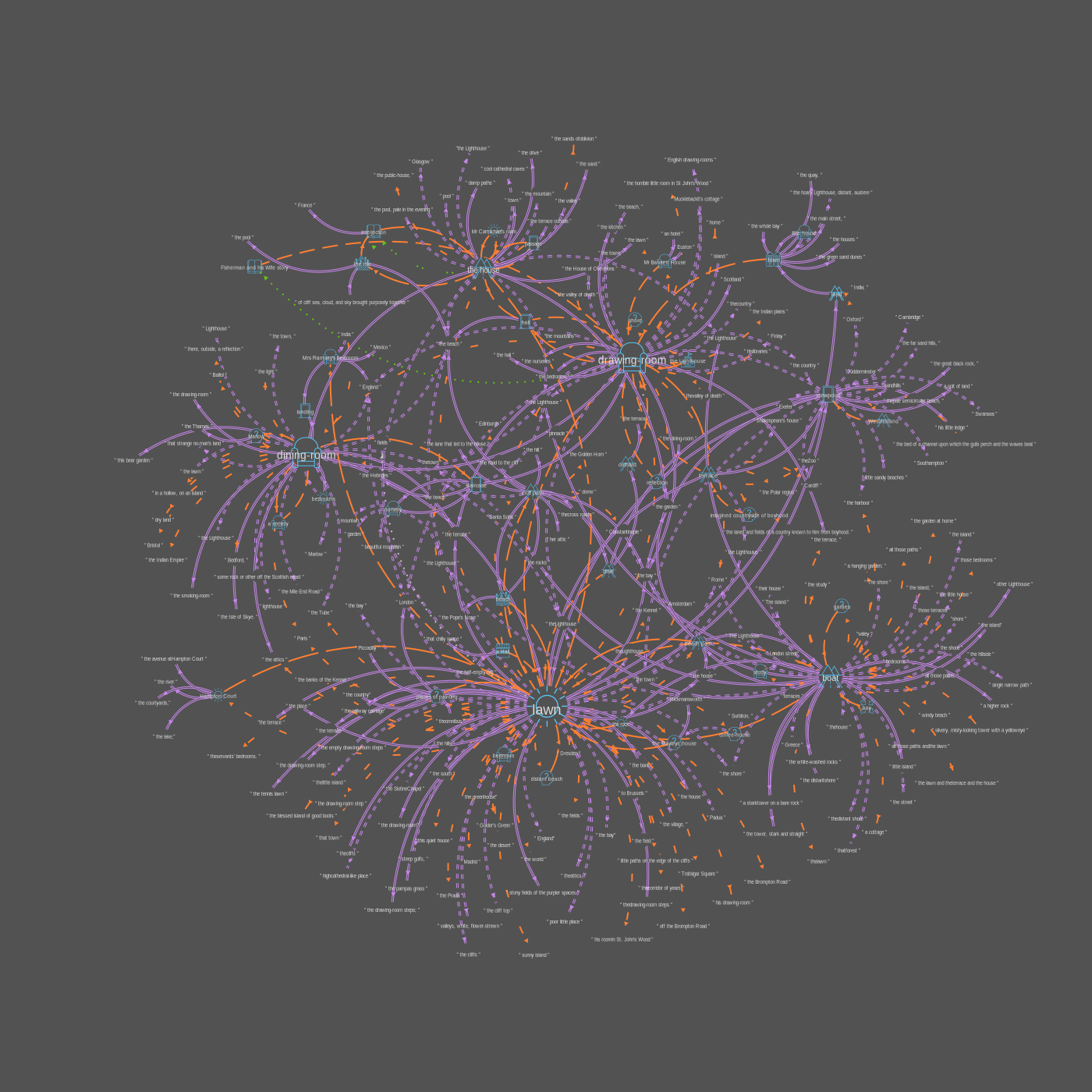
Compared with other novels in the corpus, and realist novels in particular, the volume of topoi in To the Lighthouse is relatively slim. This is because the text is more concerned with the manifold human impressions of life rather than life’s externalities. In line with this, the complete map indicates how none of the novel’s key spaces are named. Instead, they are known, domestic and local spaces such as the ‘drawing-room’, ‘beach’ or ‘town’. The dominant topoi are the lawn, the drawing-room and the dining-room, but jutting out from these are a variety of toporefs – referenced places – ‘Balliol’, ‘Marlow’, the ‘Indian Empire’. Such toporefs not only help establish the novel’s intellectual, class and political context, but relocate the characters’ mental landscape far beyond the immediate setting. Where the local setting is often vague – ‘some rock or other off the Scottish coast’ – the clarity of the projected, imagined or recalled landscape reinforces the sense that the internal trumps the external.
What is also immediately clear is that, although the book is nominally about the Lighthouse, the house is spatially dominant. The Lighthouse provides a point of reference rather than a place of being. These two structures, then, dominate the graph; the house, through the topoi – occupied spaces – and the Lighthouse through the toporefs. From the shore the Lighthouse is out of focus, imagined, and projected. Viewed from afar it is ‘hoary’, distant, austere’; a ‘silvery, misty-looking tower’. It is romanticised, an illusory structure. When viewed close up, from the boat and the rock, it becomes a ‘tower, stark and straight’, a place of practical and pedestrian labour.
Syuzhet
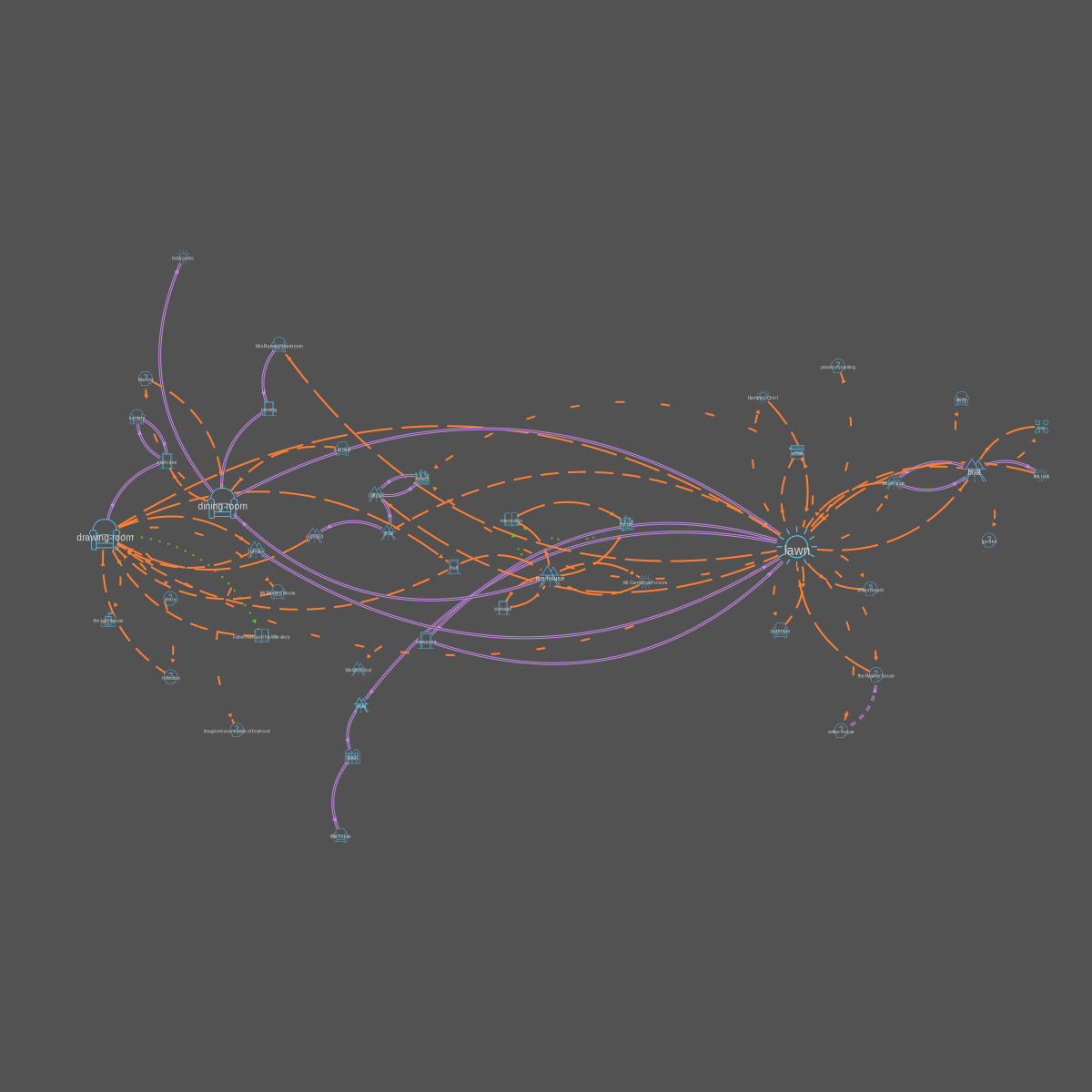
To the Lighthouse is divided into three parts: ‘The Window’, ‘Time Passes’ and ‘The Lighthouse’. The syuzhet map registers the underlying spatiality of this structure: the predominantly internal spaces of ‘The Window’ (‘dining-room’, ‘drawing-room’, ‘bedrooms’) are connected to the more external ‘lawn’ and ‘boat’ of ‘The Lighthouse’ via the less delineated ‘house’ of ‘Time Passes’. According to Woolf, and as illustrated by her diagram, her work was conceived as ‘two blocks joined by a corridor’ (see The Original Holograph, ed, by Susan Dick). Woolf’s description, like the chronotope, describes the text in terms of space-time. Two vertical blocks or spatial synecdoches – ‘The Window’ and ‘The Lighthouse’ – are connected by the horizontal line of time, made visible as a corridor. This ‘H’ form is traceable in the syuzhet map, where the topoi clusters on either side are joined by a less populated middle.
Setting aside the direct lines that connect ‘lawn’ to ‘dining-room’ (the ‘lawn’ is present in both the first and last section of the novel), the middle part’s topoi are joined by jumps, interrupts and intratextual connections that imply the prominence of time over space. This is because ‘The Window’ all takes place on a September evening; ‘the Lighthouse’ a September morning. ‘Time Passes’, on the other hand, covers a ten-year hiatus. The overall dominance of jumps and interrupts demonstrates that while the plot moves directly through the limited spatial confines of the house and its locality, the ‘other’ places – ‘Marlow’ and ‘Mr Bankes’ house’, for instance – are imagined or recalled rather than visited. This all speaks for the telling of the tale – the narrative abruptly shifts between multiple perspectives. It also shows how mapping depth as well as breadth counters the seeming simplicity of the plot.
Deep Chronotopic and Topoi and Chronotope Maps
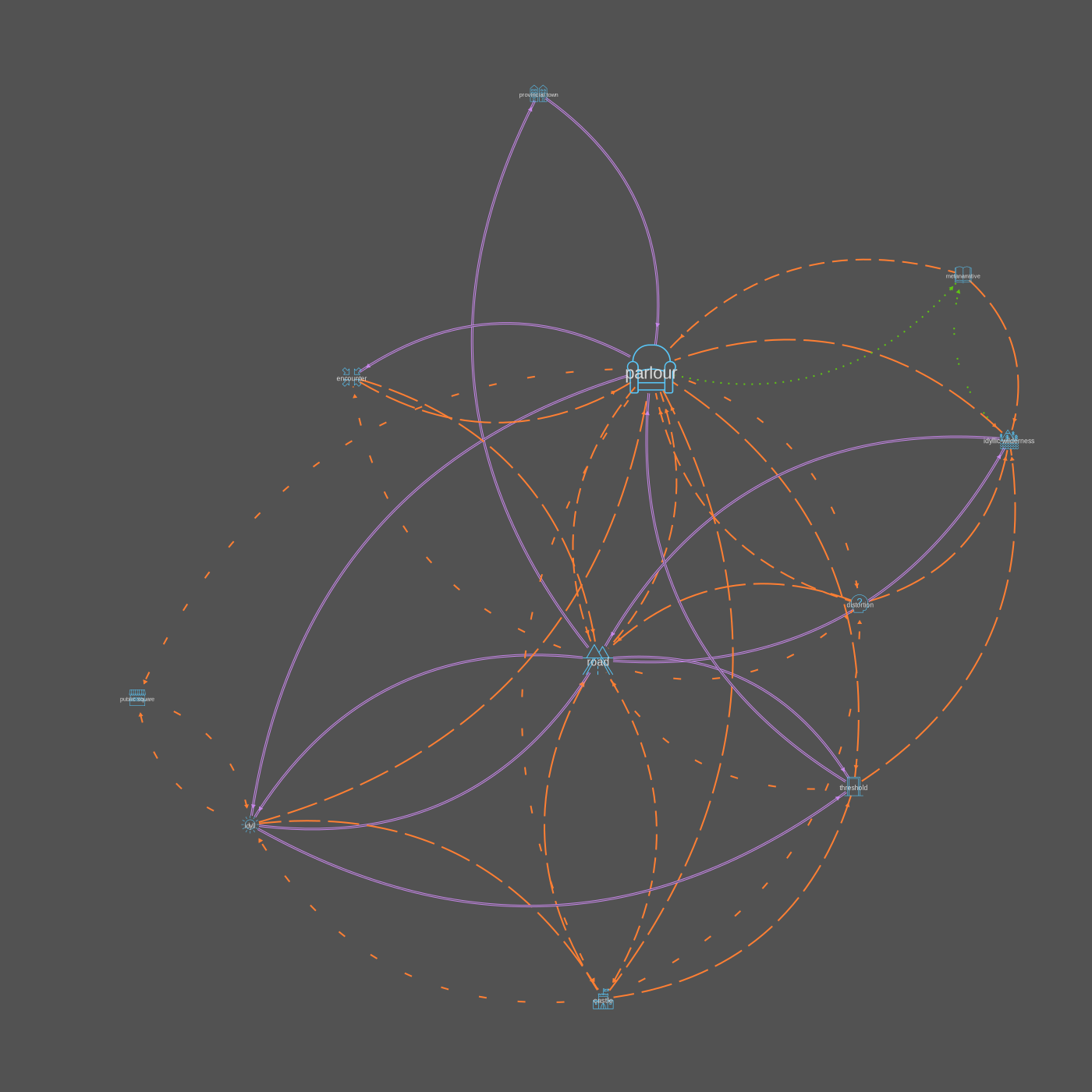
The chronotopic maps reinforce the sense of narrative interconnectivity through the proliferation of nodes and edges. The complex structure of the deep chronotope map, in which the nodal chronotopes are joined via jumps and interrupts (orange lines), register how difference spaces hold different values depending on which subjective consciousness the narrator is depicting. Unlike the more traditional realist novel, the ‘metanarrative’ chronotope is fairly minor, in line with the fact that the narrator, though always present, is always filtered or muted. Narrative control is limited. Overall, the spatial form is cyclical. This mirrors the novel’s structure. The concluding section reconciles the issue first raised at the book’s opening: the planned trip to the lighthouse finally occurs. In the graph, these cycles take the form of ellipses (two flower-like shapes with petals looping out and back), suggesting that return is only possible via another state. This sense of return also attests to the book’s connection with elegy (see Woolf’s Diary, vol. 3, 1925).
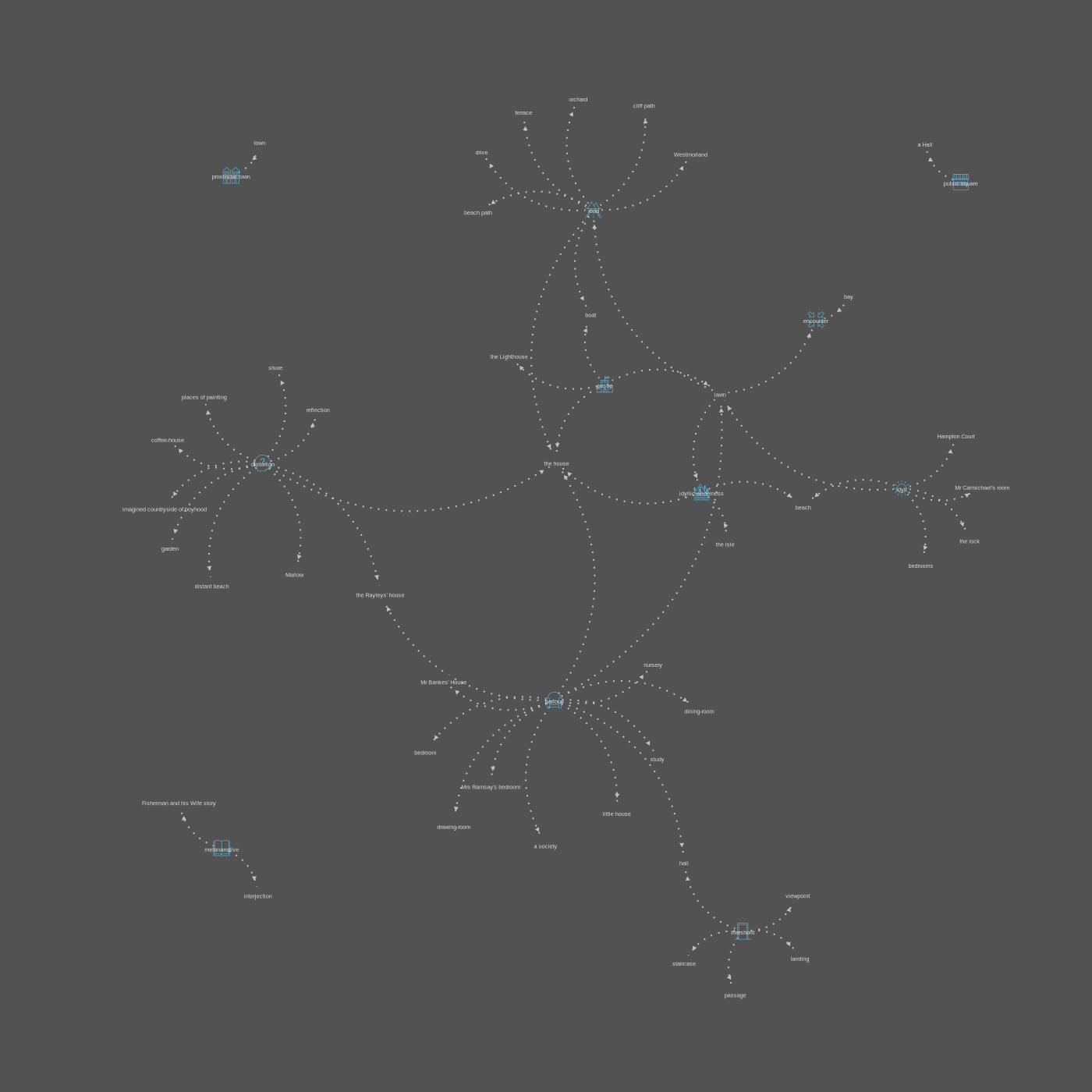
The ‘topoi and archetypes’ map highlights the multiplicity of the novel’s keys settings – the lawn and the house. Also, since the two have such distinct chronotopic values, it brings out their oppositional natures. Most dominant are the somewhat oppositional chronotopes: the parlour – stasis, interior, dialogue – and the road – movement, exterior, thought. This aligns with the book’s juxtapositions (Mrs Ramsey’s stillness met with Mr Ramsey’s pacing; Lily Briscoe’s painting versus the Ramsey’s boat trip; inner and outer selves). Overall, the spatial form of the map, in line with the book’s concern with loneliness and companionship, displays disparity and unity.