Chronotopic Cartographies
The Lonely Londoners
Sam Selvon’s 1956 novel The Lonely Londoners is a poignant, tragicomic depiction of the experience of the first arrivals in ‘the Ole Brit’n’ from the British territories in the Caribbean. Narrated from the perspective of ‘Moses’, a veteran Londoner originally from Trinidad, the novel tells of the escapades of a handful of new arrivals in a cold, unfamiliar and frequently hostile city which nonetheless offers possibilities for adventure and self-transformation. One of the first British novels to depict the arrival of Windrush generation, we see in it the combining of Caribbean vernacular with modernist-inspired textual experimentation to create an idiom and narrative form appropriate to documenting the fragmented experiences of this community.
Topoi Map
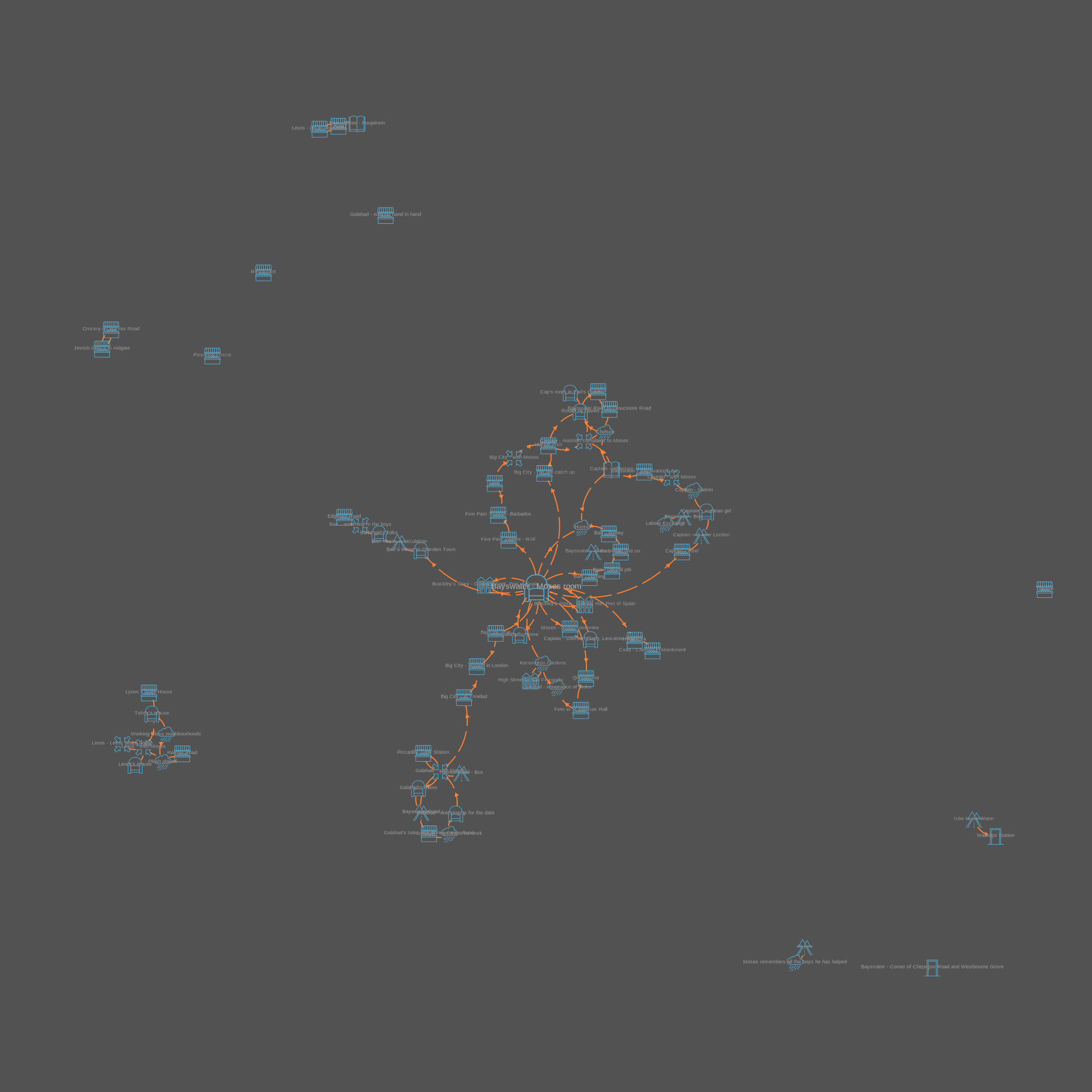
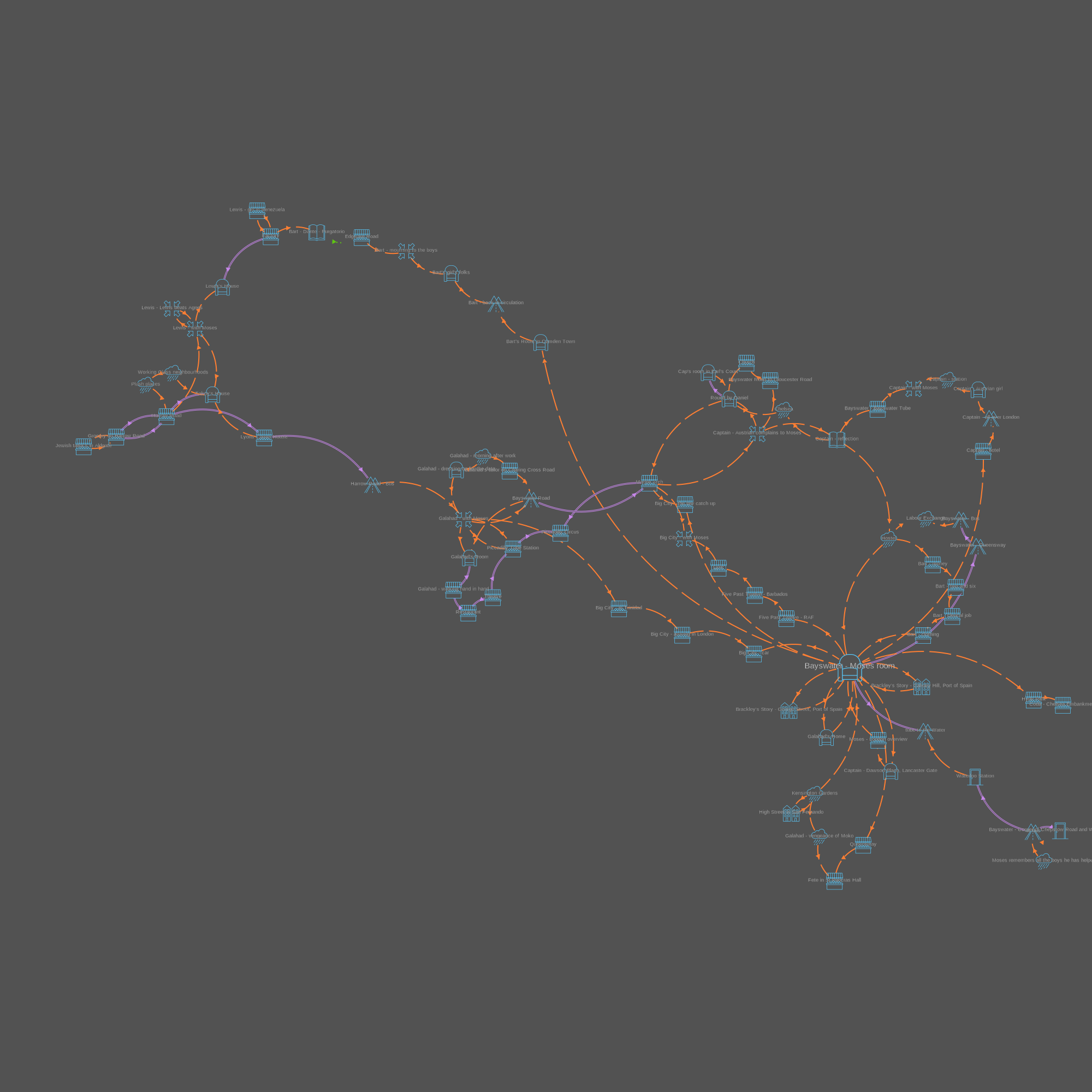
Formally, The Lonely Londoners is presented as a single continuous text, uninterrupted by chapter or section breaks or other structuring devices. Despite this lack of formal textual organisation, the novel is structured around a series of episodes in the lives of the characters: Captain, Big City, Tolroy and his family Tanty, Ma and Agnes, Galahad and Moses himself. The centrality of Moses to the novel is visible in this topoi map: by far the largest node on the graph is Moses’ room in Bayswater, from which many of the stories are related. Though the text here is not mapped geographically, the locations to which it returns most frequently — Bayswater, Marble Arch, the Harrow Road — are all in North West London, the area in which the first of the Windrush generation settled.
Filtered Topoi Map: Jumps and Direct Connections
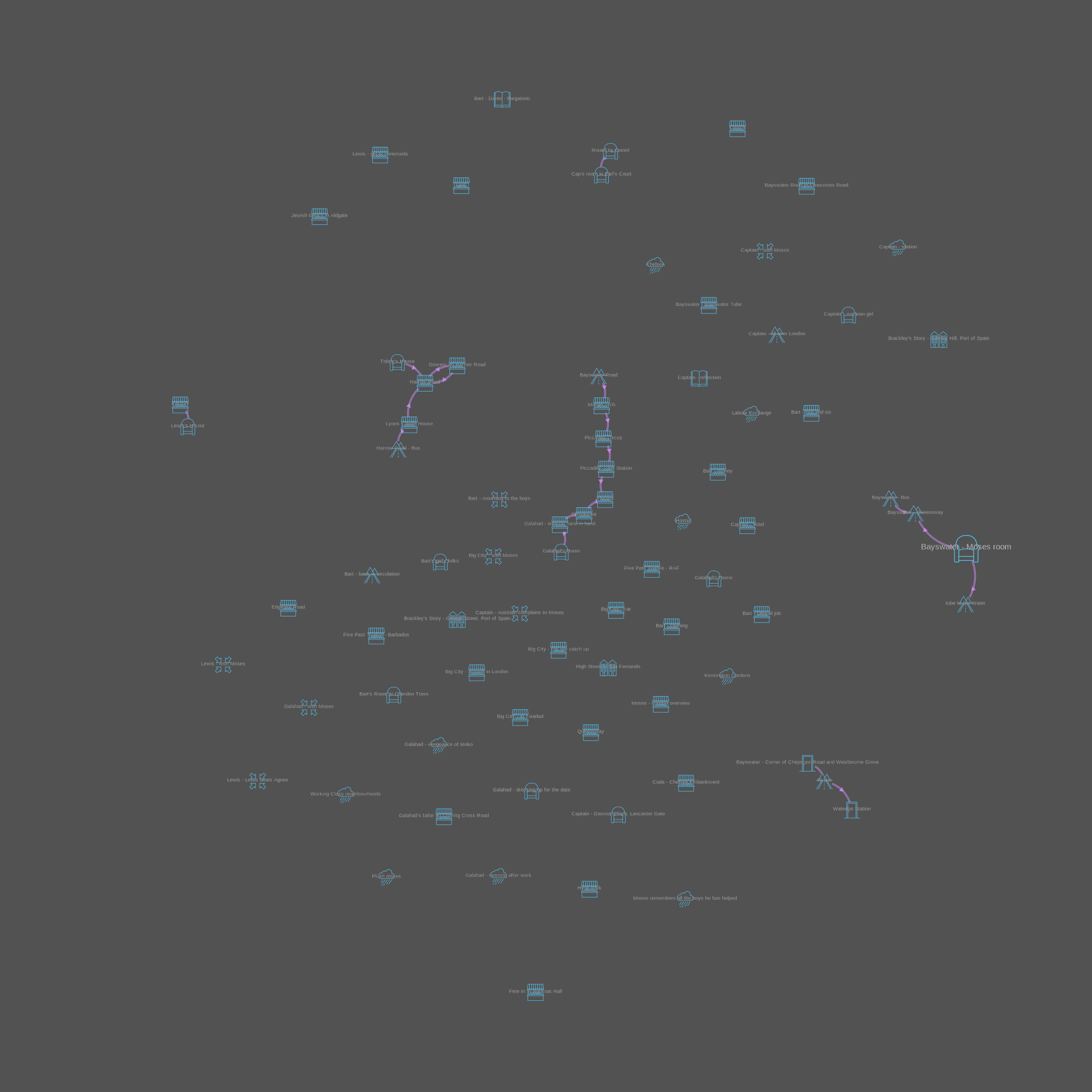
Here we present the topoi map of the novel filtered (on the left) to show only narrative ‘jumps’; and (on the right) to show only ‘direct’ connections. As can be seen, by far the most prevalent connection type is the ‘jump’. This speaks to the novel’s episodic structure, with the narration moving across London (and occasionally beyond), jumping across time and space as it does so. Filtering the novel for direct connections generates a much more dispersed visualisation of its spatial structure, with most nodes disconnected from one another. Those which are connected to one another are readily identifiable as relating to specific stories within the novel: Tanty’s trip to Lyons Corner House on Great Portland Street; Galahad’s date with Daisy; Galahad’s trip to the Labour Exchange; and the opening passage in which Moses meets Galahad fresh off the boat train at Waterloo.