Chronotopic Cartographies
The Odyssey
Homer’s The Odyssey is the Western Ur-text of exile and of the paradoxical desire to return to a home that may or may not still exist. On the one hand, Odysseus’ journey home is thwarted by Poseidon, and exile can only be endured – indeed, the capacity to do so is one of the core characteristics of Odysseus as a Greek hero. But there is also the sense that Odysseus, reacting against this subjection, actively invites danger along the way – taunting the Cyclops or insisting on hearing the sirens’ song.
This division between the longing for home (nostos) and the lure of adventure is clear in the map series created from both versions of the poem. In the maps generated out of Robert Fagles’ translation, 'royal palaces' and 'shepherds’ huts' sit alongside the 'caves of witches and giants'. But in the maps from Samuel Butler with their proliferation of ‘houses’ domesticity comes to the fore, attesting to Butler’s own reading of the poem as ‘franchement bourgeois & unheroic’. According to Butler, Ulysses (Odysseus) is a ‘servants’ hall hero’.
Complete Map - Fagles
The complete map does justice to the poem’s range, which is simultaneously broad and intimate, vast in scope, yet attentive to the smallest details (the plants of Laertes’ well-tended farm, the types and varieties of coastlines). This attention to detail highlights how The Odyssey is a narrative of lived place as well as of epic event. Through its toporefs, Ithaca is most often referenced and dwelt on via ‘projection’ and ‘indirect’ connections which emphasise its characteristic as a lost and distant place that is also the ultimate goal. It is no surprise, then, that Ithaca is at the centre of the map. It is also a site of possession and ownership: ‘my own native Ithaca’, ‘my own country’. Place names such as ‘seagirt Ithaca’, ‘the heights of Troy’, or ‘wooded Zacynthus’ incorporate topographical epithets that root places in the landscape and through memory. Overall, the complete map demonstrates how the text integrates different kinds of place – domestic, hostile, mythic, familiar – through a sustained reference system.
Syuzhet Maps -Fagles and Butler
The syuzhet maps show the extent to which The Odyssey establishes a non-chronological model for epic – starting 'in media res' – in the middle of things – with the Telemacheia, or 'Story of Telemachus', which focuses on Odysseus’s son as he journeys away from home to seek his father. This sets the scene initially in Ithaca and introduces Odysseus from an external perspective. The Odyssey has a complicated narrative; lies, exaggerations and tricks compete with one another in a fractured timeline. The syuzhet maps displayed here register this formal complexity. Odysseus himself doesn’t appear until Book 5, which introduces his journey home via the utopian Phaeacia (‘King Alcinous’ palace’ /‘house of Alcinous’). Books 9 to 12 constitute the chronological ‘beginning’ of the tale (the starting point for the fabula). So Odysseus’ first three years of travel, when he encounters the Cyclops, the sirens, lotus eaters and Circe, are told in retrospective as Odysseus recounts his tale to Alcinous.
In both maps, this warped timeline creates a looping effect, as the narrative tells of Odysseus’ return, by means of analepsis, in Book 13, to the present day. The nodes and edges of the syuzhet maps are further multiplied by the poem’s subplots: Telemachus’ journey to Pylos; Penelope’s dealing with the suitors; and by the bards’ tales. By plotting spatially, rather than chronologically, the syuzhet maps take the text on its own terms. As a result, on both maps, the spaces of Odysseus’ exile are marginalised (top; right).
Topoi Maps - Fagles and Butler
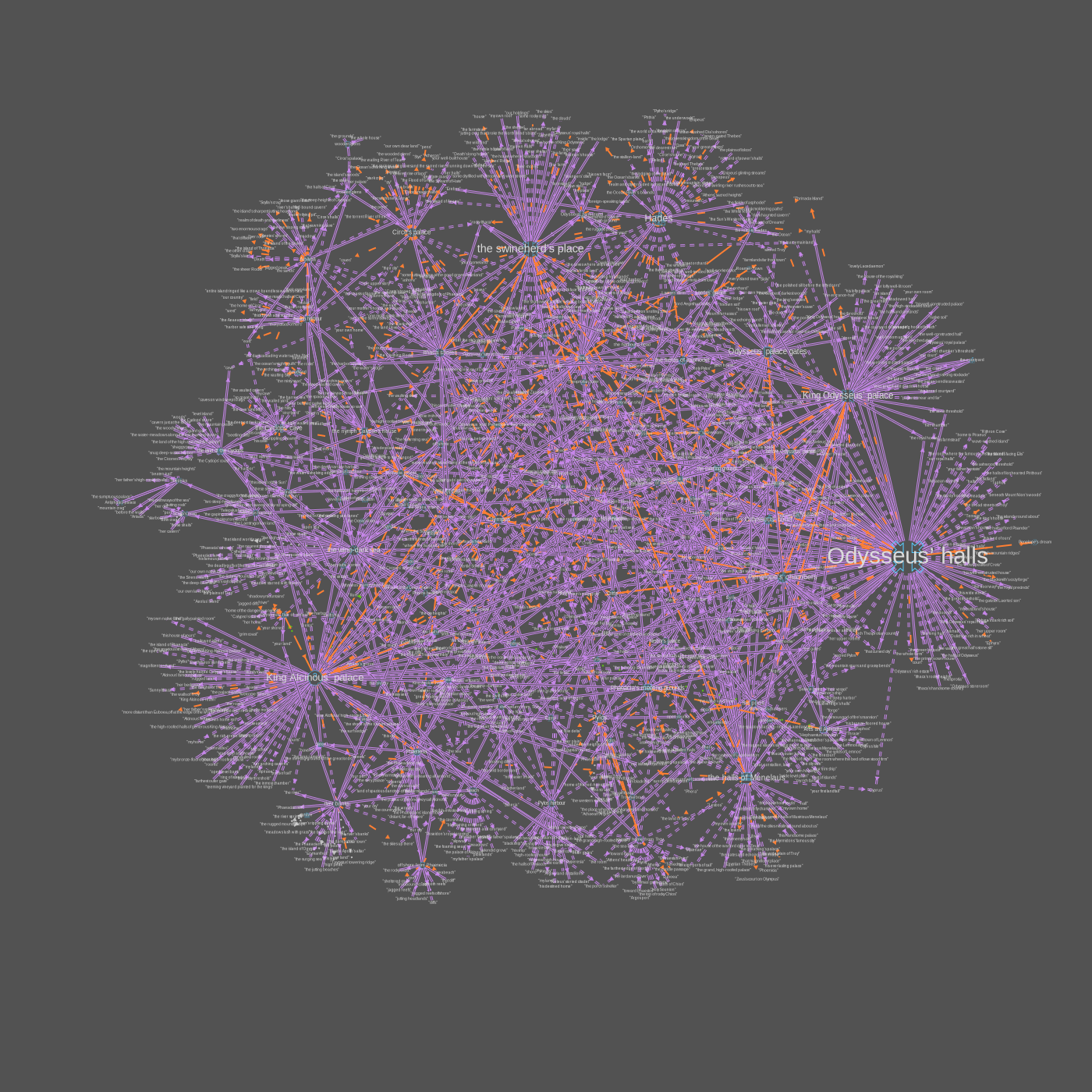
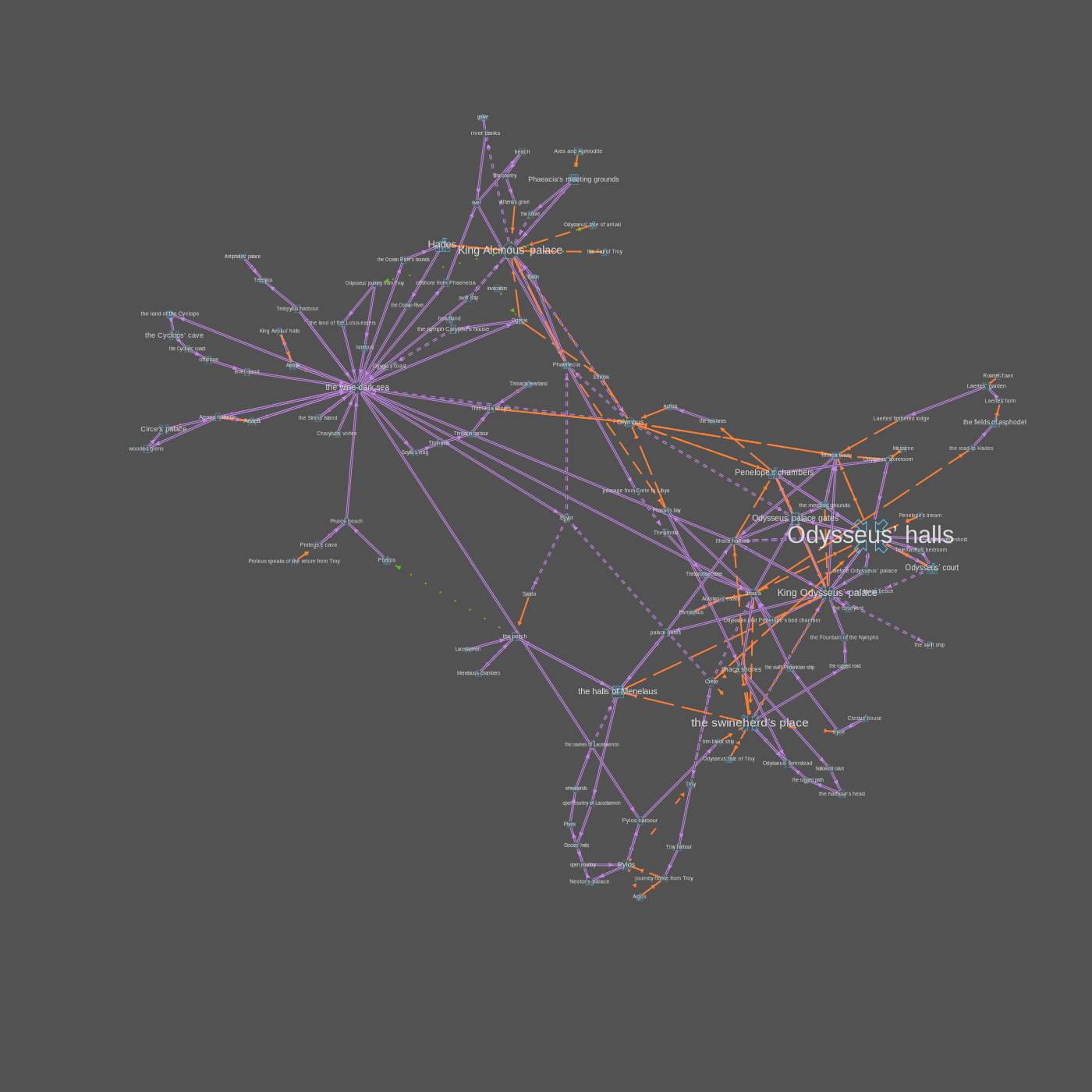
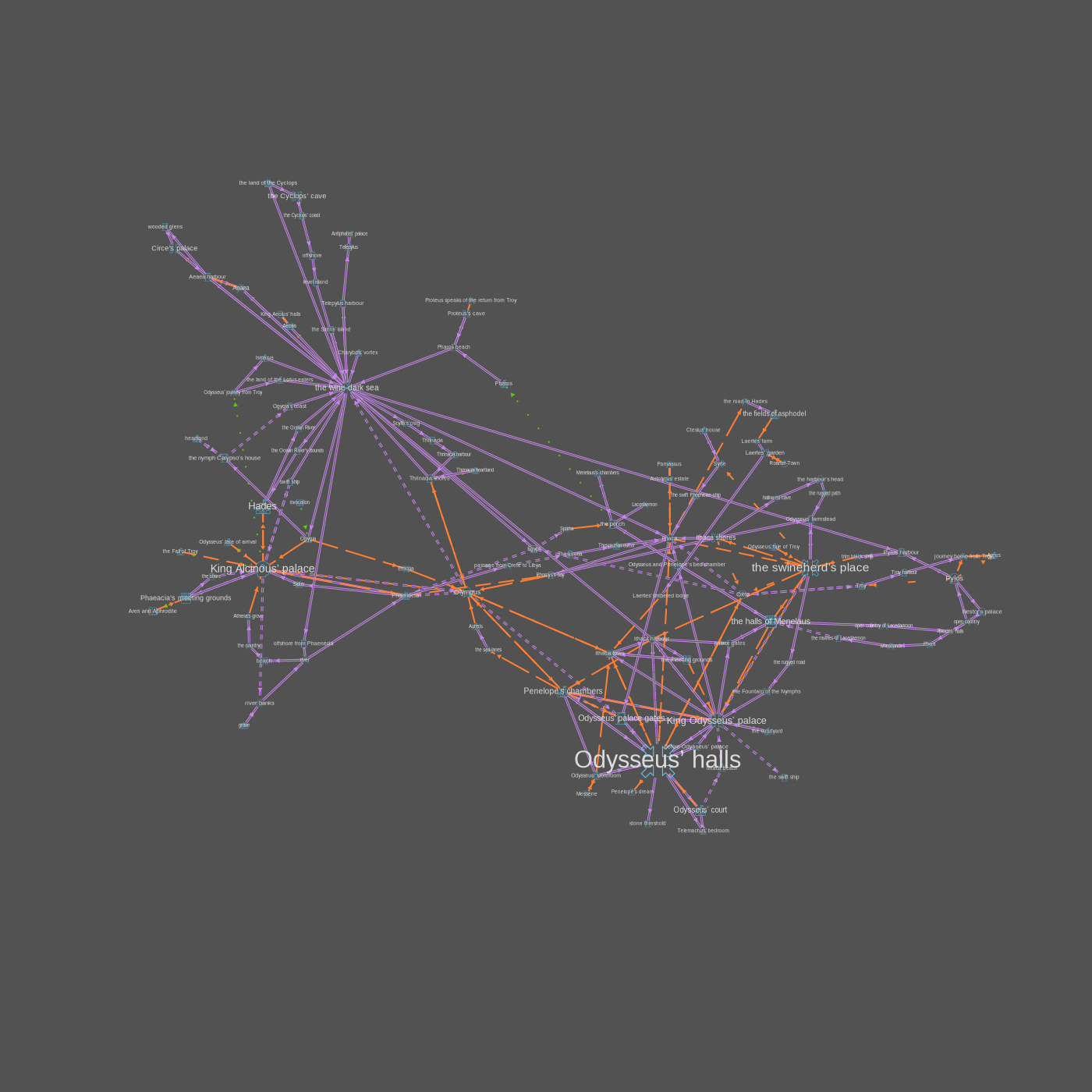
In the topoi map created from the Fagles translation (left) there are clear spatial clusters, around ‘the wine-dark sea’, ‘Odysseus’ halls’ and, to a lesser extent, ‘Pylos’. Odysseus’ halls are the most dominant topos – demonstrating the relative domesticity of the poem. It also shows how it is Penelope’s story too. But while her setting is domestic, it is complicated by its chronotopic value of encounter, giving a sense of the home invaded, a public rather than a private space. So Penelope’s world – centred on 'Odysseus’ palace' at the bottom of the map – is small and claustrophobic: her chambers figure as a 'castle'. The 'road' of ‘the wine-dark sea’ is a fulcrum from which various topoi loop out as Odysseus is interrupted on his journey home. In both maps, Olympus is situated as a midway point between the two spatial dimensions of home (the real) and away (the mythic), mediating between the two worlds but also controlling and directing– as Athena does in the text. This is a culture in which time, space, weather, and the path of the individual are all subject to higher forces.
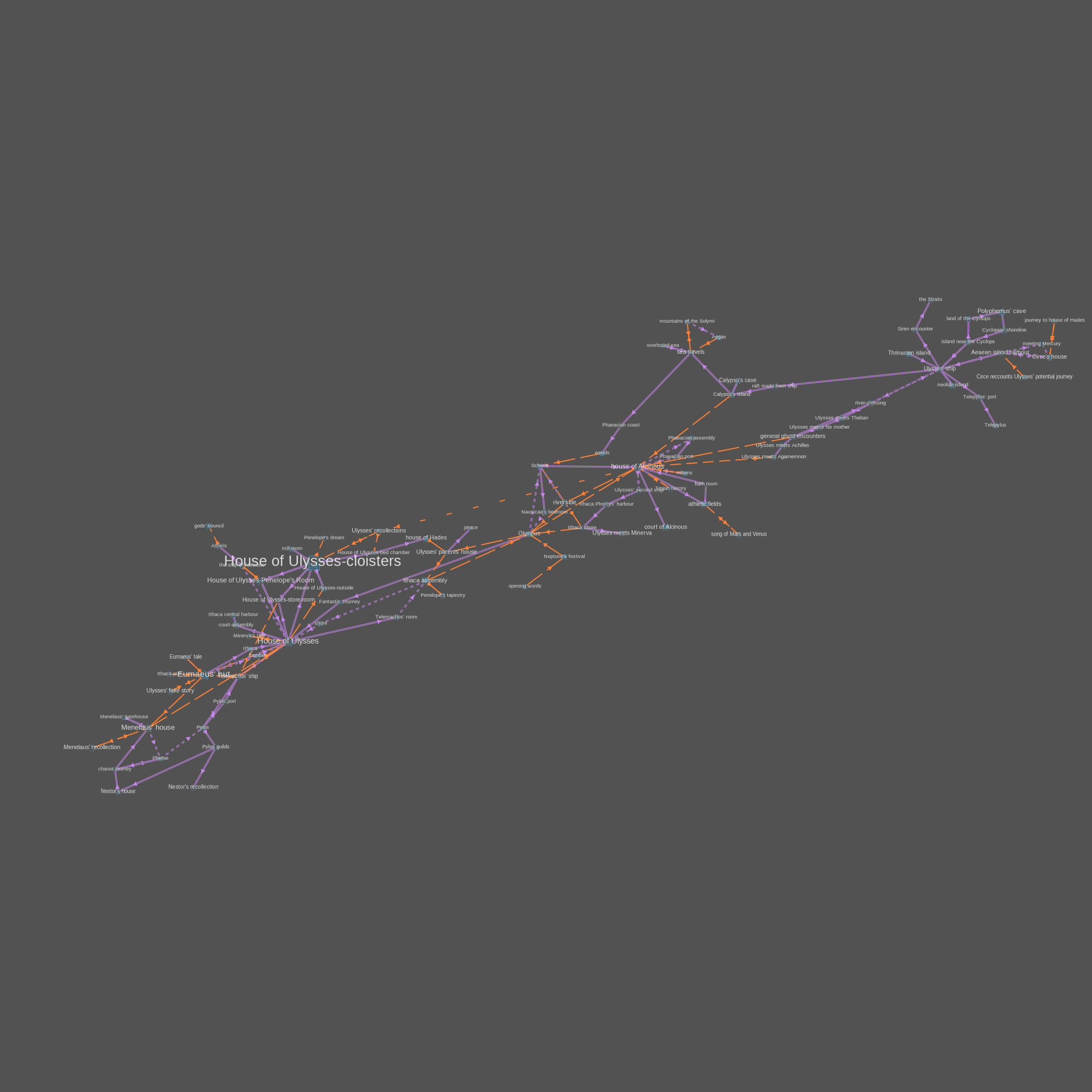
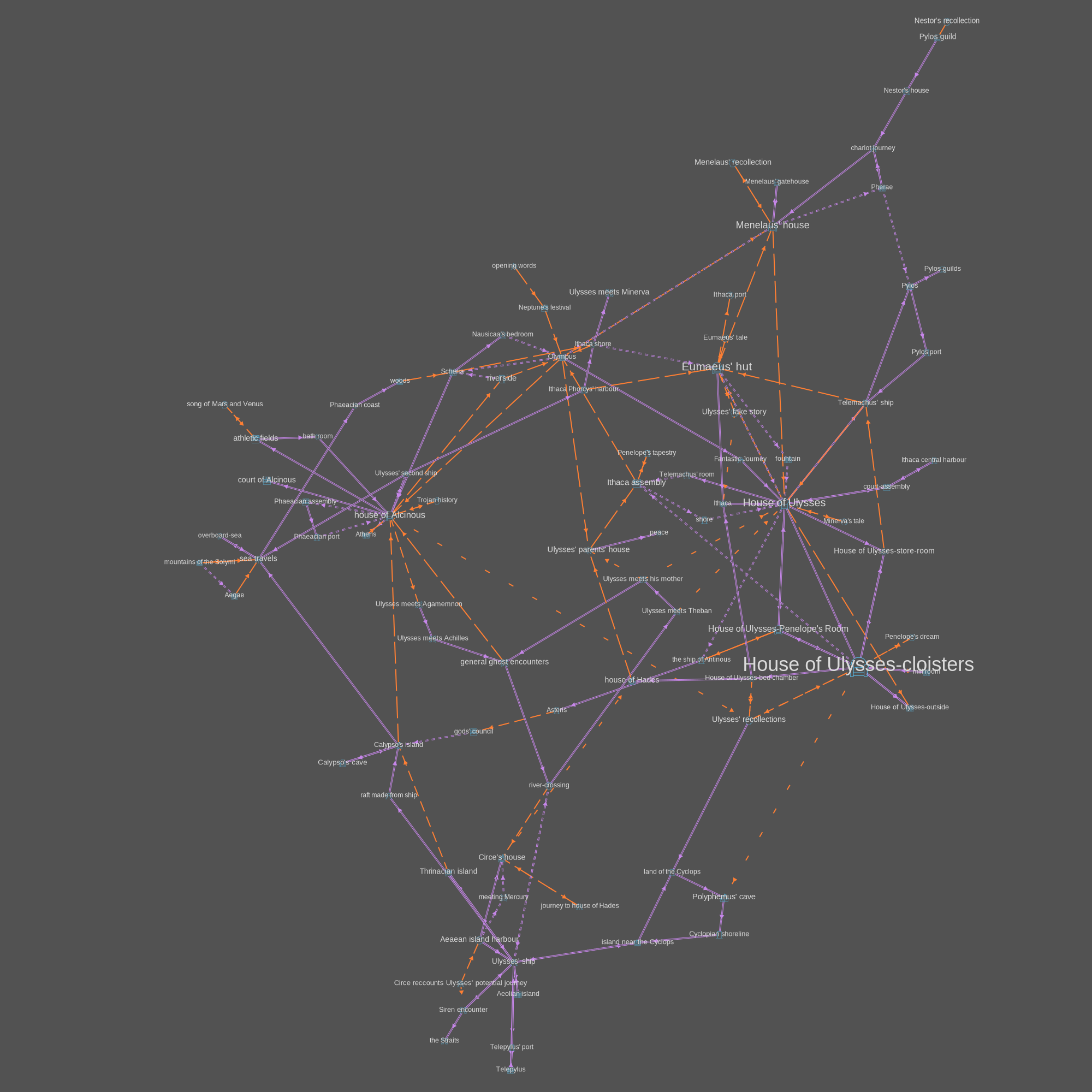
The map generated from the Butler translation (right) displays a similar distribution of spaces, but the sea – figured here as ‘Ulysses’ ship’ – play a less key role. Here frame-names (locations) are more plot-based (e.g. ‘meeting Mercury’, ‘Ulysses meets his mother’, ‘Penelope’s tapestry’) so that the sense of the chronotope is captured in name as well as value. Here, the ‘House of Ulysses’ and its related spaces dominate the right-hand side of the map, confirming the epic’s homely aspects. This sense is bolstered by its chronotopic value: the 'parlour'. In both maps, the merging of people and place in topoi names emphasises how the poem is concerned with identity: places are defined by the characters that inhabit them.
Deep Chronotopes Maps - Fagles and Butler
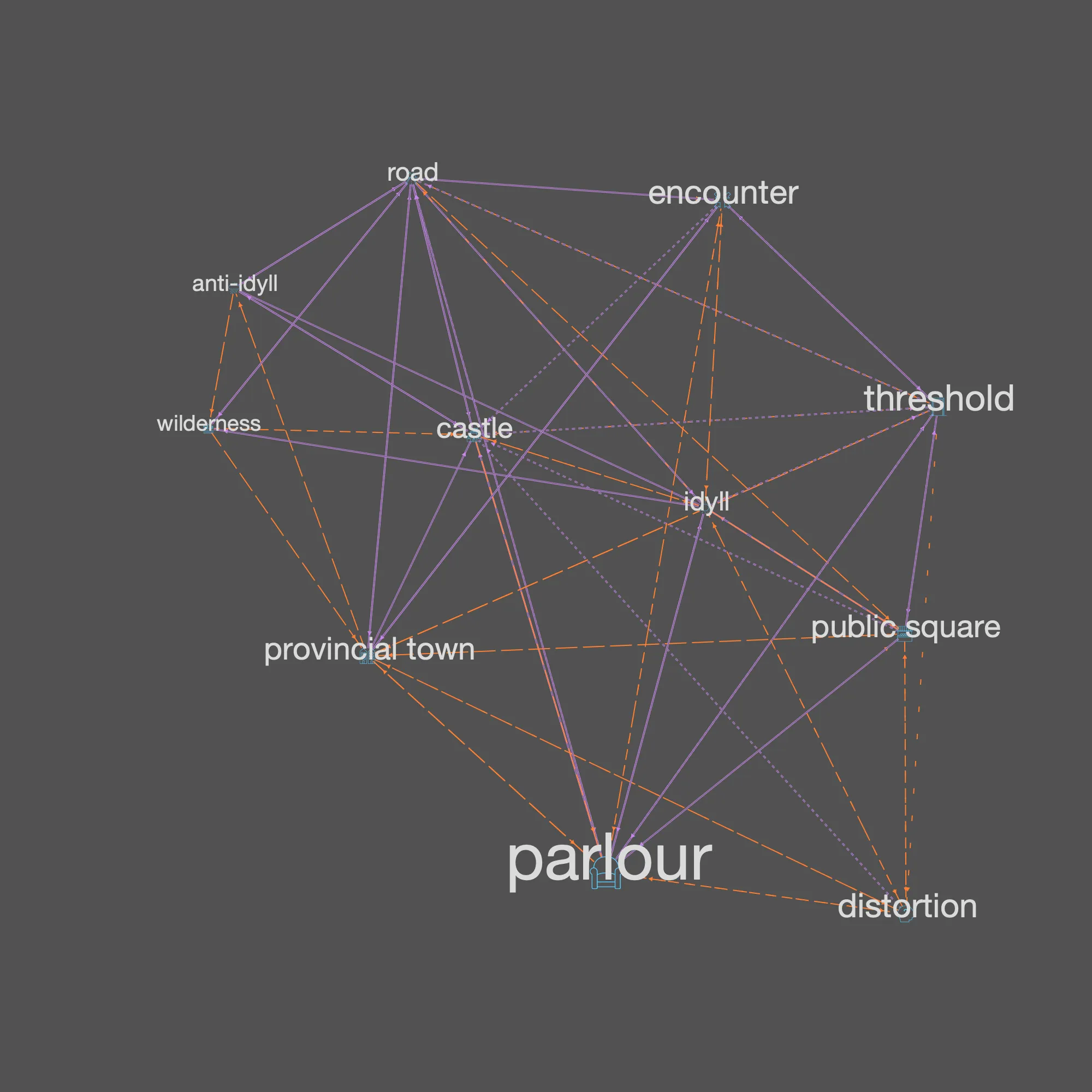
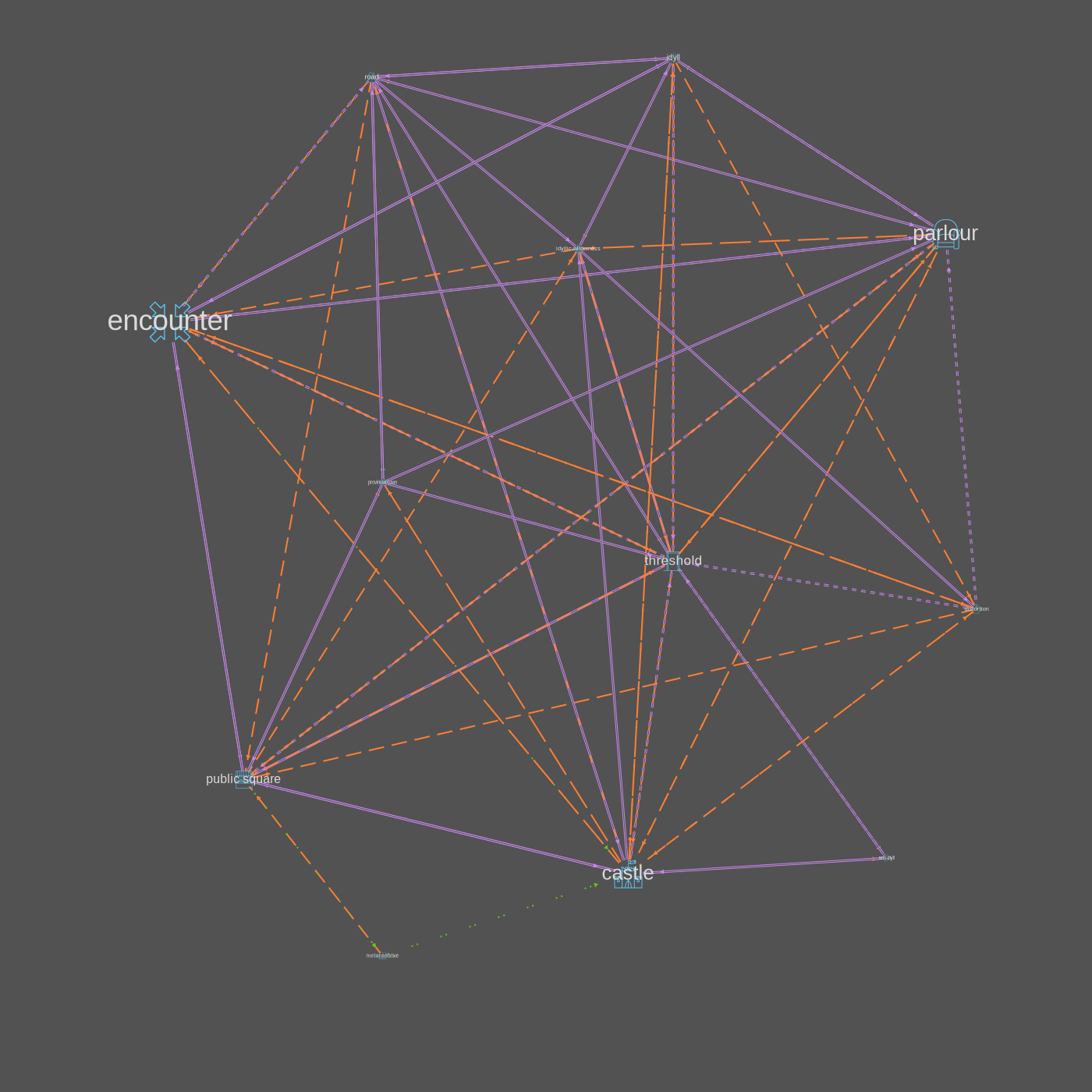
The deep chronotopes map for both texts reveal the range of chronotopes across all the different narrative strands. In both, the relative lack of text given to the chronotope of the 'road' is both surprising and telling. It registers how The Odyssey is a text concerned with the state of being away, the condition of exile, rather than the journey itself, as well as with the lack of goal-directedness created by the underlying spatial conditions of power: the hero’s fate is held in the hands of the gods. The chronotopic variety of both maps registers how the text explores a variety of worlds and perspectives. The dominance of the 'parlour' chronotope in the deep chronotopes map for Samuel Butler (left) again highlights Butler’s own emphasis of this aspect in his translation of the text. In the map generated from Fagles (right), the appearance of the metanarrative chronotope indicates the presence of another voice, and draws attention to the multiplicity of tales that make up The Odyssey. Here, 'encounter' emerges as the largest node, highlighting how the poem is constituted of a series of episodes.