Chronotopic Cartographies
Oliver Twist
The setting of Oliver Twist, or, The Parish Boy’s Progress (1838) corresponds to actual, historically-existing geographical places that can be identified through realistic details such as street names, landmarks, towns and regions. But, just because the text’s space is ‘correspondent’ to the real world doesn’t stop it being metaphorical. Real places, with real place names, are loaded with potential figurative value, for their allegory, for their reputation. Newgate, for instance, summons not just the prison itself, but the popular ‘Newgate Novel’ and its sites of criminal activity. And nested in the ‘real’, as the ‘topoi’ map demonstrates, sit invented or imagined places. The ‘Progress’ of the novel’s title, recalling Bunyan’s Pilgrim’s Progress and Hogarth’s Harlot’s Progress, plays on the picaresque novel with characters moving from place to place, between city and country.
Complete Map
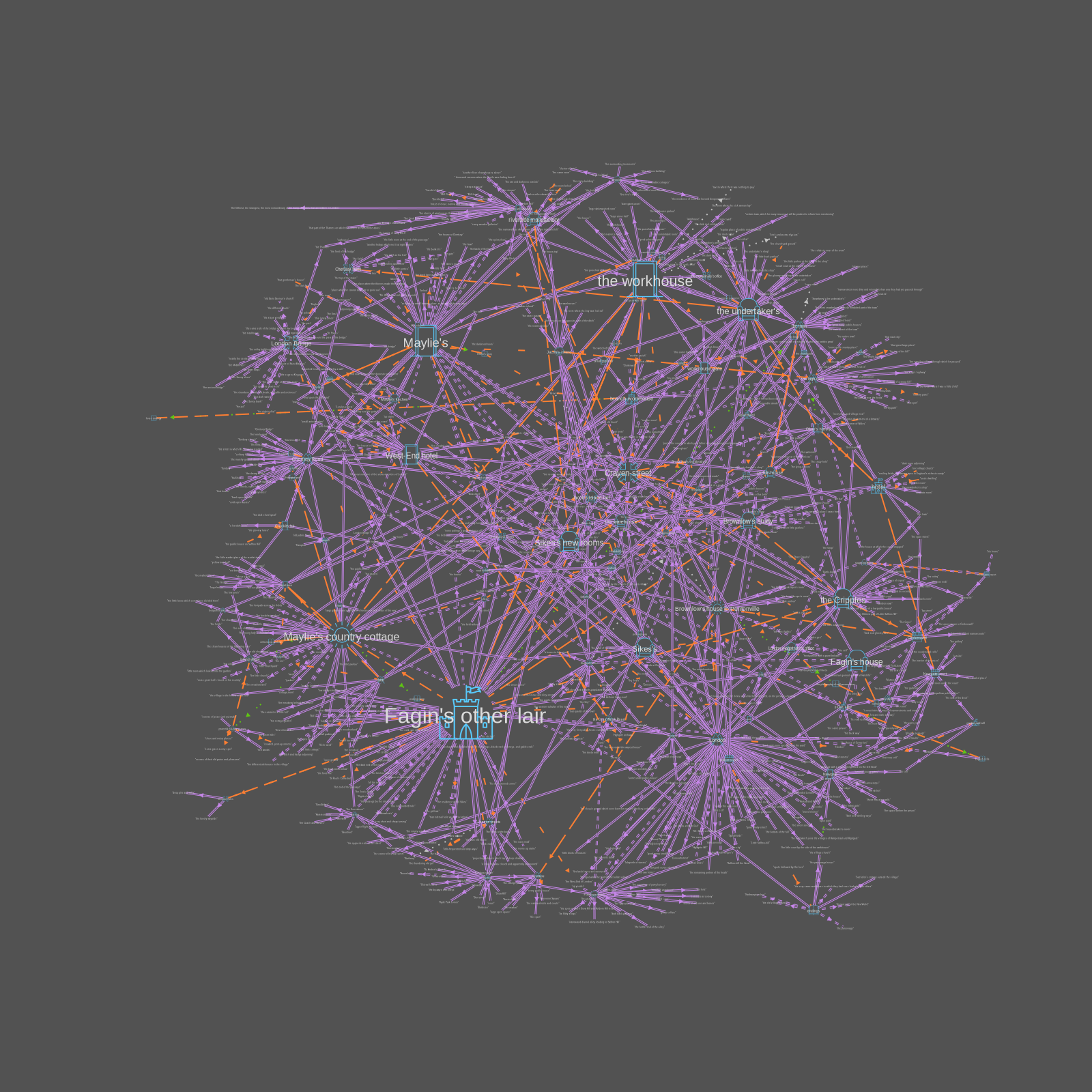
The complete map, almost extraordinarily dense in its complexity, demonstrates just how spatial Oliver Twist is. Focusing in, and taking two settings, London and Chertsey, as examples, indicates how relatively little importance is given to the non-metropolitan. ‘Toporefs’ such as ‘lanes’ and fields’ show that Chertsey is far less delineated than London which, laid out street-by-street: ‘Highgate Hill’, ‘the Heath’.
The dominance of direct connections between the setting or ‘topoi’ nodes and spatial references or ‘toporefs’ speaks of the contained nature of each space. This correlates with the novel’s original serial form, each space, like each instalment, is – to a certain extent – self-contained.
Topoi
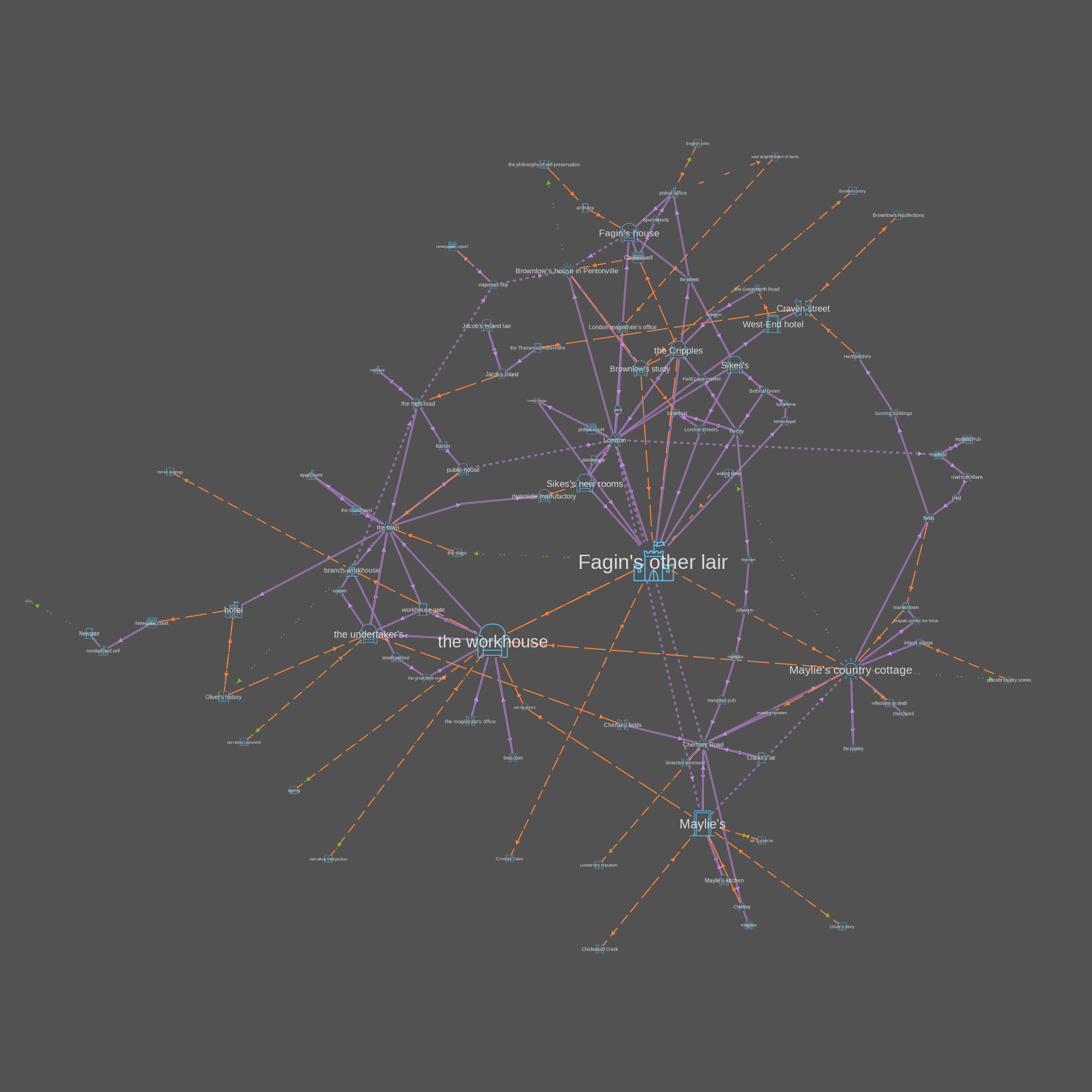
The generation of Oliver Twist’s ‘topoi’ map has resulted in two fairly distinct spatial clusters: the top of the map roughly corresponds to the city, the bottom to the novel’s country/town settings. What becomes clearer from the topoi map by comparison with the complete one is that both clusters are dominated by the fictional within or appended to the ‘real’. This confirms the importance of our mapping method that allows the plotting of both ‘real’ and imagined places, and their relationship to each other. When the novel is plotted onto a ‘real’ map, sites such as ‘the workhouse’ and ‘the town’ become vague and disconnected from the whole.
Although the London section of the map has at once more ‘topoi’ and a greater cluster of connections (thus confirming the literary stereotype of the city/country binary) that city is more mobile and interconnected than the town or country. The spatial map of the novel lends equal prominence to the otherwise ‘unmappable’ sites. With the dominance of ‘Fagin’s other lair’ the map visually enacts the narrative impulse to expose the criminal spaces hidden beneath named, known London.
Deep Chronotopic Map
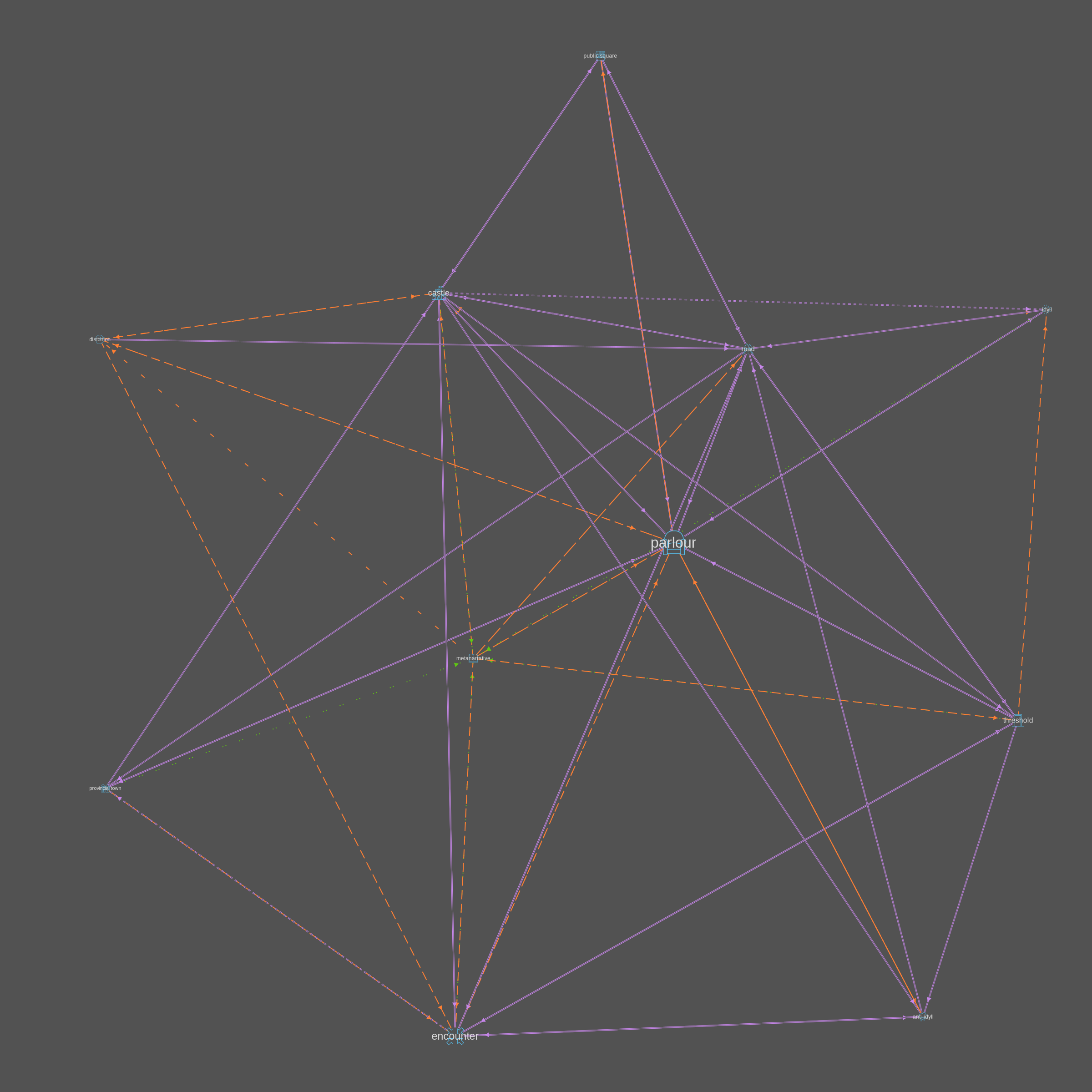
The deep chronotope map immediately registers that Oliver Twist is chronotopically varied, containing all but one of the possible chronotopes. This is consistent with Bakhtin’s claim that the novel is a more open form than others, depicting a new ‘spatial sphere’ of existence. As well as the spatiality of realism,Twist incorporates other previous forms: the novel of manners, the Newgate/Gothic novel, the picaresque. And, in fact, though the novel can be spatially understood as constructed along the city vs country divide – the plot moves between London and Chertsey – the prototypical town and country chronotopes (public square, provincial town vs idyll and wilderness) are infrequent, and wilderness doesn’t appear at all. So, the country of the novel is the lived-in country of the cottage and field rather than remote, uninhabited environments. Parlour and encounter speak for the dominance of dialogue, castle and threshold of subjectivity/focalisation. Chronotopes such as metanarrative and distortion indicate the other spatial levels or dimensions in the text. These chronotopes, corporeal, psychological, narratorial, are physically connected (purple lines) and jumped between (orange). Taken together, the metanarrative chronotope and the connecting orange edges, make the novel’s level of narrative control explicit.
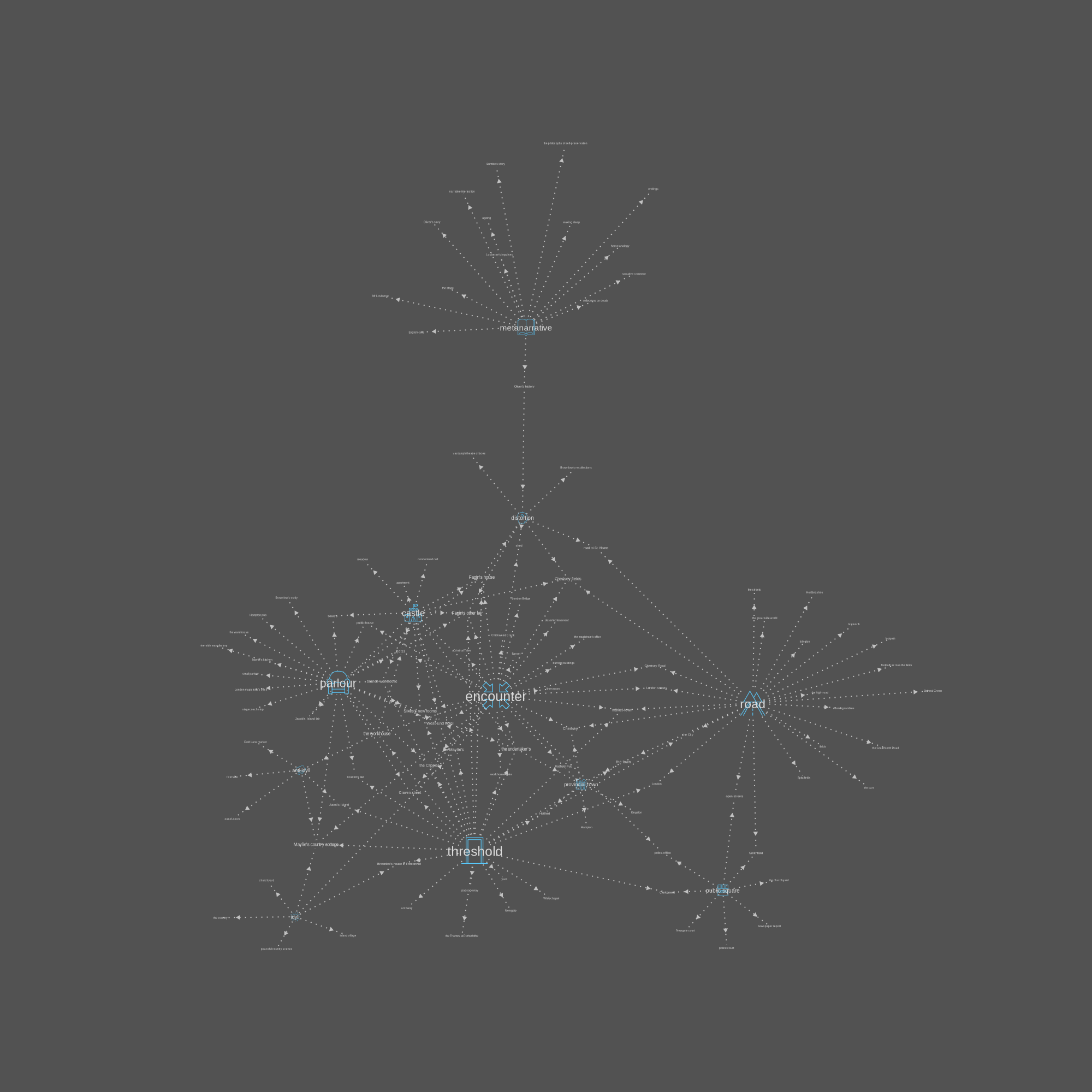
Chronotopes and Topoi
The chronotopic maps present textual places not just in terms of their spatial features, but also in terms of what happens in them. This immediately illuminates the difference between actual and literary places, where one is static the other is dynamic (‘lived’). This dynamism is shown here in the connection between chronotopes; Chertsey, for instance, is a ‘road’, ‘encounter’ and ‘provincial town’. Unusually, though, Twist’s chronotopes are completely connected, unlike others (see The Nether World, for instance) there are no ‘floating’ nodes. This may be a feature of the Bildungsroman: spaces shift in nature along with the developing protagonist. It may also be due to the panoramic quality of Dickens’ novel: the multitude of character subjectivities conceive place differently.