Chronotopic Cartographies
Peter Pan
‘To be born is to be wrecked on an island’ Barrie, Introduction to The Coral Island, 1913.
J M Barrie's Peter Pan texts are categorised in the chronotype ‘spaces of exile’ since they concern literary places of imagination and memory cut off from the ‘real’ world of home in both time and space in a way that means they cannot be returned to, or are left only existing in memory. The space of NeverLand is that of childhood play spatialised: fairy houses, mermaid lagoons, pirate ships, woodland dens. As with any mental map, or lost and half-remembered region, NeverLand is also a space characterised by absence or blankness: ‘unexplored patches’ and ‘black shadows’ (Peter and Wendy). To grow up is to leave such spaces and, as its name implies, to do so absolutely with no hope of return.
We have coded three of the Peter Pan texts in different forms (short stories; narrative; drama): Peter Pan in Kensington Gardens (1906), Peter and Wendy (1911) and Peter Pan, or the Boy Who Would Not Grow Up (performed 1904, published 1928) to register how spatiality, and even mappability, develops across the series. Where the maps of all three texts display the distinction between real and fictional places, as Peter’s world moves from Kensington Gardens to NeverLand, this distinction becomes more marked, the place itself more remote and threatening and therefore more charged with tension.
Kensington Gardens
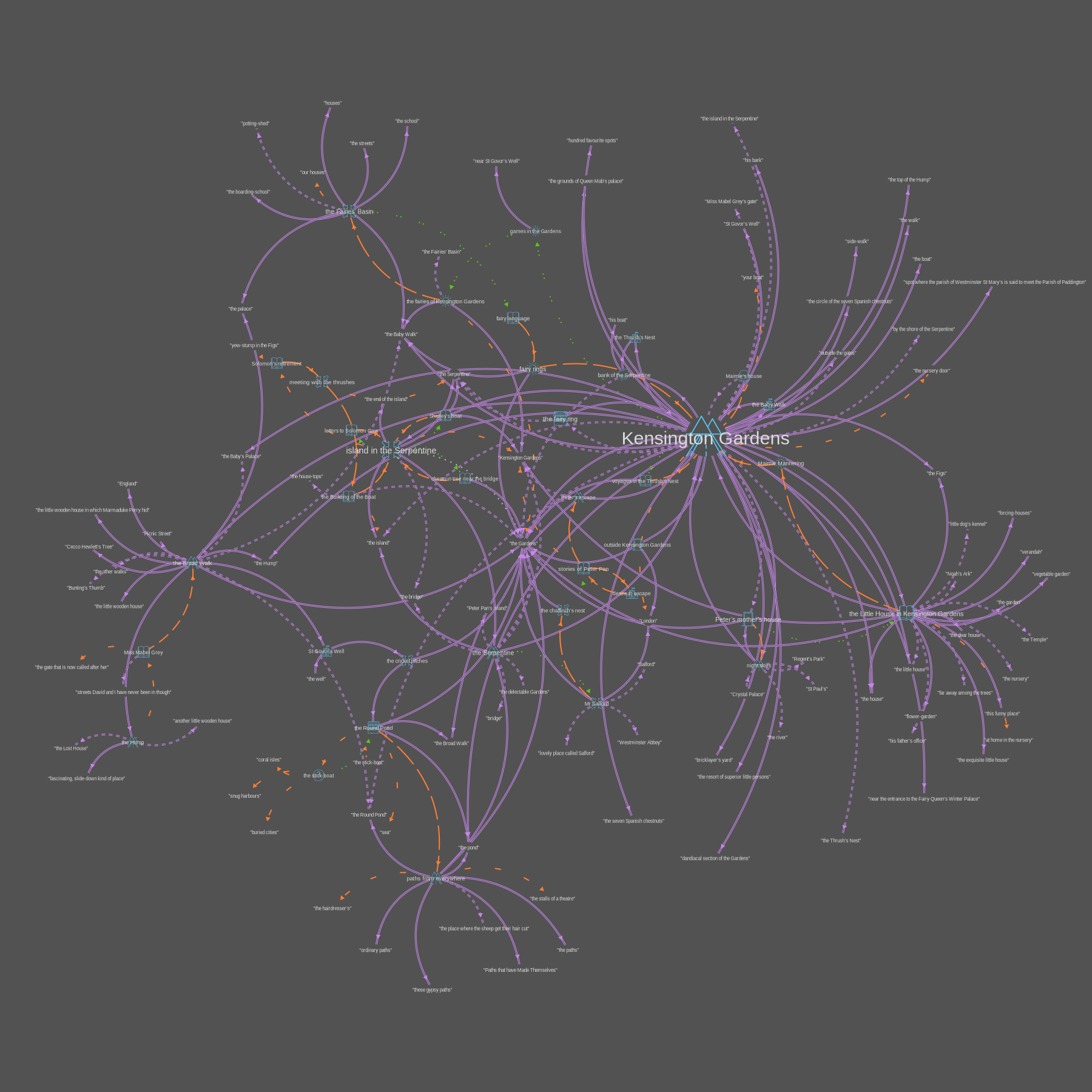
The complete map for Peter Pan in Kensington Gardens shows that, of all the Peter Pan texts, here specific identifiable places in the world and fictional spaces are the most interwoven. This can be seen in the toporefs which include: place names such as ‘the Broad Walk’ and ‘The Serpentine’ and imagined, subjective, place names such as ‘fascinating slide-down kind of place’ and ‘Paths that have Made Themselves’. This place-name division could also be seen to correspond to that between an adult’s and child’s sense of place. All the names are given equal standing since all are directly connected via solid purple lines.
Unsurprisingly, ‘Kensington Gardens’ is the largest node. It is the starting-point and container of the story and its nested settings: a place that also functions as a site for spatial stories. It is, after all, Peter Pan in Kensington Gardens, suggesting that it is a text as much about place as it is about character. This aspect of the Gardens is further confirmed by the toporefs that, linked via predominantly purple lines, are directly or indirectly connected to the topoi. Save for a few, the subplaces/toporefs are self-referential, referring inwards to aspects of Kensington Gardens rather than outwards: ‘the seven Spanish chestnuts’, ‘the flower garden’. Despite this introspective characteristic, some spaces do foreshadow those of the Pan texts to come. So, the frequent references to houses and, in particular, out of place houses that represent an uprooted and repossessed domestic, pre-empts NeverLand’s house underground and the infamous Wendy house
Peter Pan (1904 play)
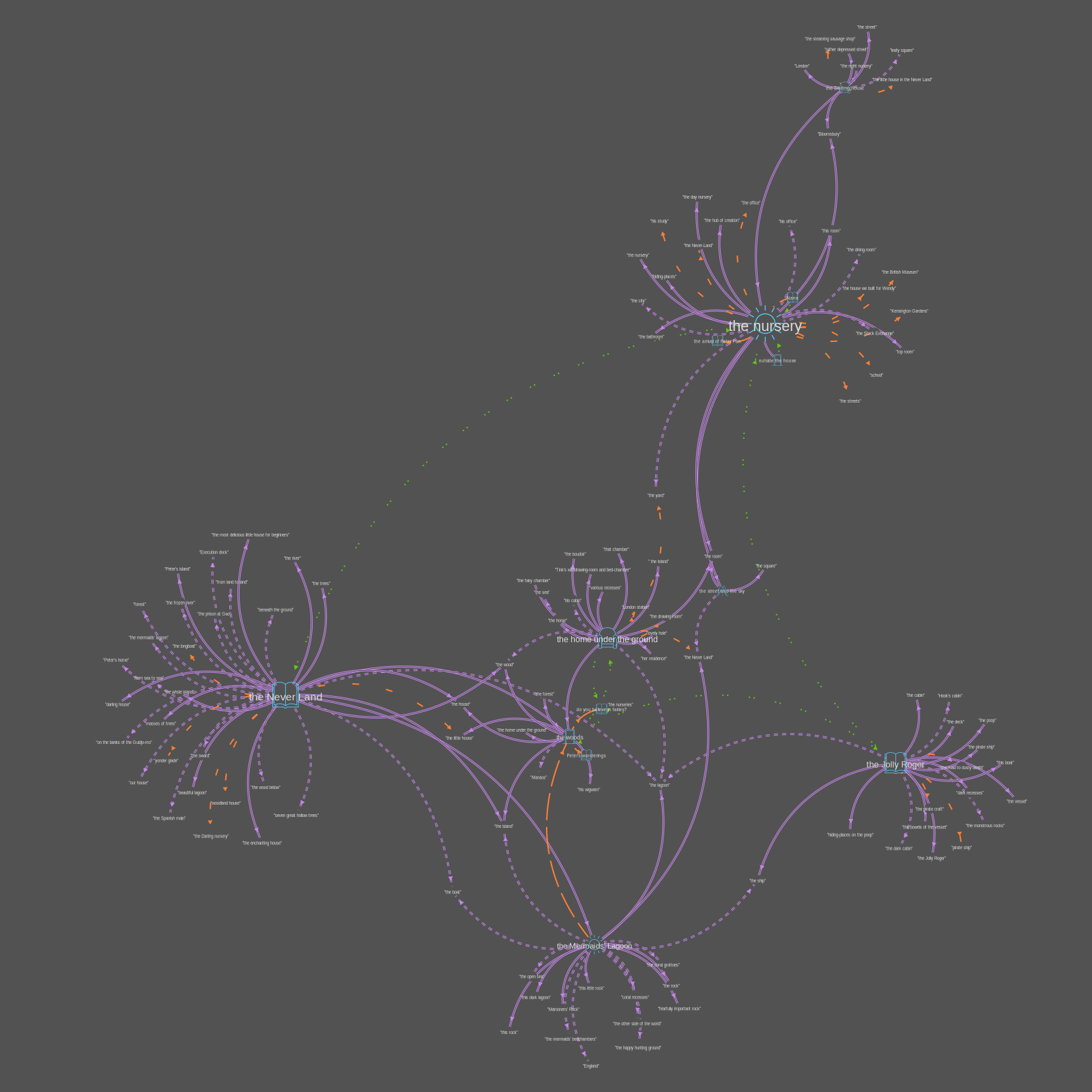
By contrast with Peter Pan in Kensington Gardens, in the complete map of the play, there is a much clearer distinction between the ostensibly real and ostensibly fantastic worlds. The real-world setting of ‘the Darling house’ and ‘the Nursery’ appears at top right, overlooking the lost or dreamed world that occupies the majority of the map. Here the discrete spaces of the NeverLand seem to position themselves naturally as sites around the island world. The distinction is caused by the limited connections between the two primary spaces (realist; imagined) – itself a symptom of the literary form and the discrete spaces of different Acts as required for a drama with stage scenery. Another consequence of the dramatic form is the limited amount of toporefs representing secondary place-naming out of a primary place. Such diegesis occurs in the stage directions alone, in contrast with the other two texts.
Peter and Wendy
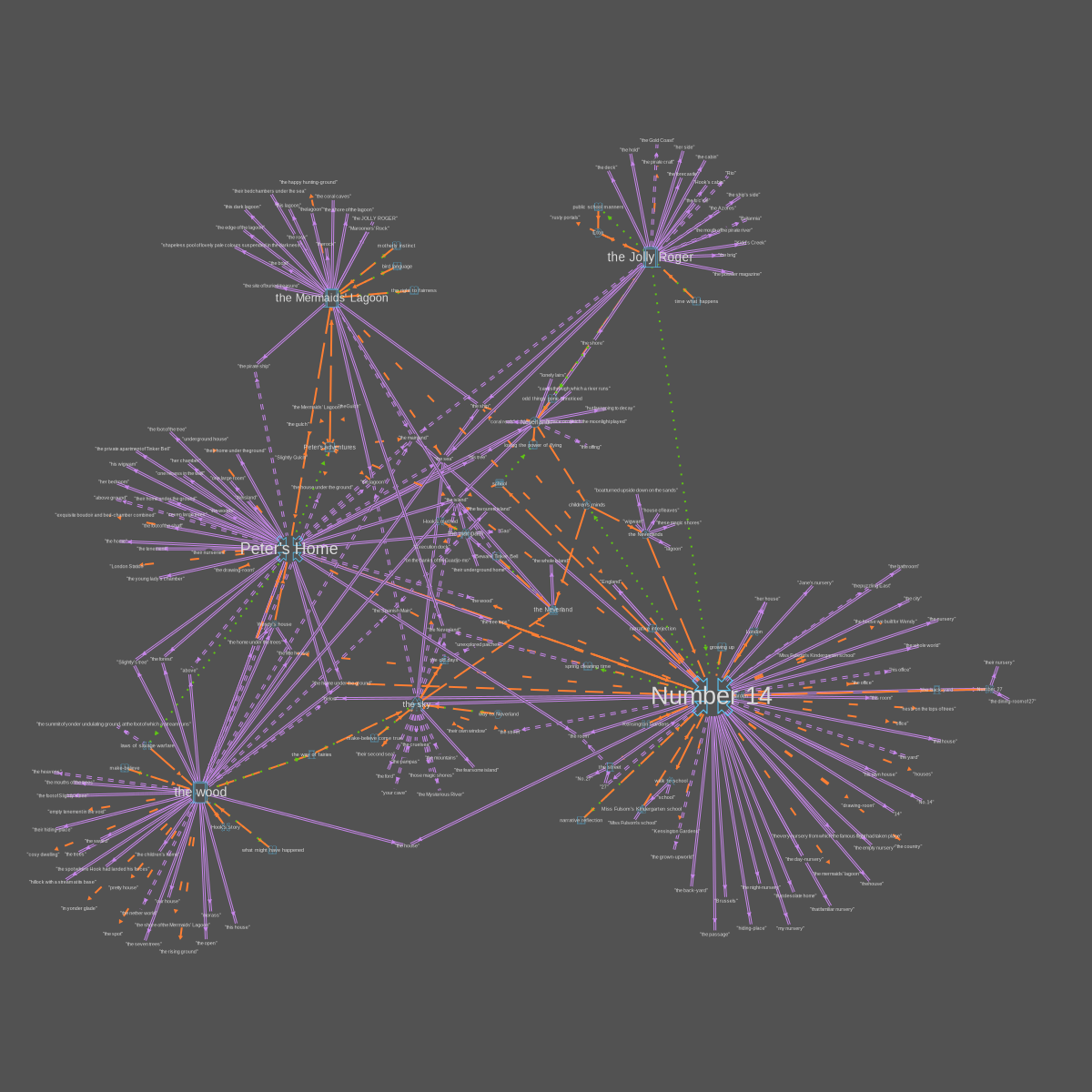
For Peter Pan and Wendy – the first full narrative version of the story – the separation between the domestic spaces of London and the Nursery and the far-away world of NeverLand is less distinct, due to the shared toporefs. Here there is far greater merging of spaces created by the narrator’s voice with a greater sense of slippage between – or in Peter’s case invasion into – the ‘real’ world. References to ‘the mermaid’s lagoon’, ‘the nests on top of the trees’, ‘the house we build for Wendy’, mean that the nursery at ‘Number 14’ in Peter and Wendy is much more of an interim space, between real and imagined, wakefulness and dream. But so too does the real encroach upon the lost: Peter’s home is full of echoes of the real or adult world: ‘the drawing-room’, ‘nurseries’, ‘London Station’. Opposing these pseudo-domestic resonances, the toporefs also reveal that the NeverLand of Peter and Wendy is the darkest of the three, full of unsettling places– ‘Mysterious river’, ‘shapeless pool of lovely pale colours suspended in the darkness’, ‘the cruel sea’ into which Michael almost falls, NeverLand itself a ‘fearsome island’. And, with the ‘Execution dock’ and ‘hut fast going to decay’, the possibility of not returning from it is a more constant and material threat. Finally, and perhaps most notably, NeverLand has morphed and multiplied: ‘the NeverLand’ is one of many possible NeverLands. It is, like its creator Peter Pan, multiple, unstable, and shifting.