Chronotopic Cartographies
The Pilgrim's Progress
The Pilgrim's Progress
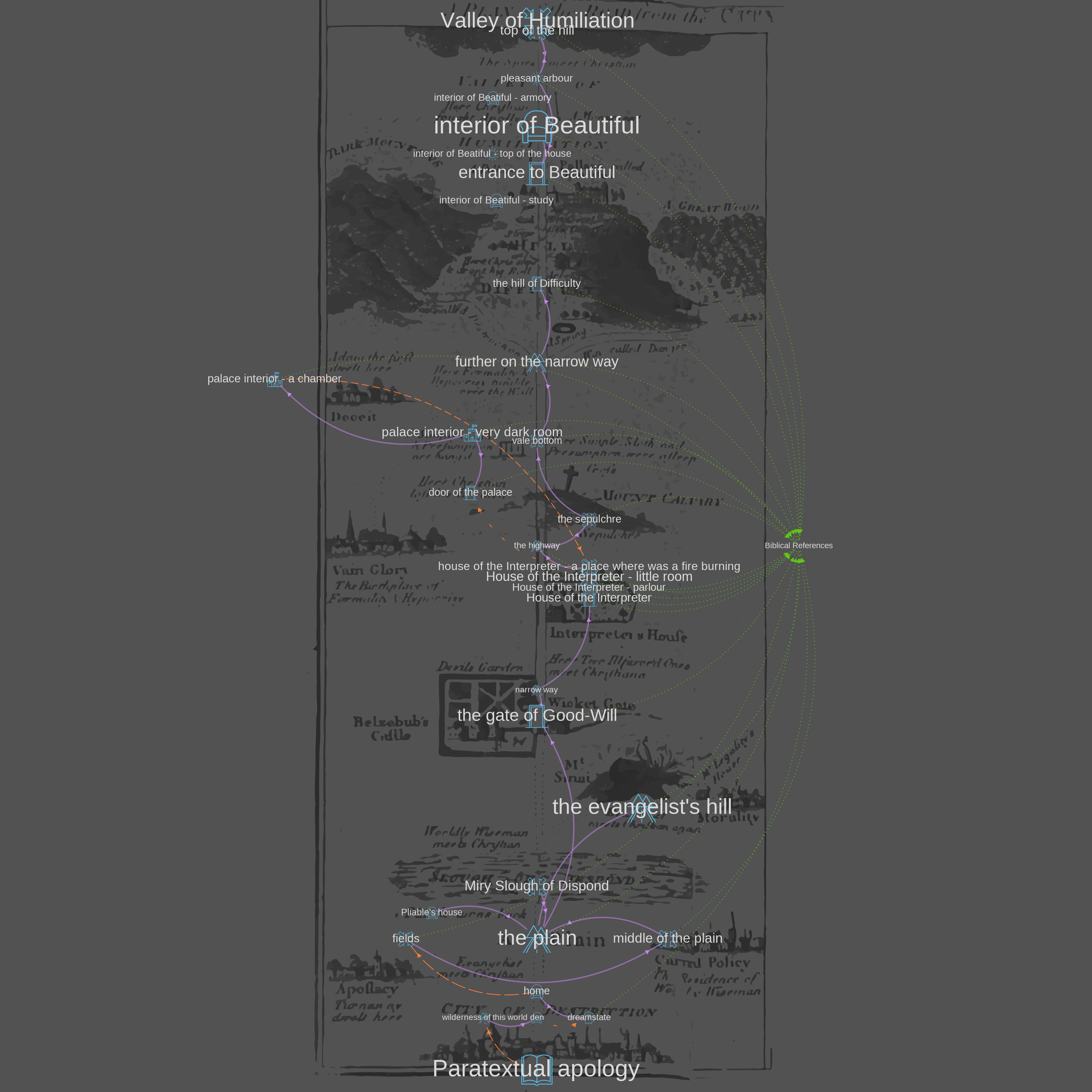
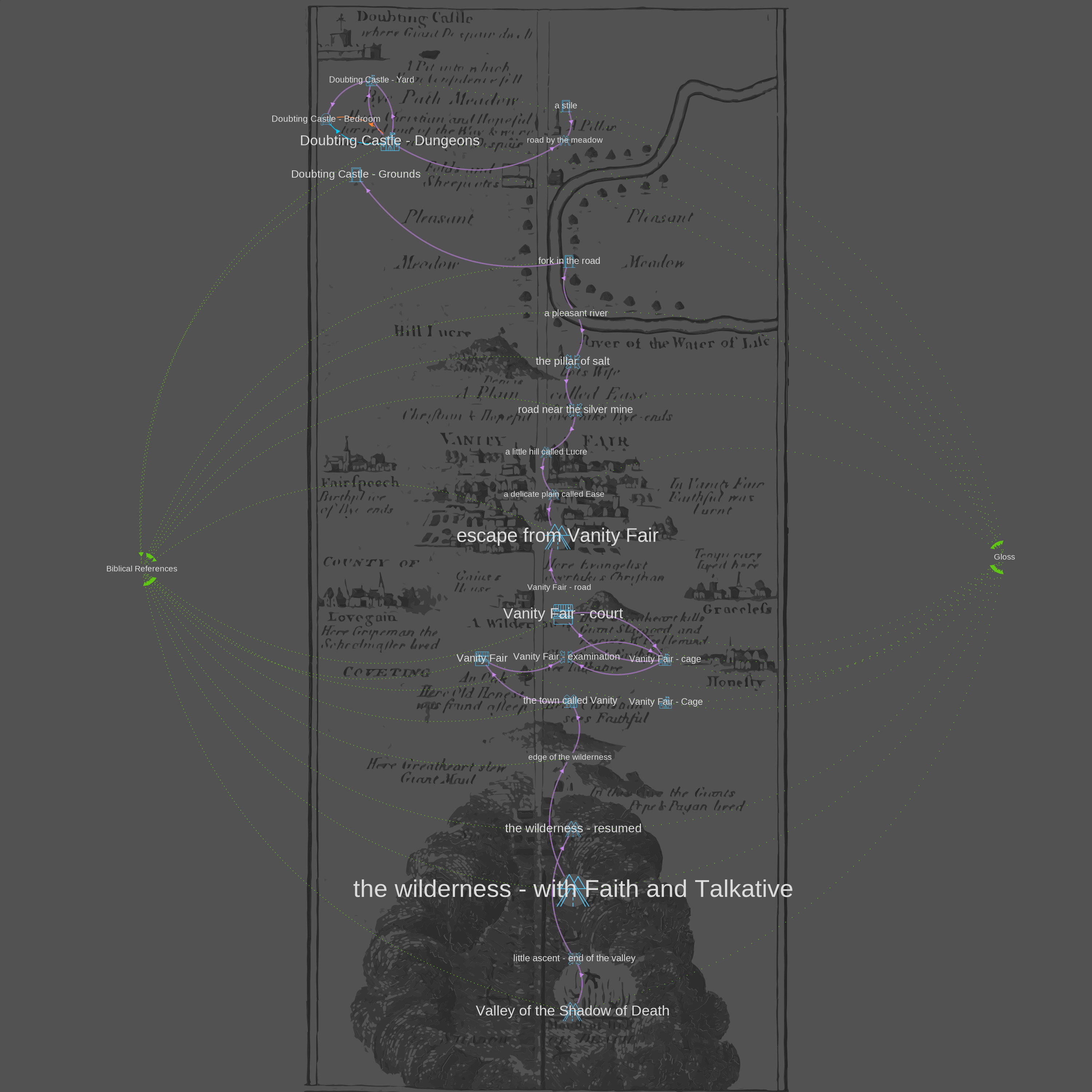
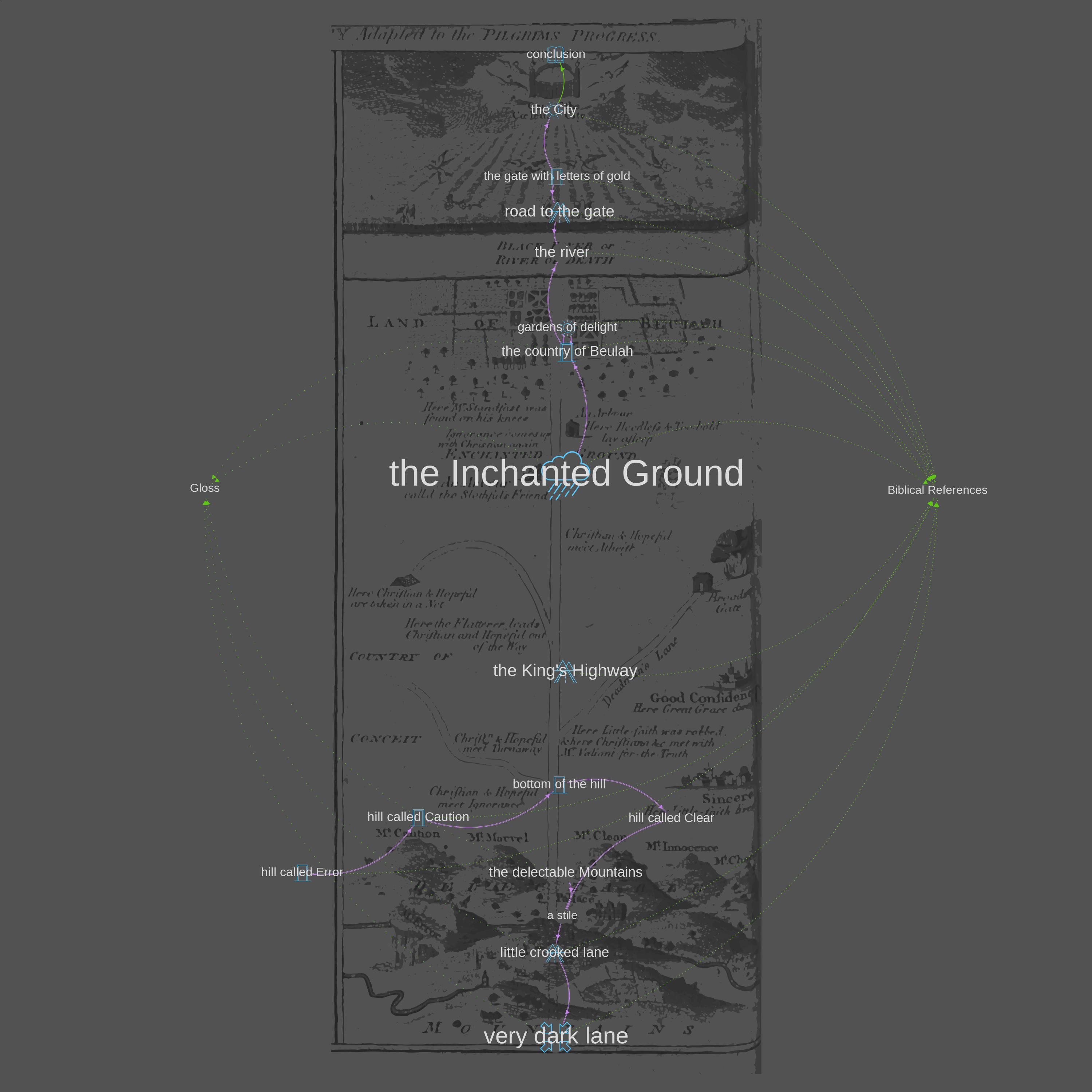
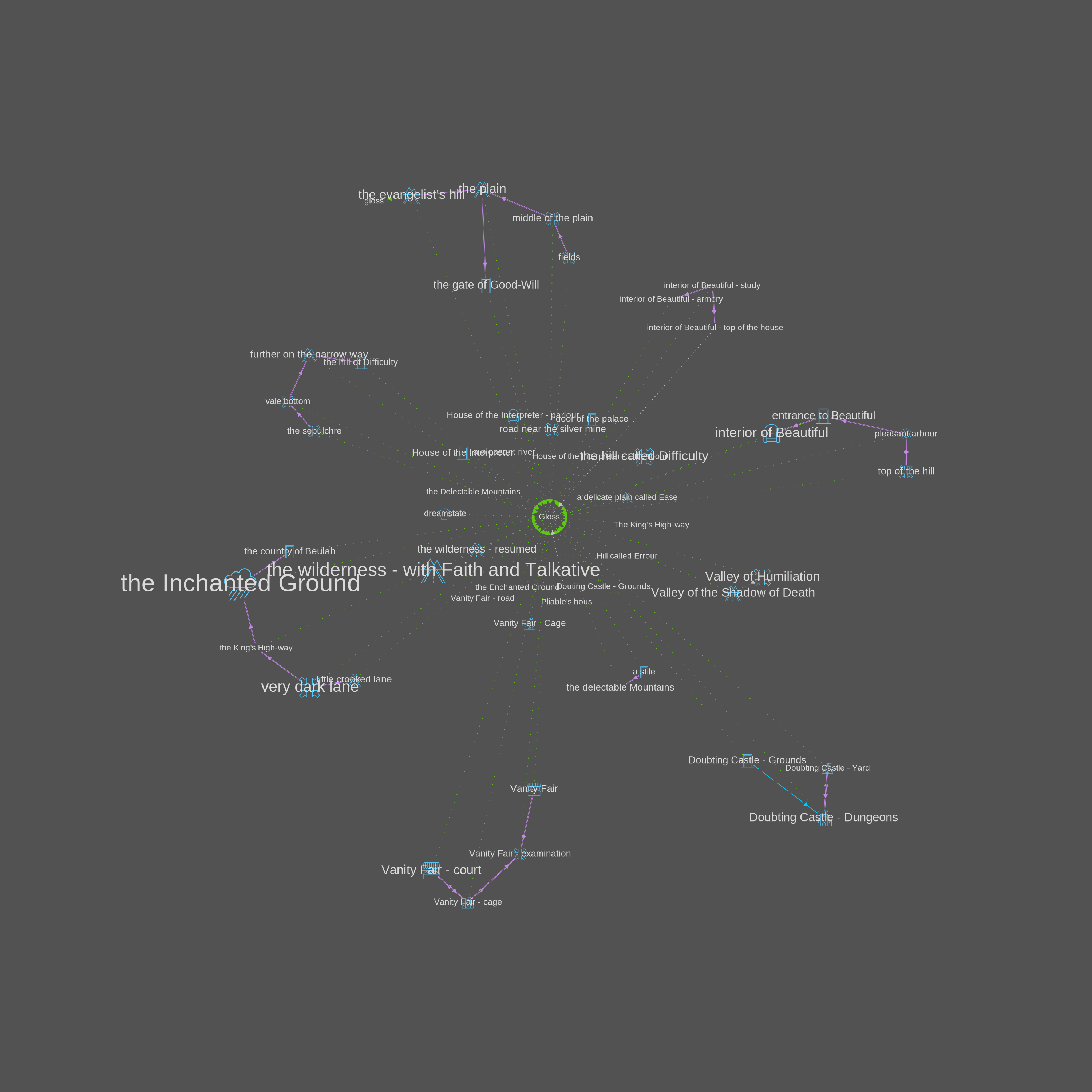
The major map for Pilgrim’s Progress immediately displays its complex paratextual nature as three texts in one. For the secondary maps of Pilgrim’s Progress the gloss is visualised as a separate map and the base text is mapped over the referential layer of an eighteenth-century strip map and a spiral map version from 1850. This illustrates the way in which our chronotopic maps can be referential to the real if needed, but also to other earlier forms of literary visualisation.
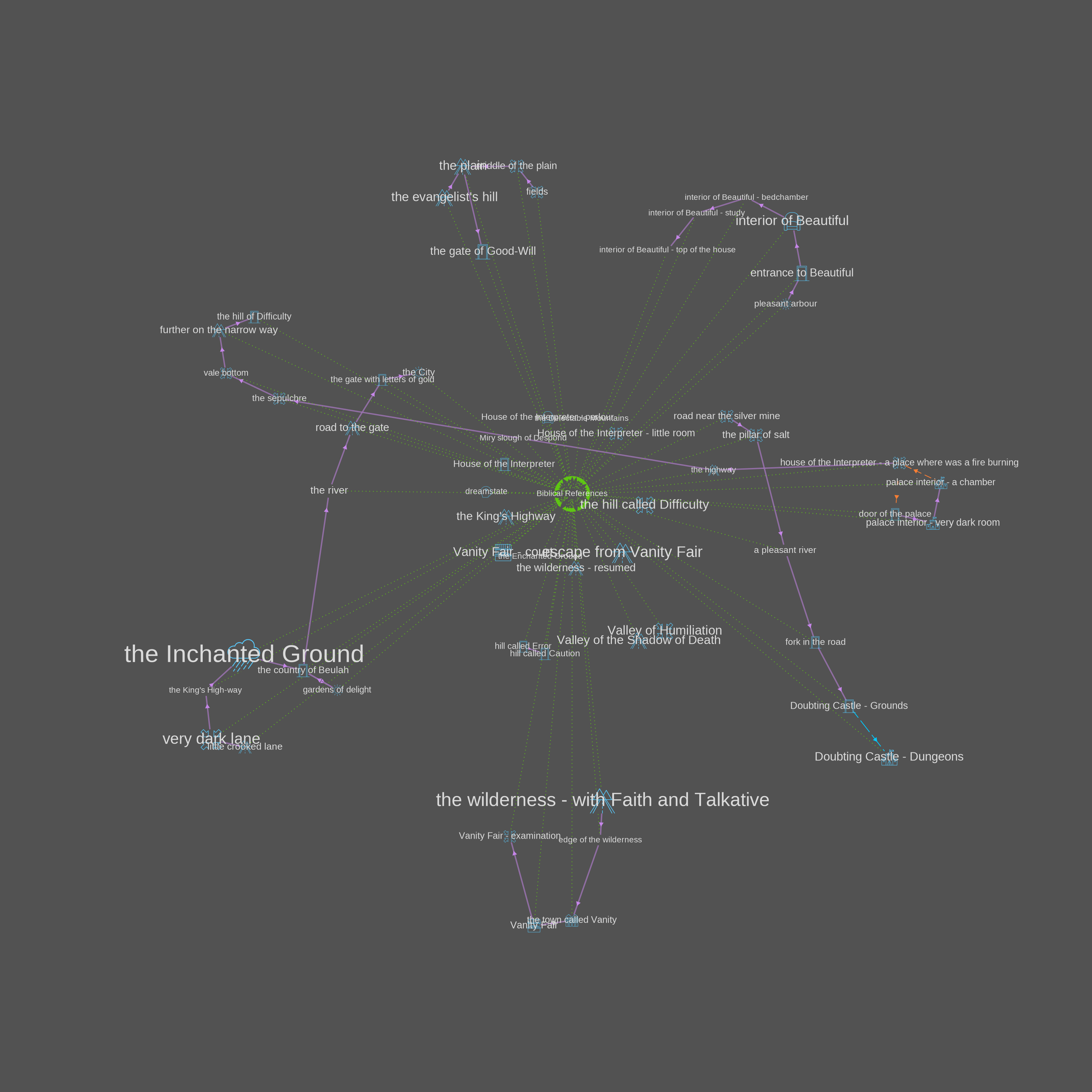
Topoi Map
The topoi map for Pilgrim’s Progress immediately displays its complex paratextual nature as three texts in one. Bottom left and top right diagonally (as the information is presented here), there are two glosses in green: one containing Biblical references the other a gloss on the key events and encounters of the main text (providing a kind of mini-map of its own). Top left and bottom right are the paratexts of the initial 'Apology' and 'Conclusion'. The glosses often work to connect and consolidate aspects of the 'actual' spatial route of the pilgrims across the allegorical landscape. They link the itinerary narrative to the authority of the Bible and to a secondary summary of key events.

Biblical References
The Biblical gloss references directly to key lines and concepts from the Bible. This is sometimes done explicitly by characters in the text but more often involves the transposition or cross-referencing of a concept. The gloss grounds the more fanciful, almost comic, nature of events or characters in the base narrative, reminding the reader of the serious eternal consequences of wrong actions.
The Gloss
The marginal gloss of Pilgrim’s Progress was added and extended in the second and third editions and stands apart from the other paratext of direct reference to Biblical passages. It largely functions as a summary of key events and interactions in the base text, reinforcing or drawing out its message in plain language. E.g. When Talkative departs from Faithful and Christian the gloss states simply: 'A good riddance!' It is strongly moral in nature and straightforward, confirming the reader’s judgment of characters and their actions. At the same time, its very existence complicates and interrupts the reading of that base text and involves the reader in another form of encounter. (Who is writing the gloss? What is its purpose?)
Strip Map (1788)
The map used as a referential layer here appears to be the earliest map of Pilgrim’s Progress (presumably made to celebrate its publication one hundred years earlier in 1668). It takes the form of a strip map – a new popular way of representing routes in the late eighteenth century that proves highly appropriate for what is essentially a road-narrative. The map is read from bottom to top and left to right across three columns. These divide the route into three sections: from the 'City of Destruction' to the 'Valley of Humiliation'; from the 'Valley of the Shadow of Death' to 'Doubting Castle'; from the 'Delectable Mountains' to the gates of the 'Celestial City'. A colour version of this map was also made in 1780 and reproduced multiple times.