Chronotopic Cartographies
Return of the Native
The Return of the Native (1878), Hardy’s sixth novel, is set in the 'south-western quarter' of Wessex. It was one of the texts Hardy categorised as a 'Wessex Novel' in the revised editions of 1912. Wessex, according to Hardy, is a 'partly real, partly dream' country ('Preface', Far From the Madding Crowd, London: Macmillan, 1912, p. viii), and it is because of this amalgamation of imagined and the real-world geographies that it has been chosen as the focus for spatial type 3. Wessex represents, then, a fictional region nested in an ostensibly more real territory corresponding to actual place-names in the South West of England. In the novel, the clash between the old and modernity, between tradition and fashion, is played out in this tension between reverie and reality, and figured spatially through that age-old dichotomy between the country (Egdon Heath) and the city (Paris or Budmouth). Return of the Native is also a 'Novel of Character and Environment' with a highly condensed time and space. As the topoi map demonstrates, all the action is confined to Egdon, and we must look to the complete map to gain a sense of Egdon’s place within the wider world. What’s true of space is also true of time. Though the novel’s plot covers a year and a day, the prehistoric depth of the Heath gives a sense of an imagined moment in the vastness of real, geological time.
Complete Map
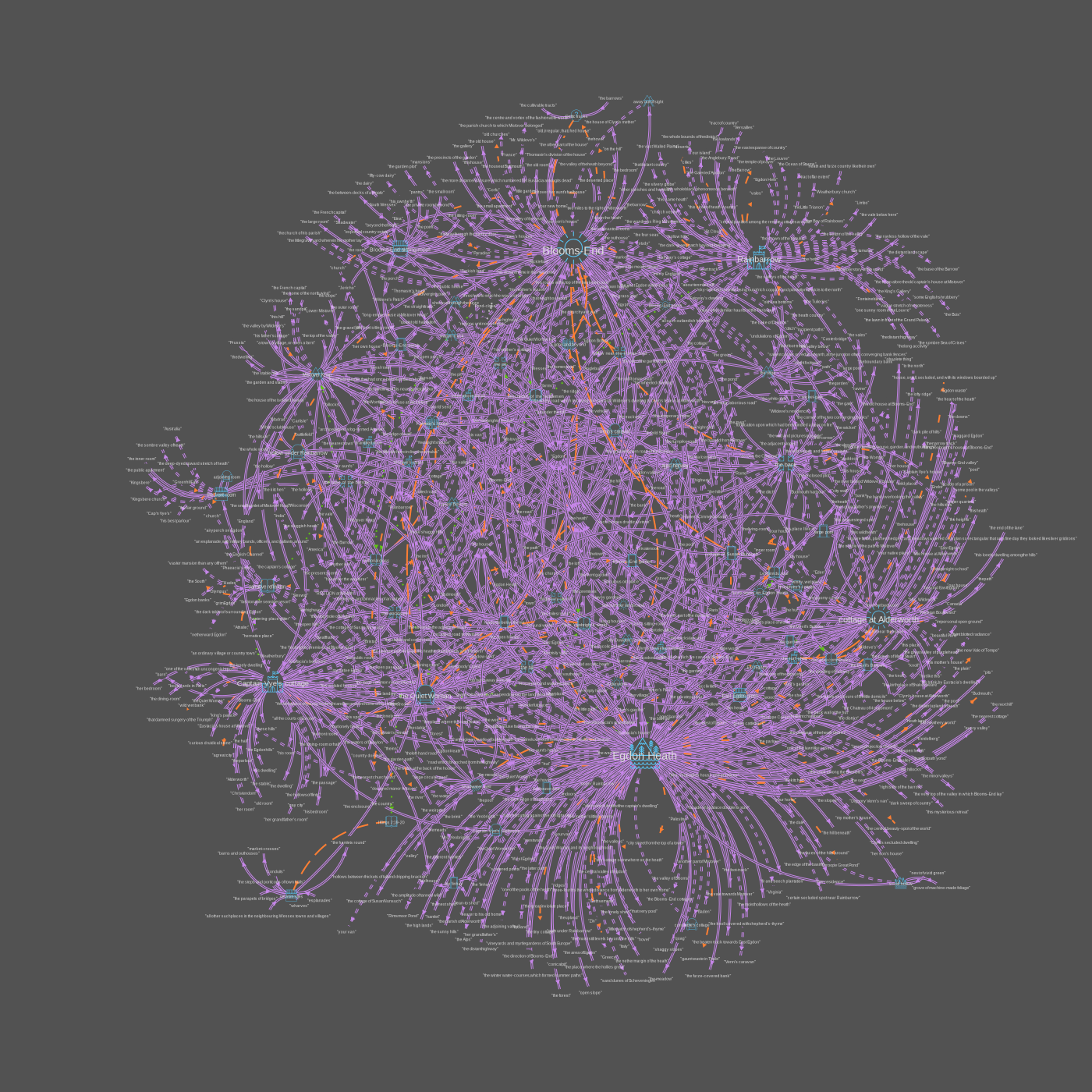
The 'ball of yarn' of the complete map exemplifies the limits of the model in relation to a three volume realist text. The density of the work makes the map almost unreadable. Aside from the Heath itself, the dominant nodes – Blooms-End, Captain Vye’s cottage, the Rainbarrow, the Quiet Woman – spatially encapsulate the novel’s key characters and their interactions: Clym Yeobright, Eustacia Vye, Thomasin Yeobright and Damon Wildeve. Since the novel’s action is completely contained in Egdon and its surroundings, we rely on the toporefs (detailed references to place) to give the external context, or wider sense, of the world in which Egdon is nested. Where direct toporefs are topographical and describe known places ('shaggy slope', 'her grandfather’s'), other, indirect or distant toporefs often reinforce a sense of the other ('Louvre', 'Versailles', the 'little Trianon'). 'Paris' is the Paris of the visitor and not the inhabitant. This immediate spatial insularity is shown in that all such places outside the Heath are connected indirectly (dotted rather than full purple lines) or via jumps (orange). Further analysis of the directly connected toporefs reveal the Egdon scenery dotted with stains, spots and patches. The heath itself both is 'a lonely spot' and contains, for instance, 'furze spots' and Wildeve’s Patch. This contrast between the expansive and the particular correlates with the novel’s episodic structure – a symptom of its serialised form. This is also detectable in the distinct topoi nodes: the Egdon region is partitioned out into smaller patches or topoi nested within it. This can be given more clarity in the topoi map.
Topoi Map
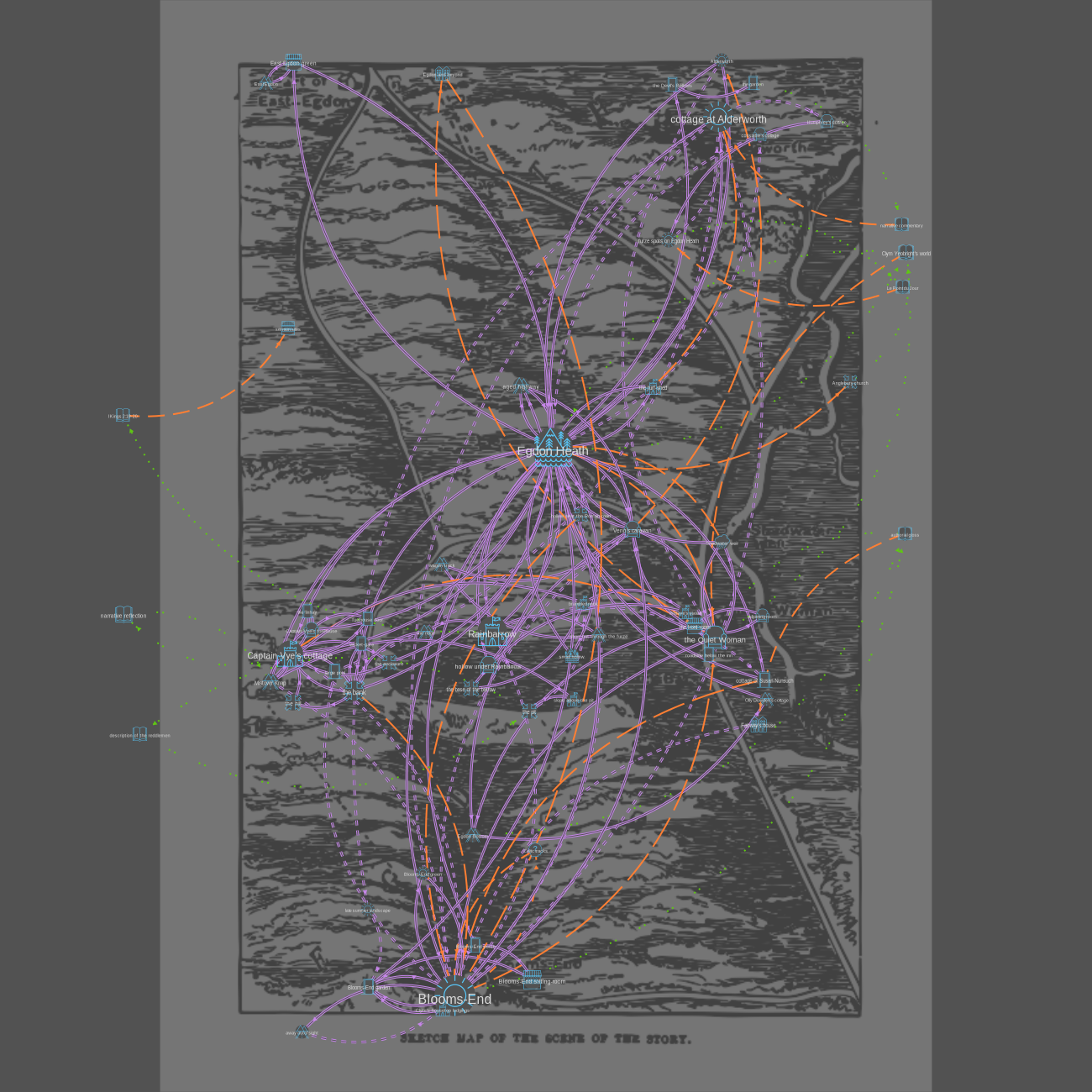
The topoi has been laid over a referential layer taken from the first edition of The Return of the Native. As an authorial sketch map, it is not accurate but approximate, symbolising novelistic rather than real world places. The map makes clear that the novel’s action is contained in Egdon or, at the very least, the locality of Egdon. The 'outside' of the novel is expressed through its absence. Through the map, Egdon becomes a synecdoche for region and underlines the sense of Egdon as a self-contained nested world. According to Hardy, 'Under the general name of "Egdon Heath," […] are united or typified heaths of various real names, to the number of at least a dozen; these being virtually one in character and aspect' ('Preface', 1895). While the map symbolises and consolidates the unity of place Hardy imagines and builds into Egdon, it also displays official roads or ways cutting through the expanse of heathland between the houses on the edges.
Mapping the topoi onto the authorial map gives a sense of the relative positions of, and connections between, the various sites on Egdon Heath where the plot unfolds. Clym and Eustacia’s home at Alderworth and Blooms-End, for instance, are at opposite ends of the map. Wildeve and Eustacia also face each other. The topoi also demonstrate not only that the novel is very topographical, but also that we take Egdon on its own terms: it relates only to itself. The geography is local – a contraction of place symbolised, of course, in Clym’s return and ensuing blindness.
Syuzhet Map
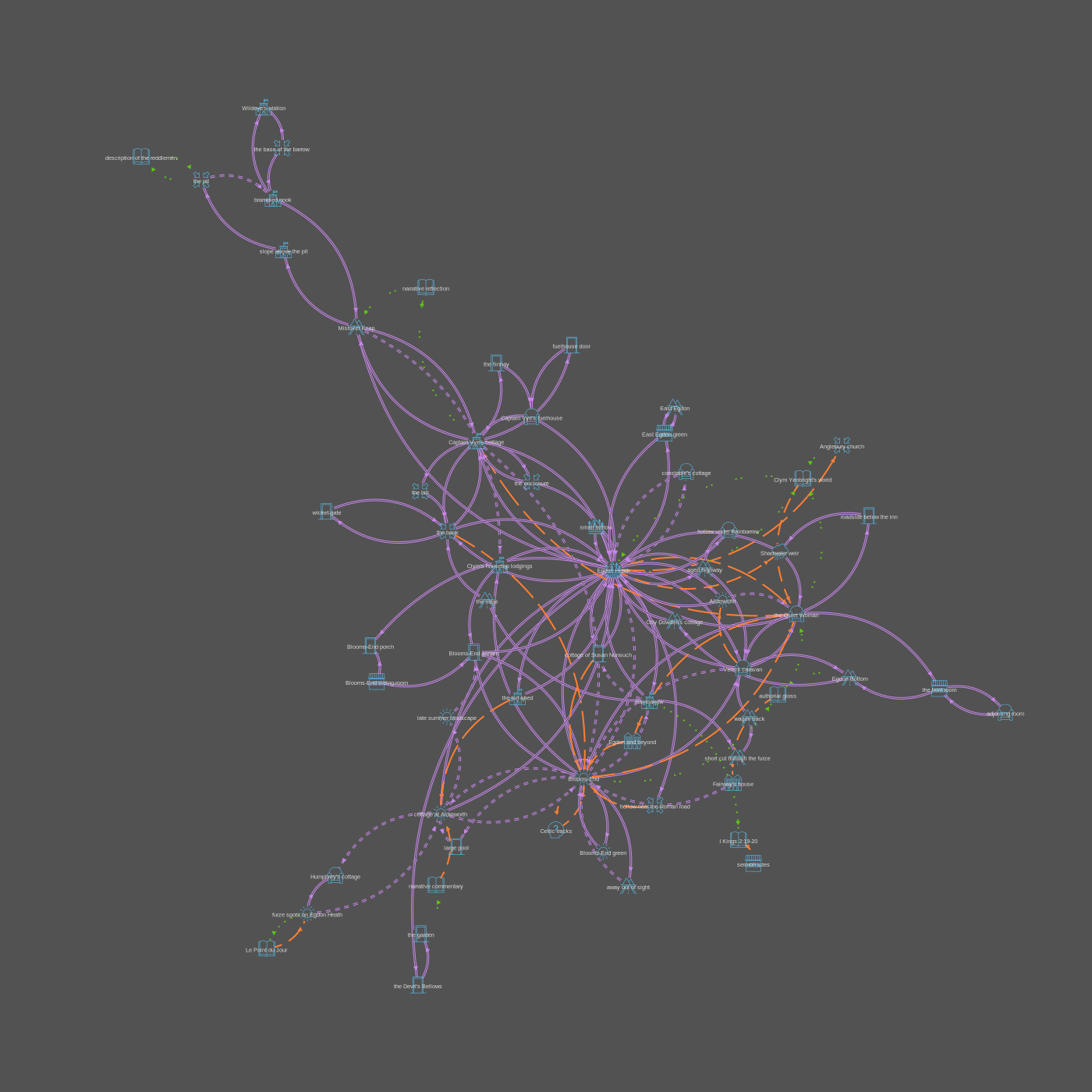
In terms of the telling of the tale, the novel starts by introducing the environment and its characters: Egdon Heath and the highway cutting through it. The now almost clichéd suggestion that Egdon is a character in its own right is nonetheless reinforced by its position at the centre of the syuhzet map (and therefore the action of the plot); every other key node is connected to the Heath. Where the nodes represent centres of action, the edges (or lines) represent movement (physical or narratorial) between them. The Heath’s centripetal force is such that, although The Return of the Native is, unsurprisingly, a narrative of return, such returns are confined to that native region of Egdon. The resulting loops visualise restless to-and-fro, or out and back, movements driven by characters’ changing motives and desires. The massing of direct edges (shown here in the solid purple lines) is a symptom both of the multi-plot narrative typical of the realist novel, and the condensed temporal range within which this plot unfolds.
Deep Chronotopes
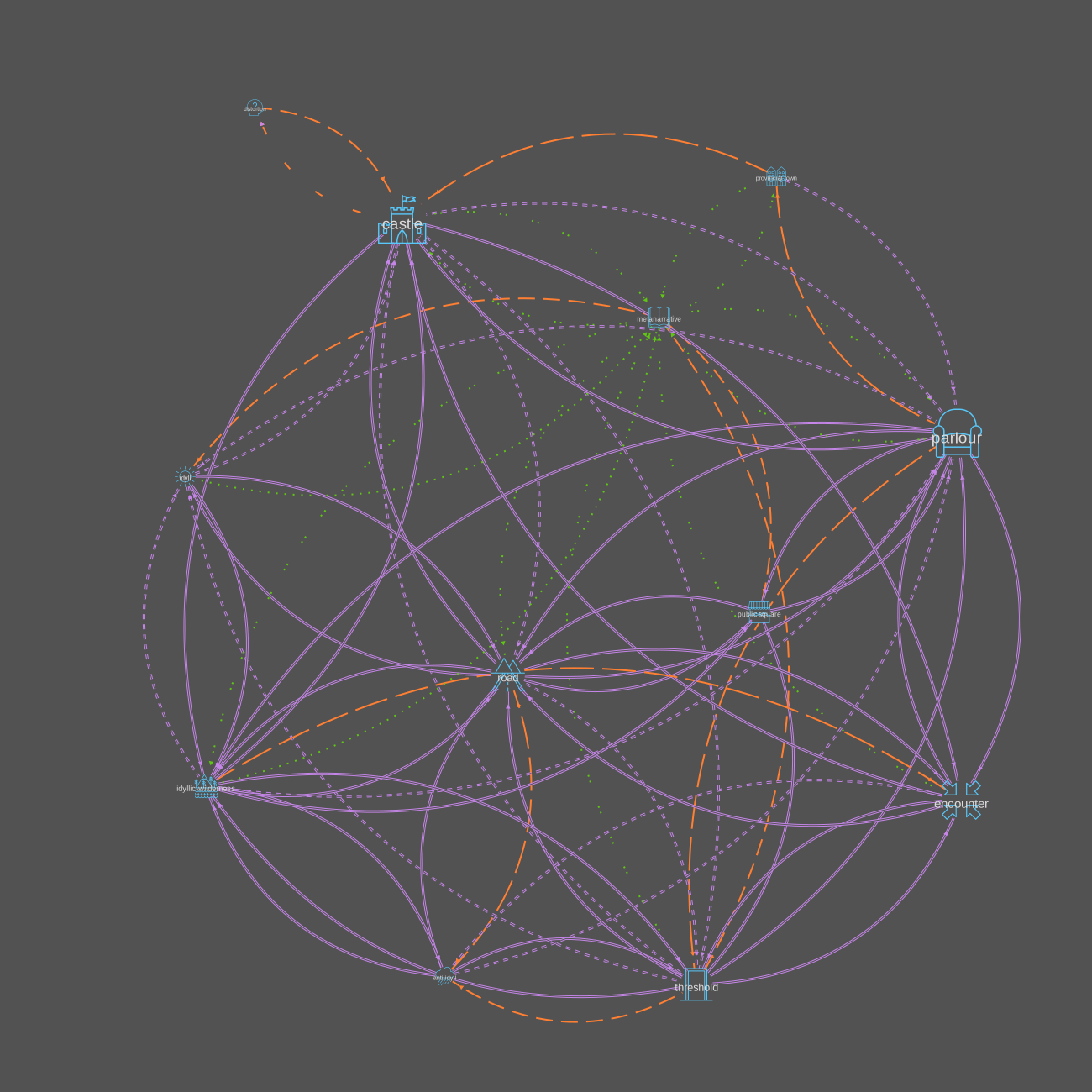
Unusually, the deep chronotope map for The Return of the Native contains all of the 12 available chronotopes – particular remarkable, perhaps, when considering its spatio-temporal constraints. This chronotopic complexity is typical of the long and narratorially diverse realist novel since it incorporates the chronotopes of the plots, subplots and narrative. For Return in particular it emphasises how differently the same, confined setting is perceived and experienced by the different characters. The places associated with Eustacia, for instance, compound into the 'castle' chronotope, those of Clym, the 'idyll'. The 'metanarrative' node is numerously connected via 'metatextual' edges (green dotted lines) which visualise the novel’s dominant narrator. Rather than existing as an absent voice, the narrator acts as a presence, a vantage point from which the Heath and its characters are portrayed. Similarly connected, but this time – as witnessed in the larger node size – textually dominant, are the 'road', 'threshold' and 'encounter'. Return is a text on the move, of meetings along the way, of arrivals and departures. Many of the novel’s most powerful or significant scenes occur in in-between spaces (Venn and Wildeve’s dice game on the Heath; Mrs Yeobright ignored outside Clym’s cottage; her death on the Heath). The human or character-based chronotopes are matched with a final key chronotope, that of the 'wilderness', a time-space resistant to human influence. As the text makes clear, the Heath is timeless: 'on Egdon there was no absolute hour of the day' (p. 420). Time, like the deep chronotopic map, is cyclical.