Chronotopic Cartographies
Robinson Crusoe
Robinson Crusoe is the first desert island narrative, presenting a classic myth of man’s ingenuity in isolation. Popular from the moment of its publication, with four editions in 1719 alone, it went on to spawn numerous imitations in the form of the 19th and 20th century Robinsonade. Whilst originally celebrated by Rousseau on the grounds of Crusoe's self-sufficiency, it has been increasingly subject to more negative imperialist readings as, over time, Crusoe sets about possessing, taming and colonising the island and its indigenous visitors. Such readings directly connect with the text’s spatiality: the relationships between centre and margins, interior and exterior, society and isolation that it encodes.
Topoi
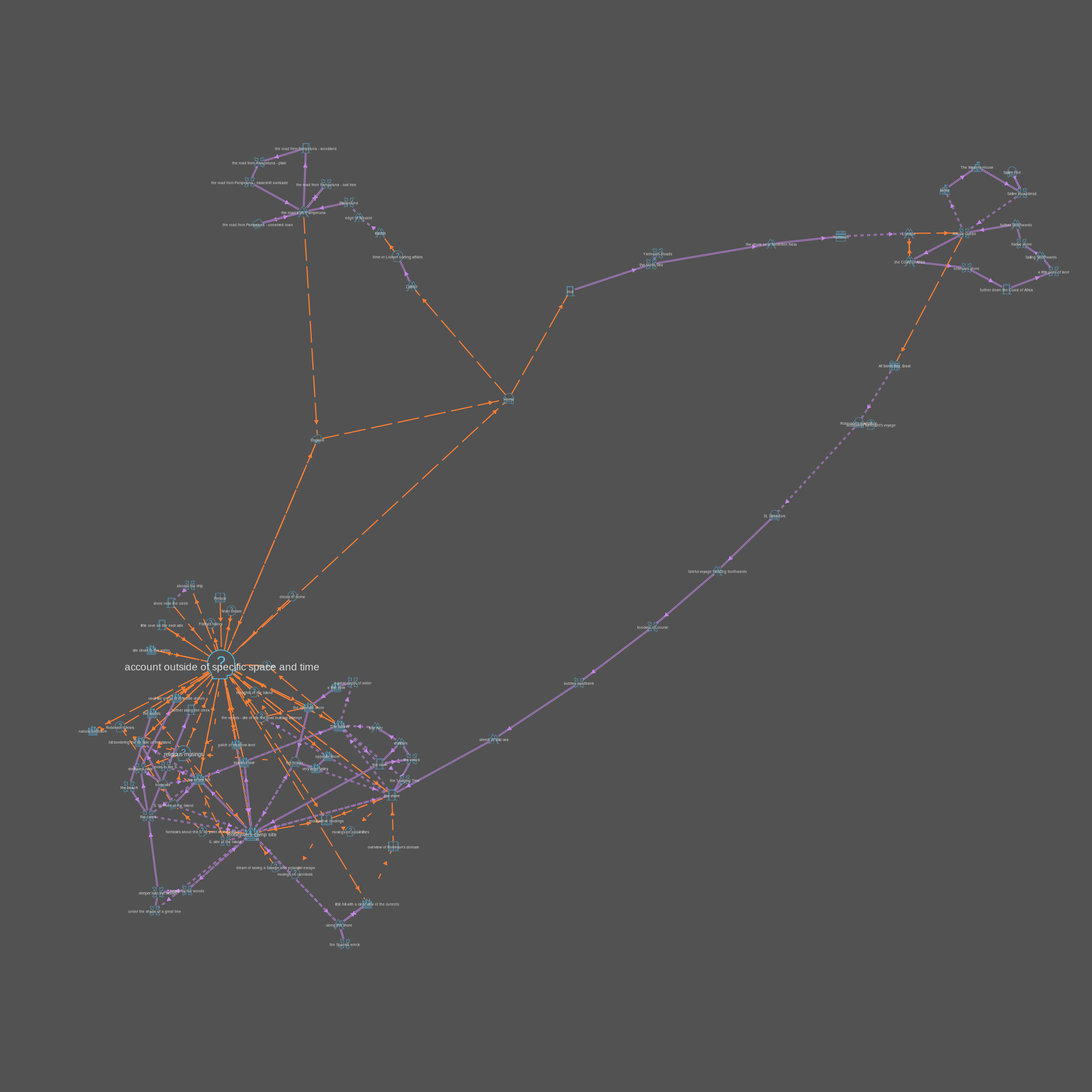
Robinson Crusoe is a challenging text to map because of Crusoe’s adventures prior to arrival on the island as well as on the island itself which means that spatial experience functions at two main scales. The double hemisphere World Map that was made for the 4th edition of Robinson Crusoe (by famous map-maker Herman Moll) was given to show Crusoe’s travels around the known world at that time. This global scale is reflected on the topoi map here by the purple lines extending leftwards with their own independent loops along the coast of Africa; the North Sea round Lisbon and to Brazil. In contrast, on the right of the map, the cluster of places in orange, with purple lines extending from and feeding into it, is centred on the island space but makes explicit how much of that experience is interior as much as exterior. Thus the physical space acts directly on mental space. The long orange feelers that reach across the page leftwards, almost inevitably, extend towards “home”.
Syuzhet
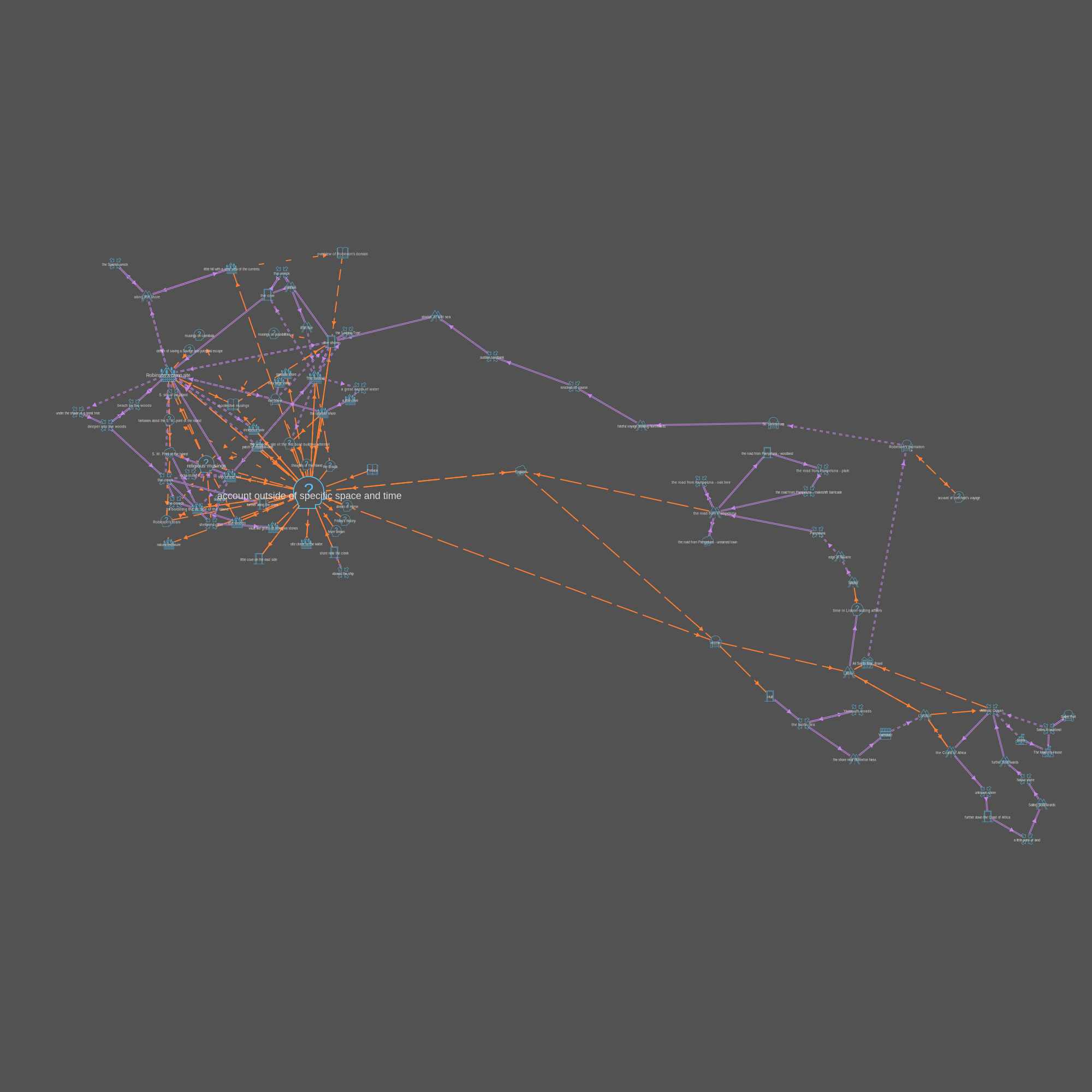
The narrative is structured around three distinct timelines (pre-, during, and post island castaway) and these correspond to the hero’s moral and spiritual state and his conversion to Christianity during the experience. The extensive nature of Crusoe’s travels is made readily apparent through the visualisation. Each of his individual 'travels' at various points form their own self-contained loops that can be seen at the extremes of the topological form (in purple). The node 'account outside of specific time and space' (in orange) creates a strong hub that exists alongside and in counterpoint to Crusoe’s actual experiences on the island and his gradual exploration and enlargement of spatial knowledge. This double core – of real and recalled/remembered/ dreamed place reflects again the division of the narrative in relation to character (who Crusoe was before the island and who he becomes as a result of this experience).
Deep Chronotopes Map
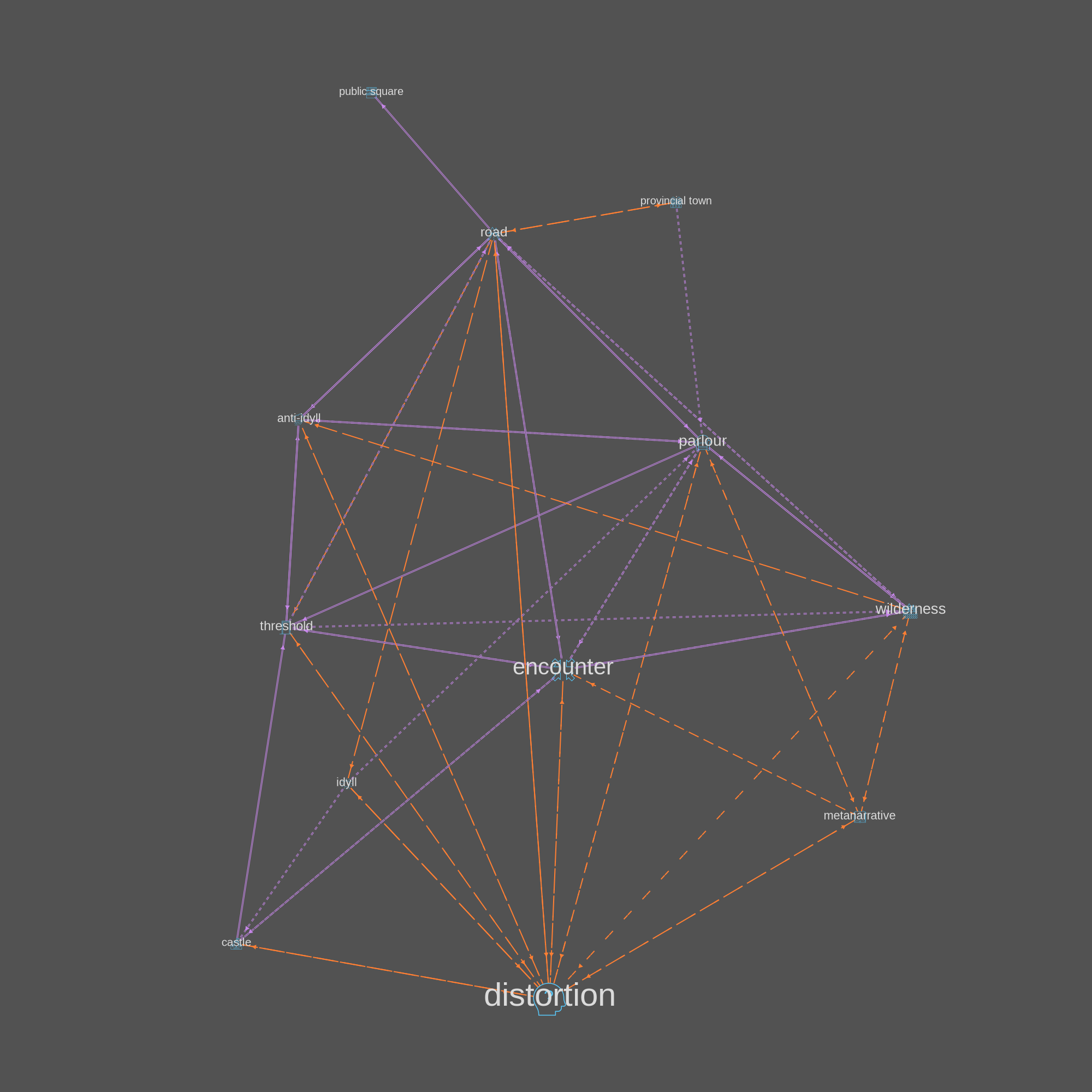
Robinson Crusoe provides a superb example of a double-pentagram in its deep chronotopic map which exists in both actual and imagined/ internal space. The foundational chronotopes – 'encounter' and 'distortion' – reflect this. The dominance of 'distortion' is created by the ways in which Crusoe adapts to his predicament, as he muses on possibilities, fears, and religion in equal measure – escaping from his external condition into internal thought. The 'wilderness' chronotope is surprisingly not as prevalent as the 'parlour'. Although alone in a potentially hostile environment, Crusoe centres his energies on creating a secure and extremely well-defended 'home', and gradually enlarging from this to colonise the island.