Chronotopic Cartographies
The Shepherd's Calendar
This collection of John Clare's poems is centred on a tightly-focused area and perspective over the course of a year, providing an interesting study into chronotropic variation as directed through the representation of the temporally cyclical nature of the seasons. Each of the twelve poems offers discrete narratives, but together they create a nostalgic account of a past time deeply missed. Thoughts frequently stray to metaphysical considerations, showing a shift from the spatial towards the temporal as the collection progresses that perhaps echoes broader mortal concerns as one ages – hence the inclusion in this spatial type. Each of the three visualisations generates a different central frame that guides the reading of the spatial build, aptly demonstrating the flexibility and utility of the topological model.
Complete Map
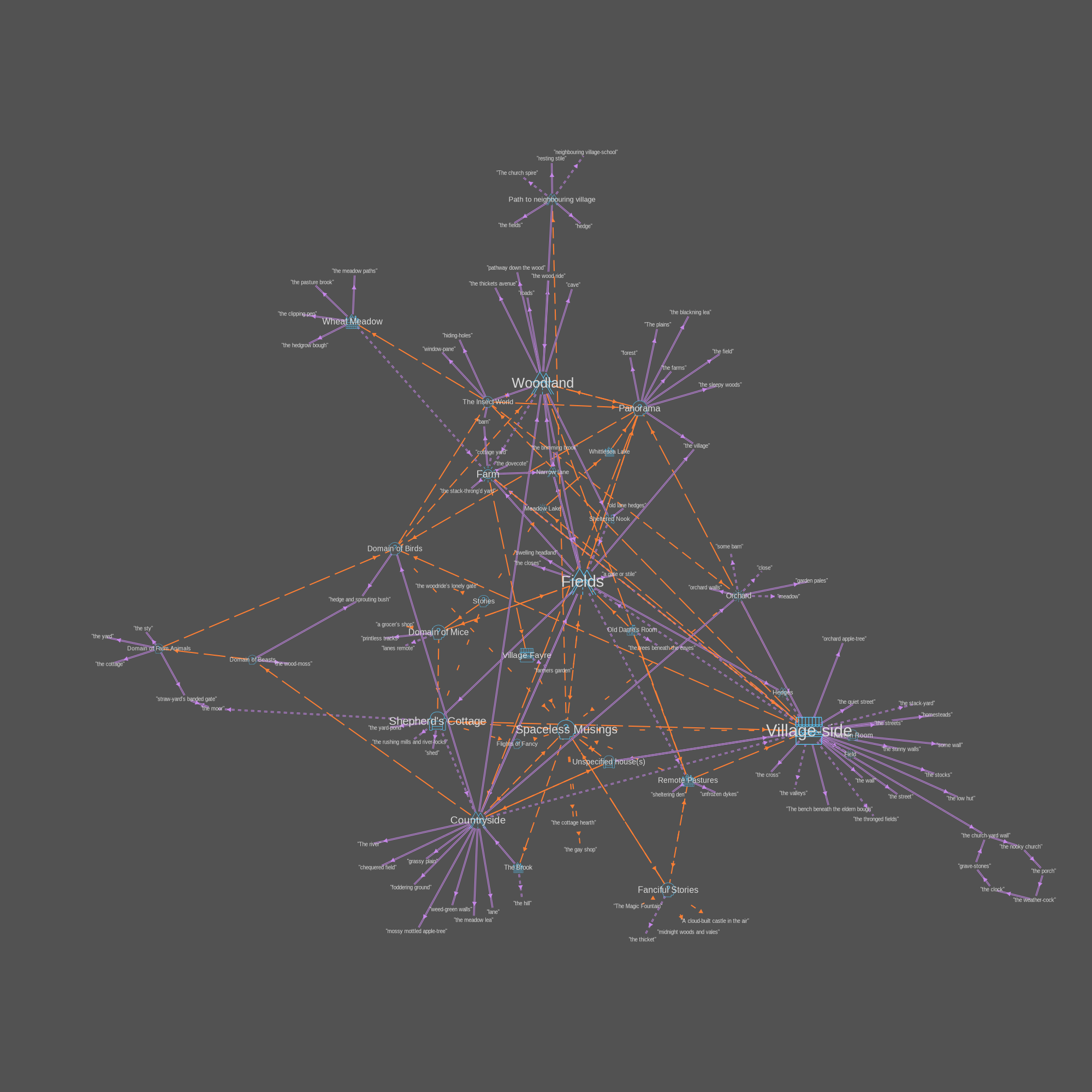
This visualisation of the entire text is even more interconnected than the syuzhet model as various key toporef side-places provide additional linkage points. The most notable difference between the two core forms of reading is the switch between 'spaceless musings' and 'field'. The latter is given a more central priority in this interpretation being the location from which most of the narrative thoughts are conducted (as opposed to the most frequently visited). The toporefs provide finely-tuned details that emphasise the pastoral qualities of each frame, and demonstrate fairly self-contained narrative constructs within the broader poetic compilation. As the textual form is rich in suggestive imagery and nearly entirely comprised of non-specific spaces there are numerous instances (such as 'the pathway down the wood', 'the wood ride', 'roads', and 'the thickets avenue') that all creatively refer to the same entity, but in different contexts defined by the month in which an entry is set. Although the topological layout specifically arranges toporefs that connect only to a single frame in an arbitrary manner to minimise edge overlap and avoid unnecessary clustering, this instance presents an example where a more temporally-aligned layout (based on a clock-face derived from the twelve months of the collection) might provide additional interpretative value as terms change according to the time of year. Equally, the main map begs for more detailed 'nested' maps for each individual month.
Frames and Chronotopic Archetypes
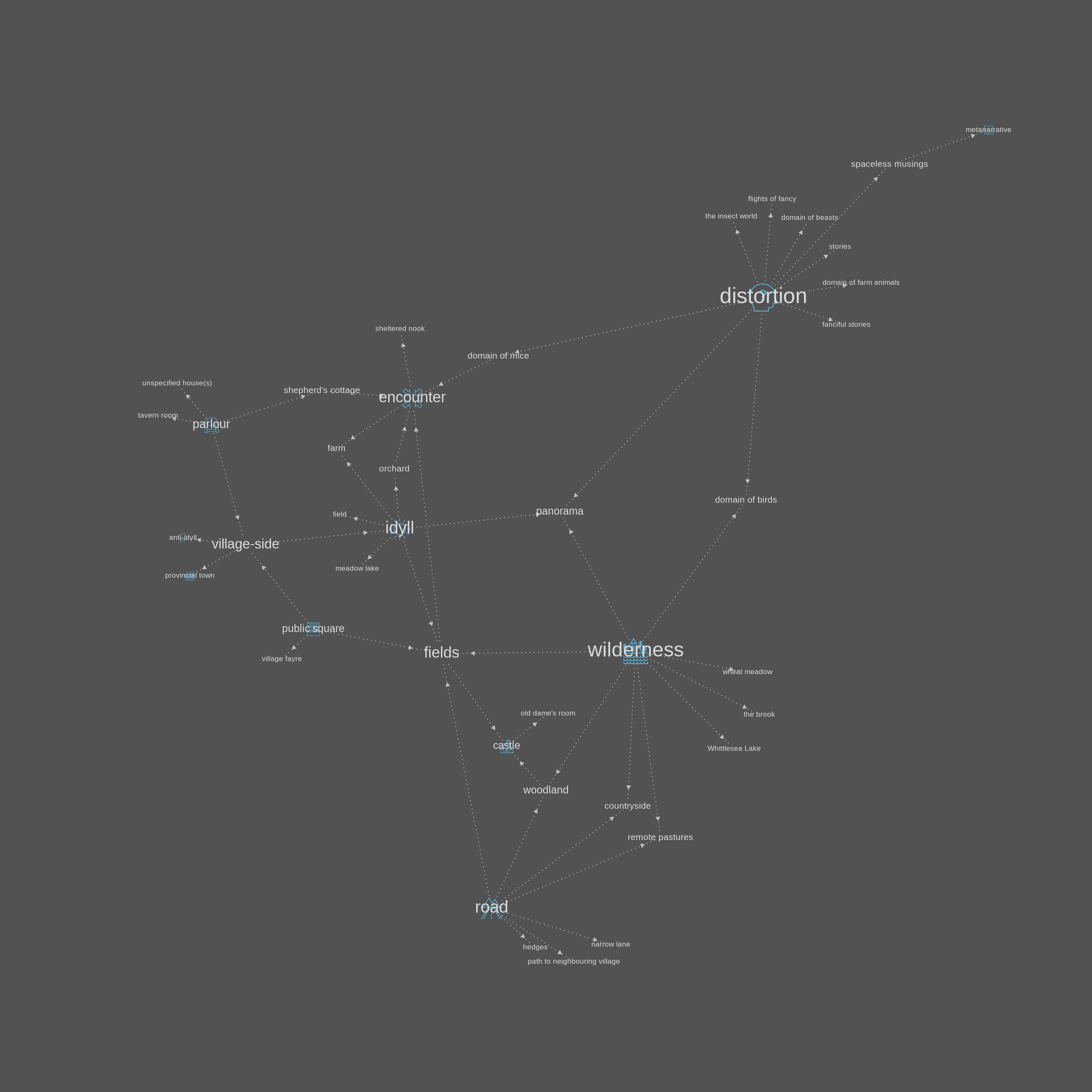
The central positioning of the 'panorama' frame in this visualisation provides a fitting overview for the whole text as the iconic pastoral setting coalesces over time into broader and less-focused memories. The 'wilderness' and 'distortion' chronotopes provide the dominant spatio-temporal forms throughout the narrative. Of particular note is the inclusion imagined perspectives from various forms of wildlife – but every chronotope is represented here. Temporally-aligned markers might offer additional interpretative value. For example, in what named month is the village-side represented as an 'anti-idyll' (a place of feeling trapped) – in the month of September where the harvest yields will dictate their experience of the following winter months. The nostalgia-laden premise of the collection makes the low-key role of the 'castle' (typically representative of the past, the static, the unchanging) somewhat surprising. Here, past forms are remembered for the original feelings elicited, rather than as states altered by recollective longing.
Syuzhet Map
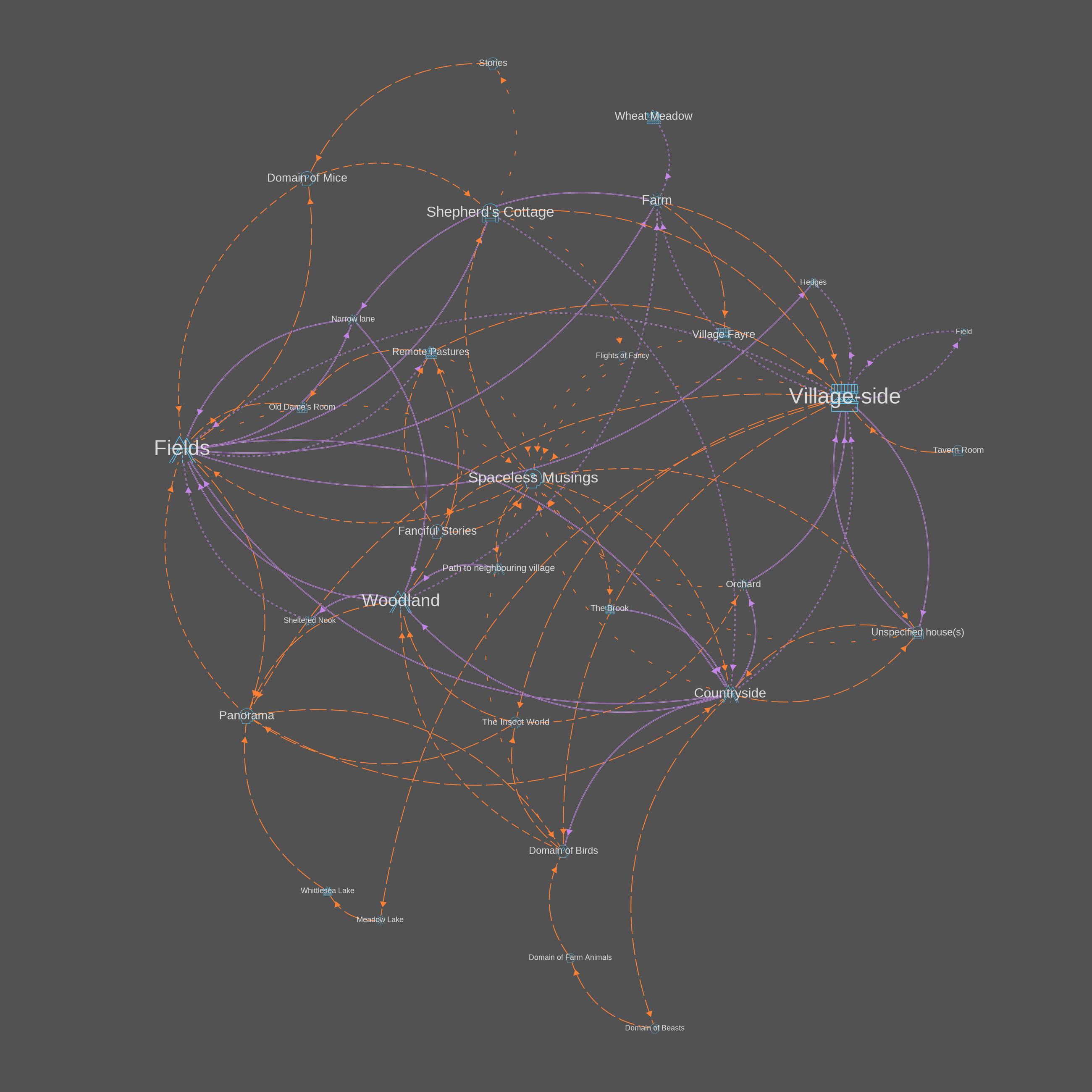
The syuzhet reading provides a highly-connected map, showing the extent to which key areas (and themes) are revisited across the period of a year, bound by an interpretative core that is the 'spaceless musings' of what was and what is yet to come. Ponderings of faith, of change, and of times long lost guide this reading, as such a state is visited throughout the piece, perhaps reflecting that the ever-progressing passage of time remains the only constant, even when the spatial component of metaphysical consideration is removed. The setting is non-specific (with the exception of two named places), making the narrative a highly personal construct, as befits the nostalgic-centric premise. Four additional key areas that appear throughout the collection are simply denoted : 'fields', 'village-side', 'woodland; and 'country-side', aptly suited to the contained and self-centred (at least, superficially so) focus of the text. The 'village fayre' frame presents a particularly interesting inclusion, as it is an ideal representation of a crystalised space and specific time and serves as a nostalgic exemplar of youthful spirit.