Chronotopic Cartographies
A Shropshire Lad
For these maps of A. E. Housman’s A Shropshire Lad we chose to code the text up twice with two different coders (Sally Bushell and James Butler) to show the extent to which the act of coding and map-generation is subjective and to remind the viewer that the maps do not have any kind of absolute authority. The maps made by each coder are placed side by side in each section.
Sally’s maps for A. E. Housman’s A Shropshire Lad are highly distinctive and look quite different from any of the other maps across the chronotopes. This is largely as a result of her decision to respect the cumulative nature of the text which consists of a number of short poems placed side by side with linking themes to create the whole but also existing as individual pieces in their own right. Her mark-up therefore treats each poem as a separate “place”. This results in small space-specific clusters for particular poem-sites such as the famous “On Wenlock Edge” In contrast, James marked up the text as if it were a single whole by determining certain key spatial areas which he denotes as: “Somewhere in Shropshire”, “London Streets” “Shropshire county”, “Ludlow Town” and the gloriously non-specific “Spaceless Thoughts”. Some of the maps look quite similar (the underlying deep chronotopes and the chronotopes and topoi) others look very different (Syuzhet; Topoi).
Complete Maps
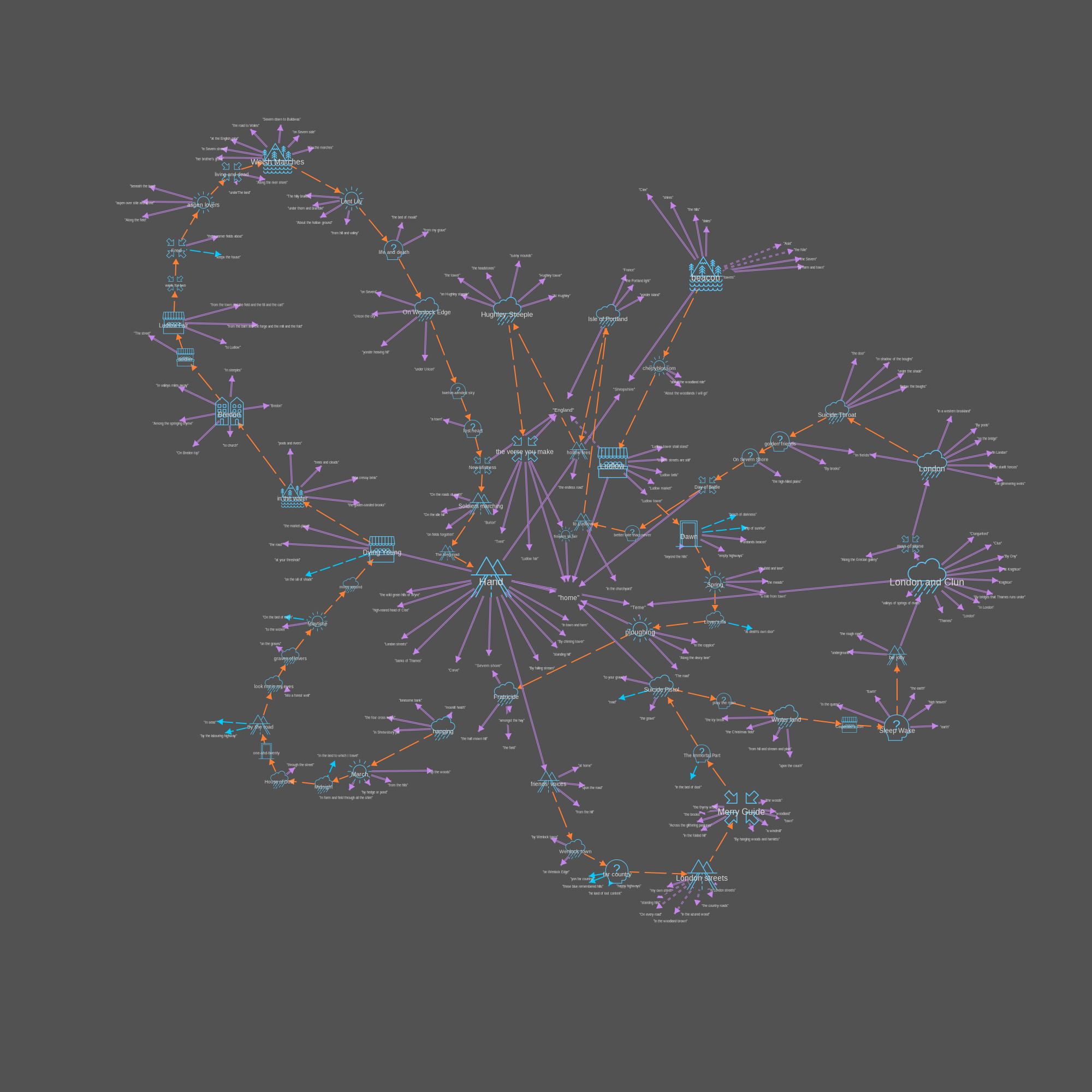
The resulting complete map seen here for Sally’s mark-up takes on the form of a flower/ butterfly. Loops (petals/ wings) are created by the jumps between each poem in orange. The effect of her mark-up and map 'style' is to create small spatial clusters around the dominant topoi that almost read as poems themselves. So, 'in the water' (detail) contains: 'pools and rivers'; 'trees and clouds'; 'the cressy banks'; 'the golden-sanded brooks'. Where the underlying chronotope is of the mind (distortion) this is felt even more strongly as if the places spring from the imagination. Perhaps the best example of this is 'Far Country' as a poem about the narrator’s own youth with the related toporefs of: 'yon far country'; 'those blue remembered hills'; 'the land of lost content' and 'happy highways'.
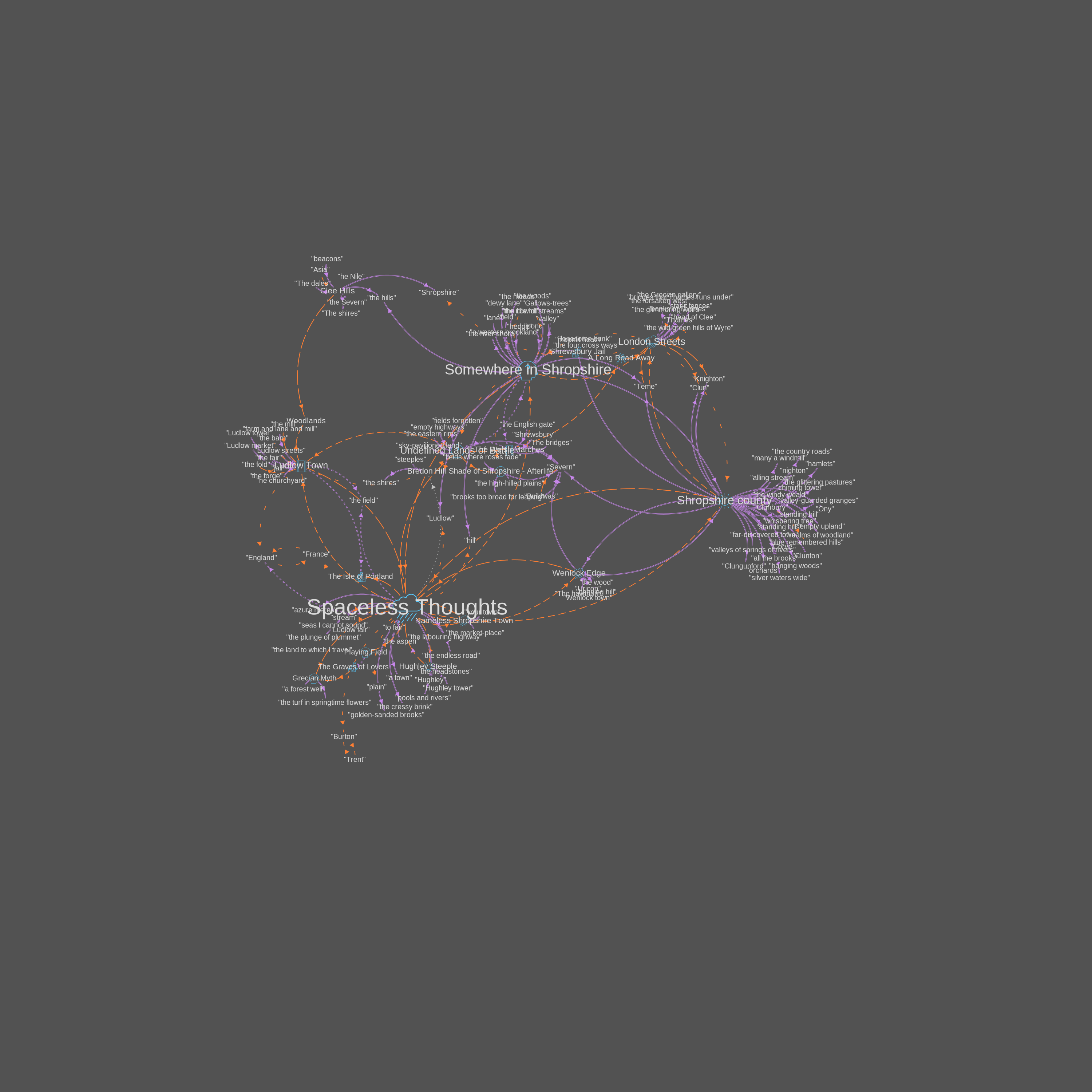
James’s map also has a flower-like quality but is far more focused around the four key sites he identifies. The complete maps show the coalescence of a number of conceptual representations of Shropshire as a place, spanning specific towns, the county as a whole, and an idealised dream-like remembered version. It is likewise engaged with from inside the county, from the far-removed (and very different) London, and (in James’s version) from a spaceless bubble of philosophical musing.
Syuzhet Maps
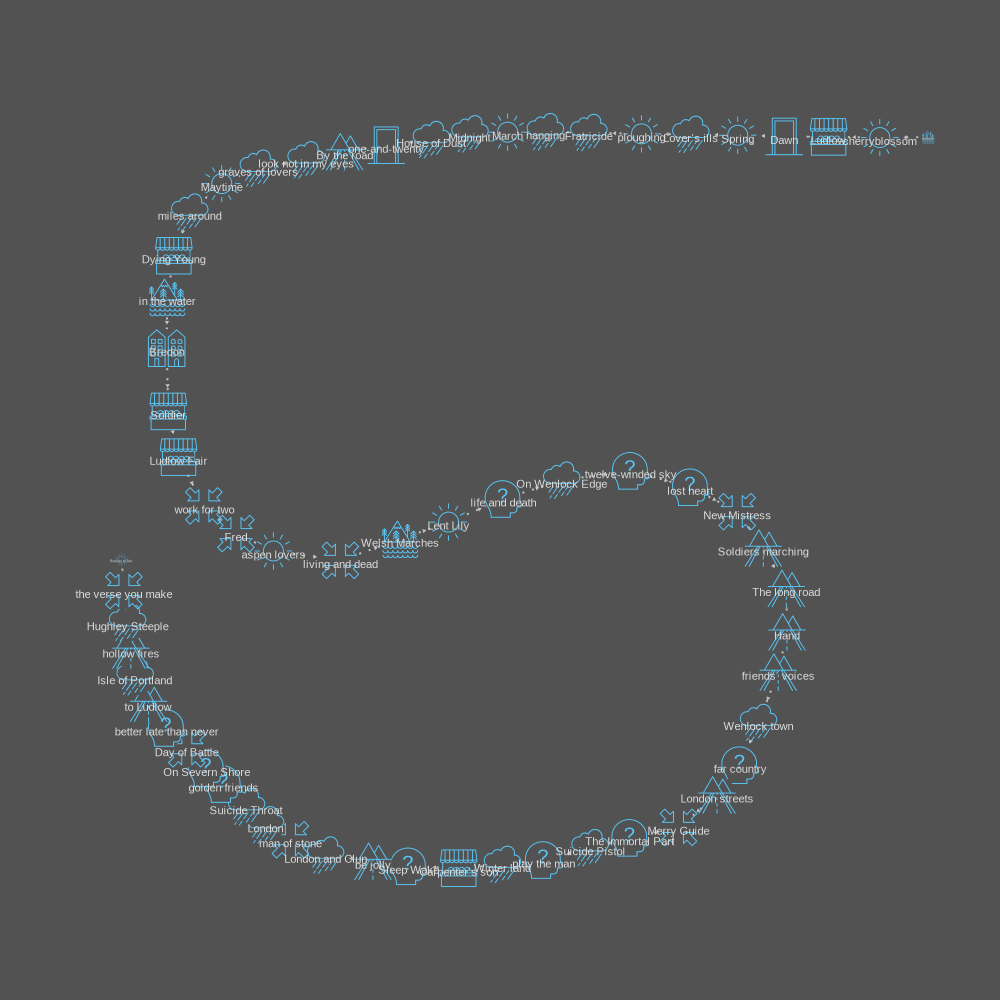
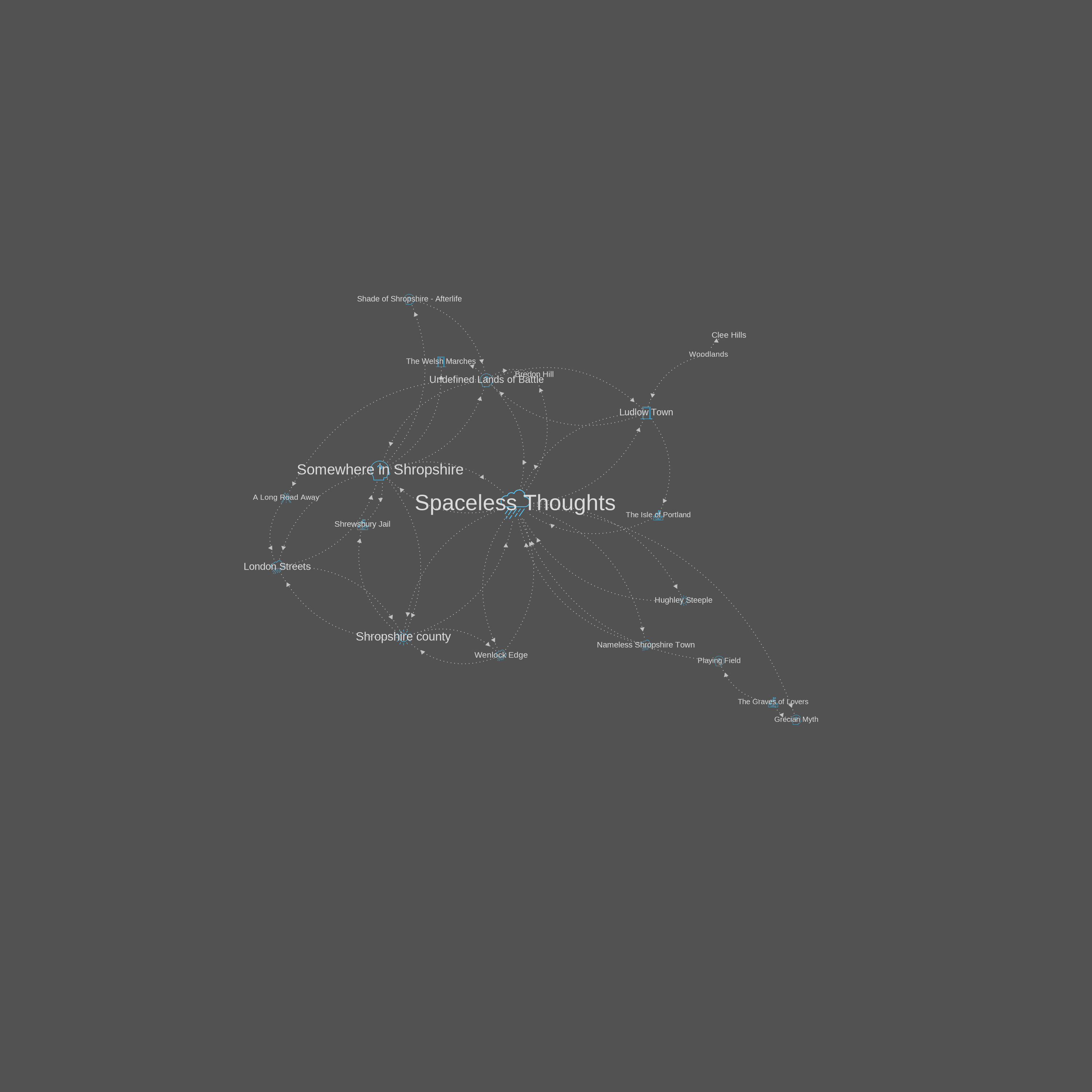
The syuzhet maps are a point at which the two coders are most divergent. Sally’s highly unusual map form is created by the fact that for her the poem moves forward in a series of steps which creates a chain of linkage but represent distinct moments in time. The figure S (“S” for syuzhet) is just a pleasing coincidence created by the graph algorithm. In James’s syuzhet map, despite all the spatial specificity of the poem, 'spaceless musings' lie at its heart. The number of connections emphasises the poem's format as a series of interconnected and intermingling memory pockets expressed though a narrator that – at the point of narration – lies outside the spaces and times being recounted.
Topoi and Chronotopic Archetypes
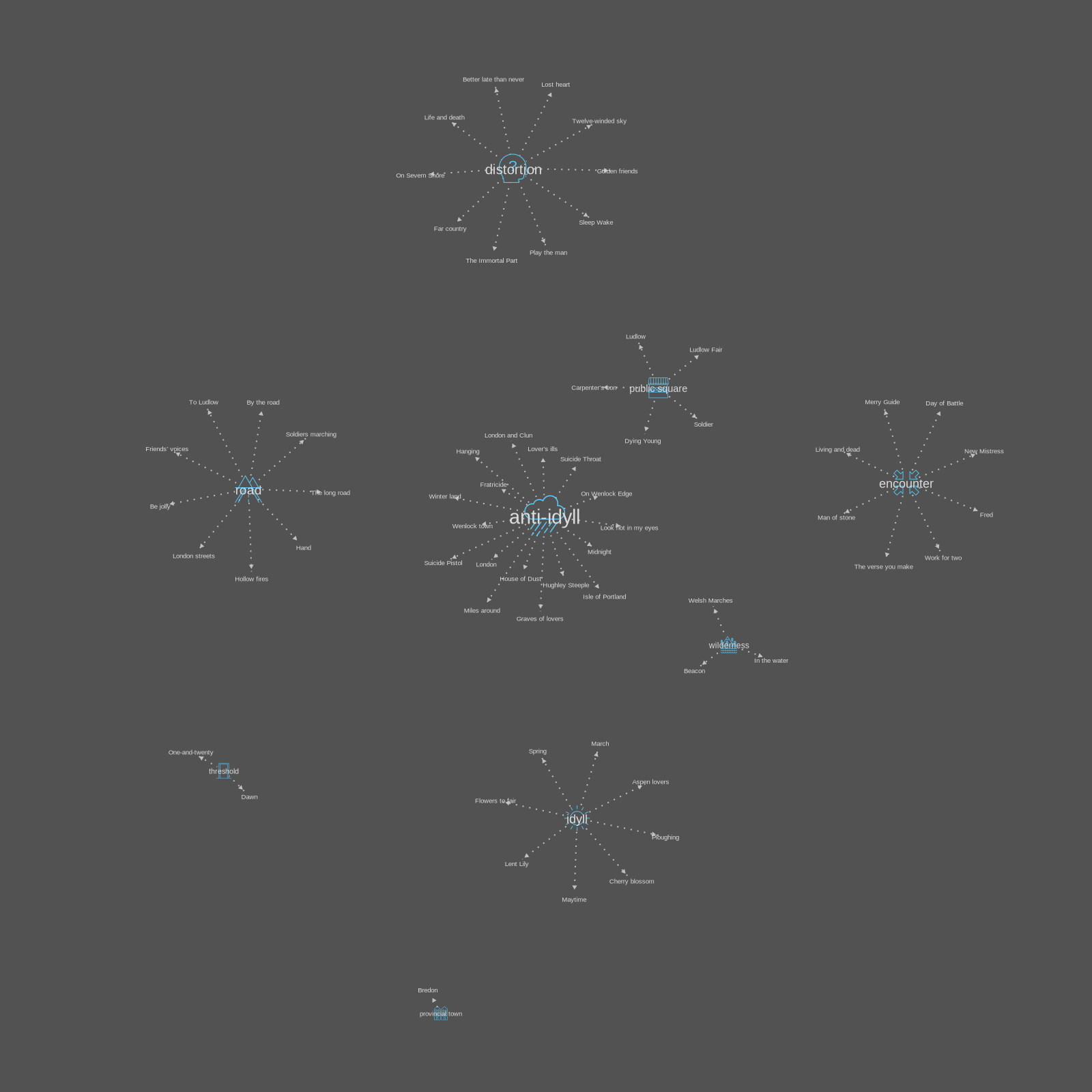
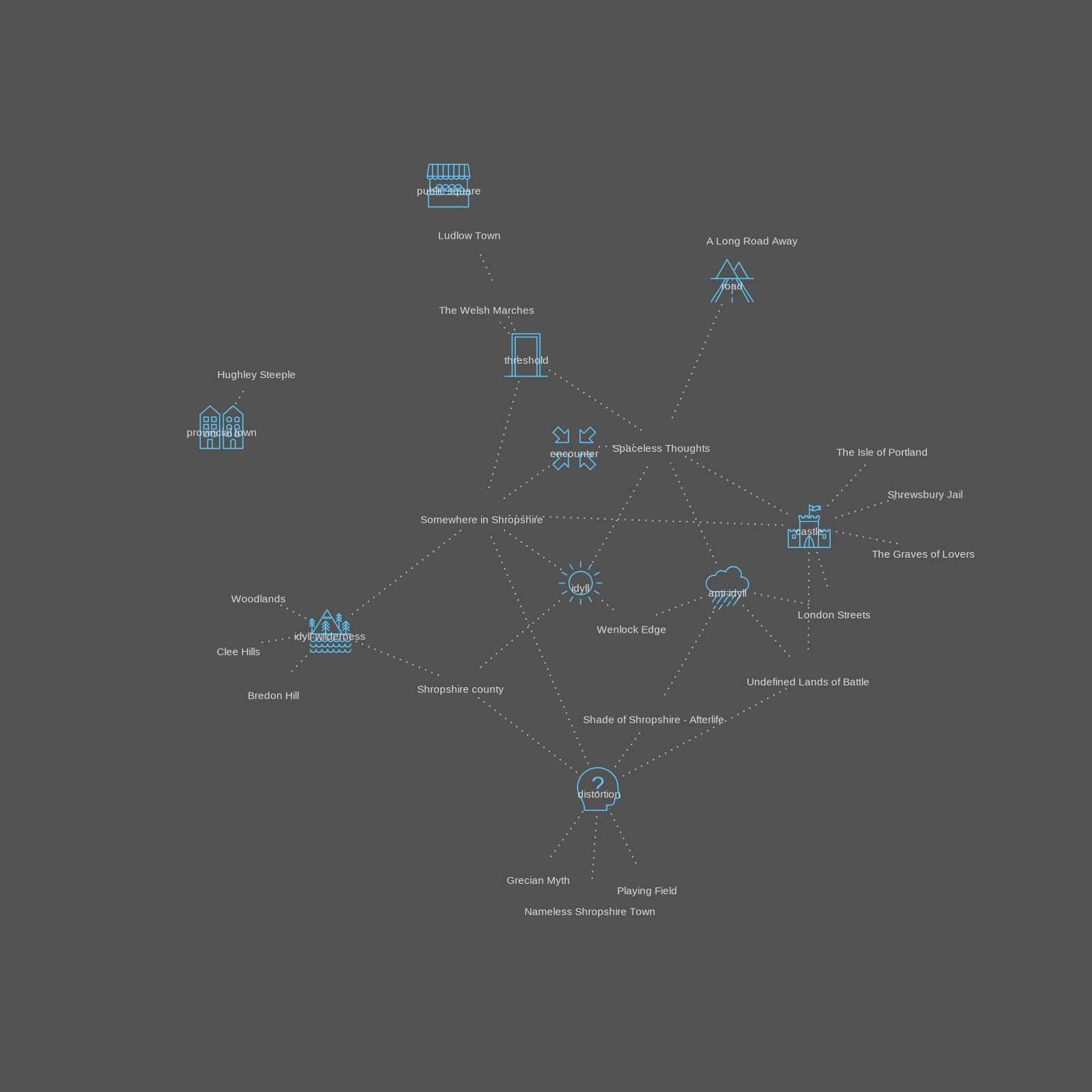
The purpose of this map is to show the relationship between each topoi (place-specific framename) and the underlying chronotopes. Although Sally and James identified similar deep chronotopic structures beneath the poem, Sally’s privileging of the poetic spaces of each mini-text within the whole, creates a snowflake structure with each underlying chronotope and related topoi floating separately. This is because each topoi is assumed to only ever relate to one spatio-temporal form. In Sally’s map the 'anti-idyll' predominates with eighteen topoi linked to this chronotope. The sense in which the imagination of the narrator/persona determines the mood and content is also felt in the dominance of both 'anti-idyll' and 'distortion'. In James’s comparable visualization, places are far more dynamic in their relations to the chronotopes because one place can change its chronotopic identity. The idyll form ('idyll'; 'idyll-wilderness'; 'anti-idyll') again predominates. But now 'Wenlock Edge' is both 'idyll' and 'anti-idyll'; 'Shropshire County' is at different times an 'idyll wilderness', an 'idyll' and 'a remembered place'.
Deep Chronotopic Structure
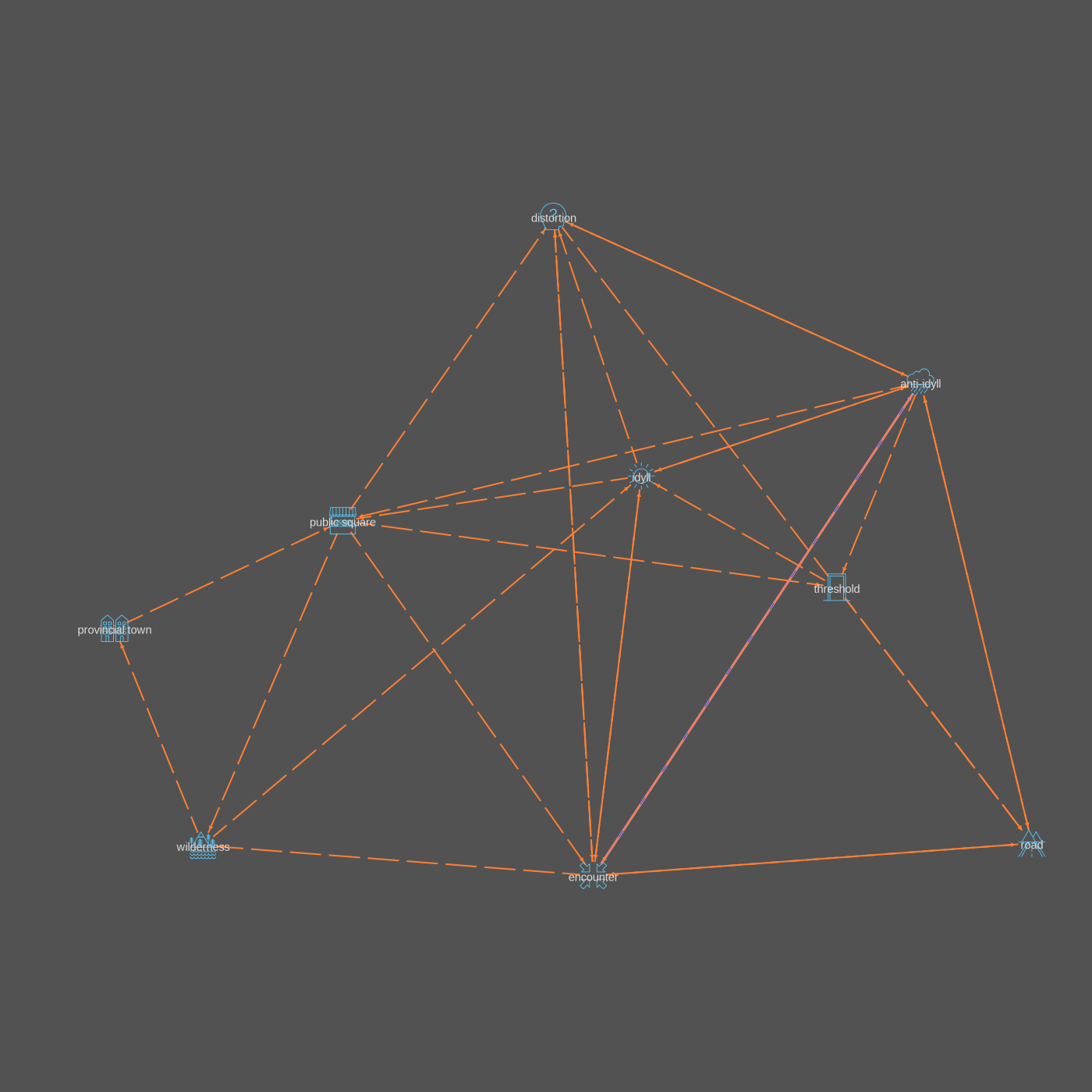
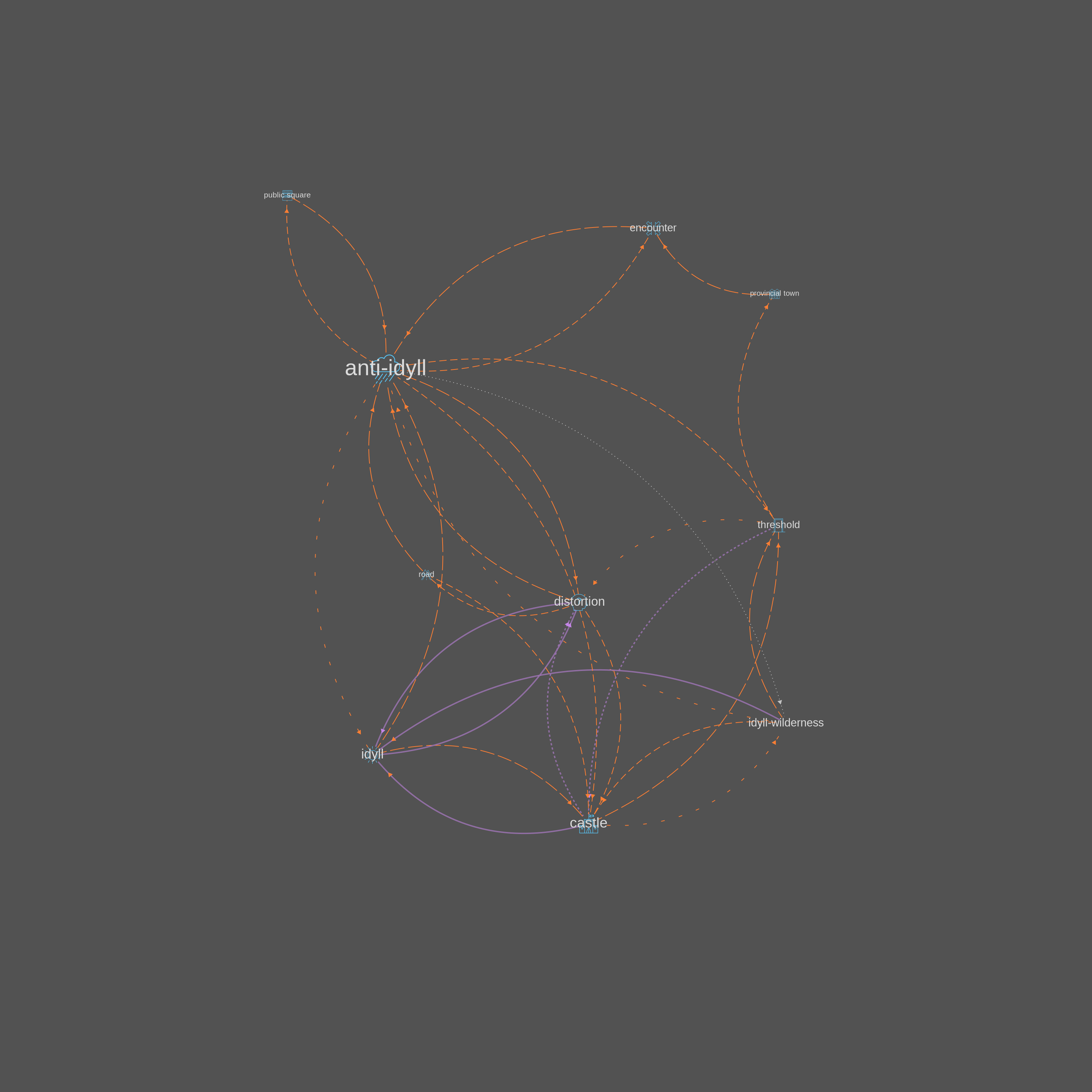
The two maps showing the deep chronotopic structure are fairly similar with identical chronotopes except for Sally’s 'road' and James’s 'castle'. For James’s map the dominant chronotope is that of 'anti-idyll' and the chronotopes are largely linked to each other by jumps though with some direct connections. Sally’s chronotopic structure is more balanced across the types and has 'idyll' rather than 'anti-idyll' at its centre (although as the topoi map shows more topoi do correspond to 'anti-idyll' than any other spatio-temporal form).