Chronotopic Cartographies
Sir Gawain and the Green Knight
Sir Gawain and the Green Knight was chosen for Spatial Type 2 as a popular medieval text for which the landscape is semi-symbolic in nature; strongly present but non-place specific. Its popularity lies in its identity as a self-contained Arthurian narrative that starts at the centre of power in Camelot, wanders far away and challenges the hero’s self-identity before returning, as well as in the power of its symbolic, allegorical and moral meaning. As a text, Gawain is notable for the number of times it has been translated, adapted and reworked after its discovery in 1836, most recently by poet Simon Armitage (Faber & Faber, 2009).
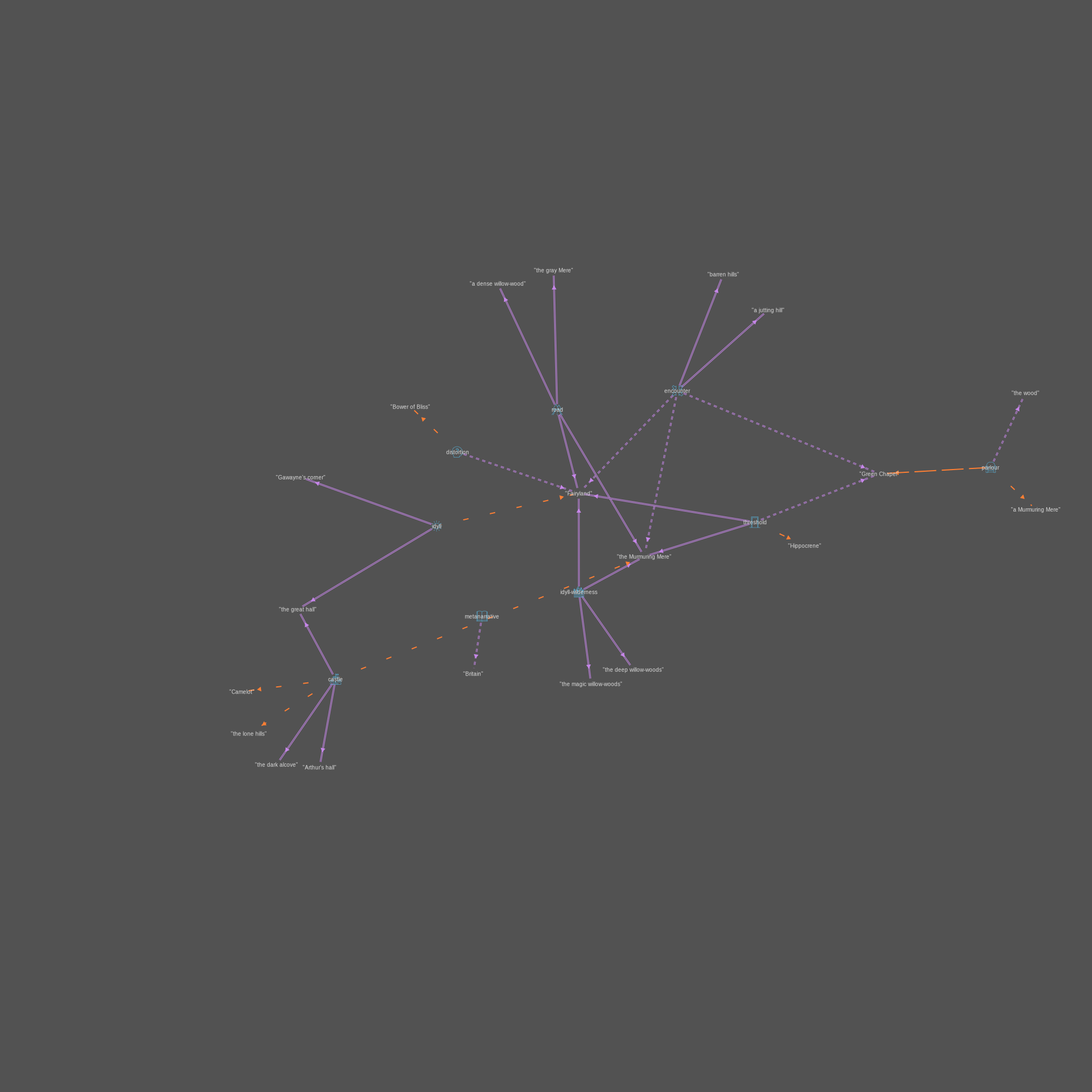
The two versions chosen here, offer contrasting ways of understanding the story spatially. Version one is derived from the 1903 re-interpretation by Charlton Miner Lewis (Yale, 1903), which includes the subtitle: 'A Fairy Tale', for good reason. Version two is taken from Keith Harrison’s 1983 translation of the Middle English (Oxford, 2008). Although the core journey and base settings of the narrative are consistent between the versions, Miner Lewis’s interpretation shapes the map in a manner which emphasises the role of the fairy realm. In contrast, an unnamed path is found at the heart of the map for version one.
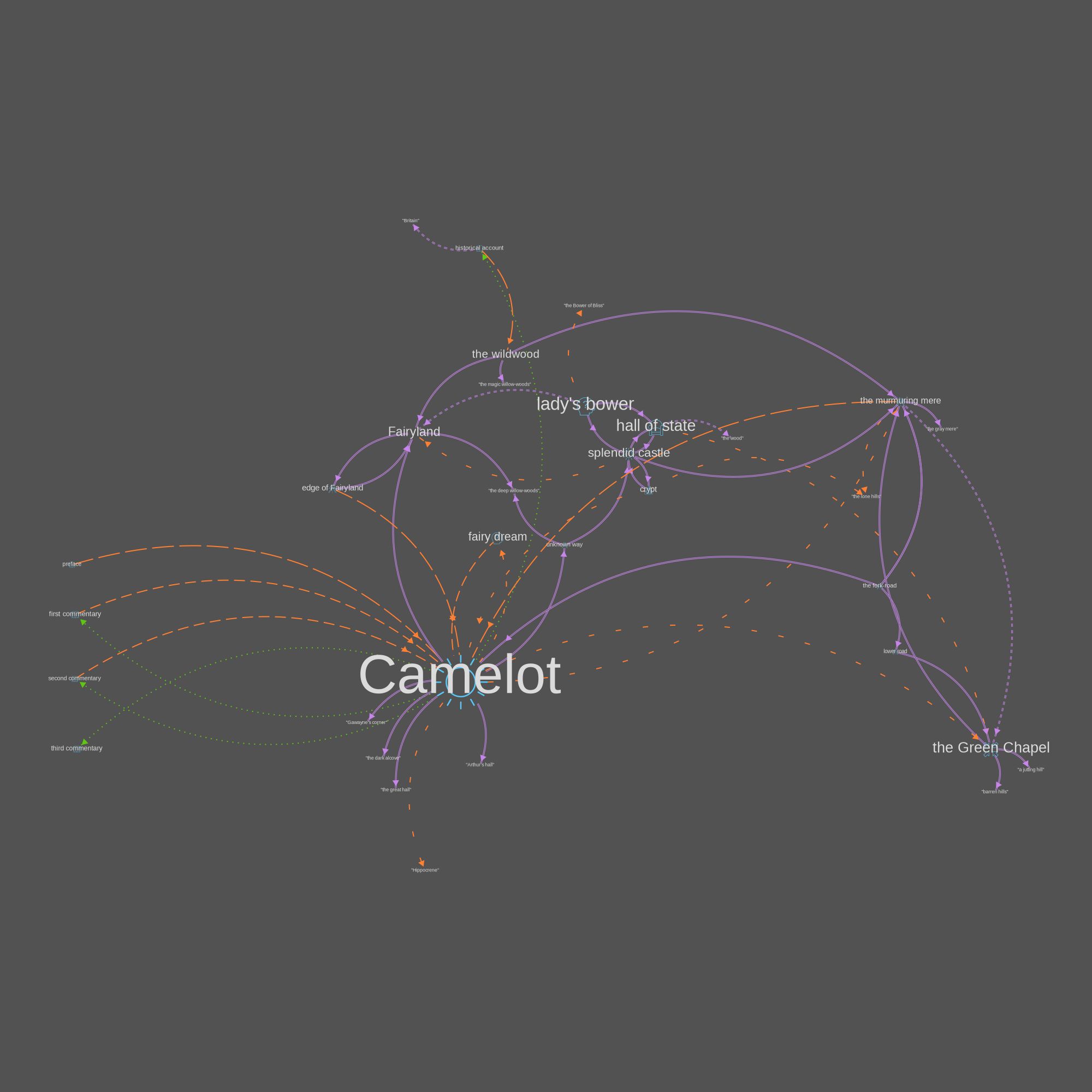
Miner Lewis Adaptation
The complete map of Miner Lewis's variation of the Gawain tale shows a focalisation towards the fairy tale aspect through the clustering of additional spatial elements ('the Fairy Dream', 'the Fairy land', 'the enchanted willow woods', 'the Lady's Bower') that denote the magical at the centre of the visualisation. Although Camelot is the location in which the most 'time' is spent (in terms of word count and chronological context) and is the most connected point (in terms of both active and passive relationships), the focal shift is so integrated into the story's re-imagining that the enchanted space literally becomes the centrepiece for this map.
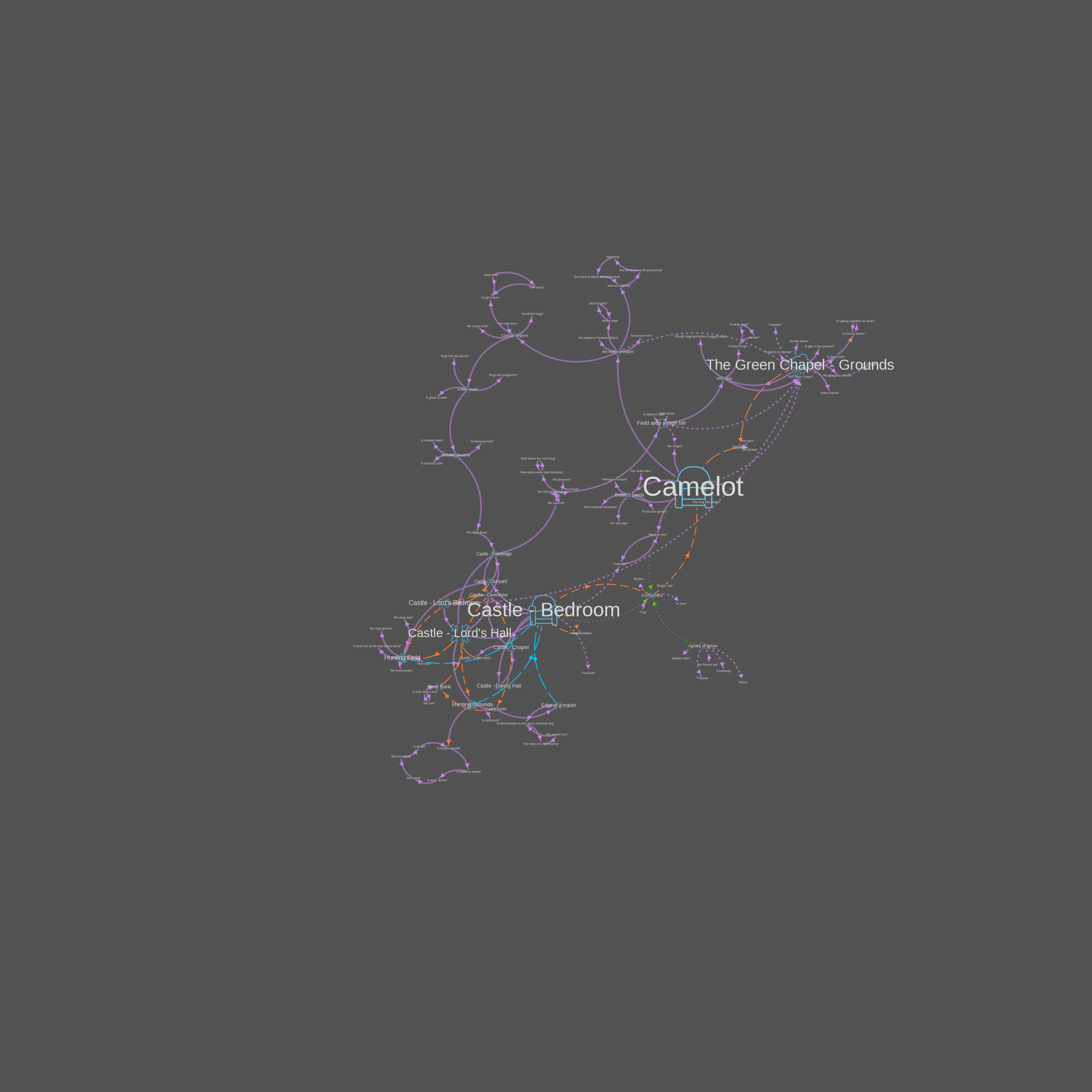
Harrison Translation
The complete map generated from Harrison's direct translation provides a much greater level of place-specific detail than other versions of the poem. This starts with real place referents of the realm of Logres (the domain of King Arthur), as Gawain passes the isles of Anglesey and the forest of Wirral, before moving off the known path into 'curious regions'. These provide generic topographic descriptors then transition into the fantastic space of the unknown 'Lord's Castle' and the more familiar 'Green Chapel'. At such points conventional mapping methods become compromised, because the imaginary realms defy referential reality, but this journey provides an ideal exemplar for demonstrating the effectiveness of the chronotopic model for referential and non-referential spatialisation.
Translation and Adaptation Compared
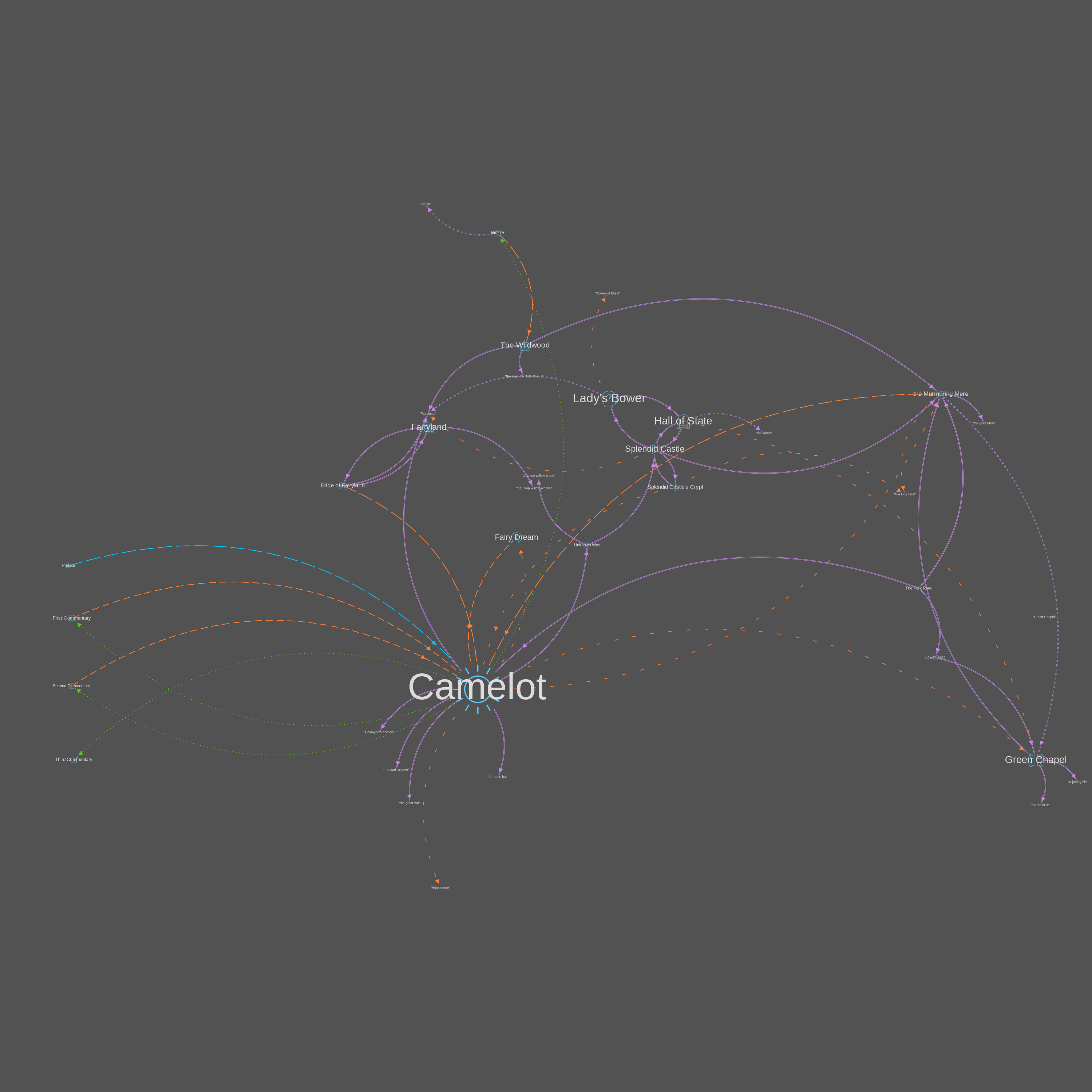
When we compare the two complete maps directly, we see that in Miner Lewis (left), environmental description is limited and Gawain’s journey simplified. The transformation of the unnamed forest into the magic willow woods of the fairy realm makes it harder to follow. There is unexpected indirect and potentially symbolic connection. For example 'Turkestan', in the silks that adorn both the high dais of Camelot’s chapel and the bedroom in which Gawain is tempted.
The rich environmental detailing in Harrison (right) is immediately obvious from the number of toporefs and sequences featured in almost all of the frames. Gawain’s journey can be easily followed on this map although it is also highly circuitous. The narrative is weighted evenly across the three key sites, internal and external, of 'Castle', 'Camelot' and 'Green Chapel'.
Miner Lewis - Chronotopes and Toporefs
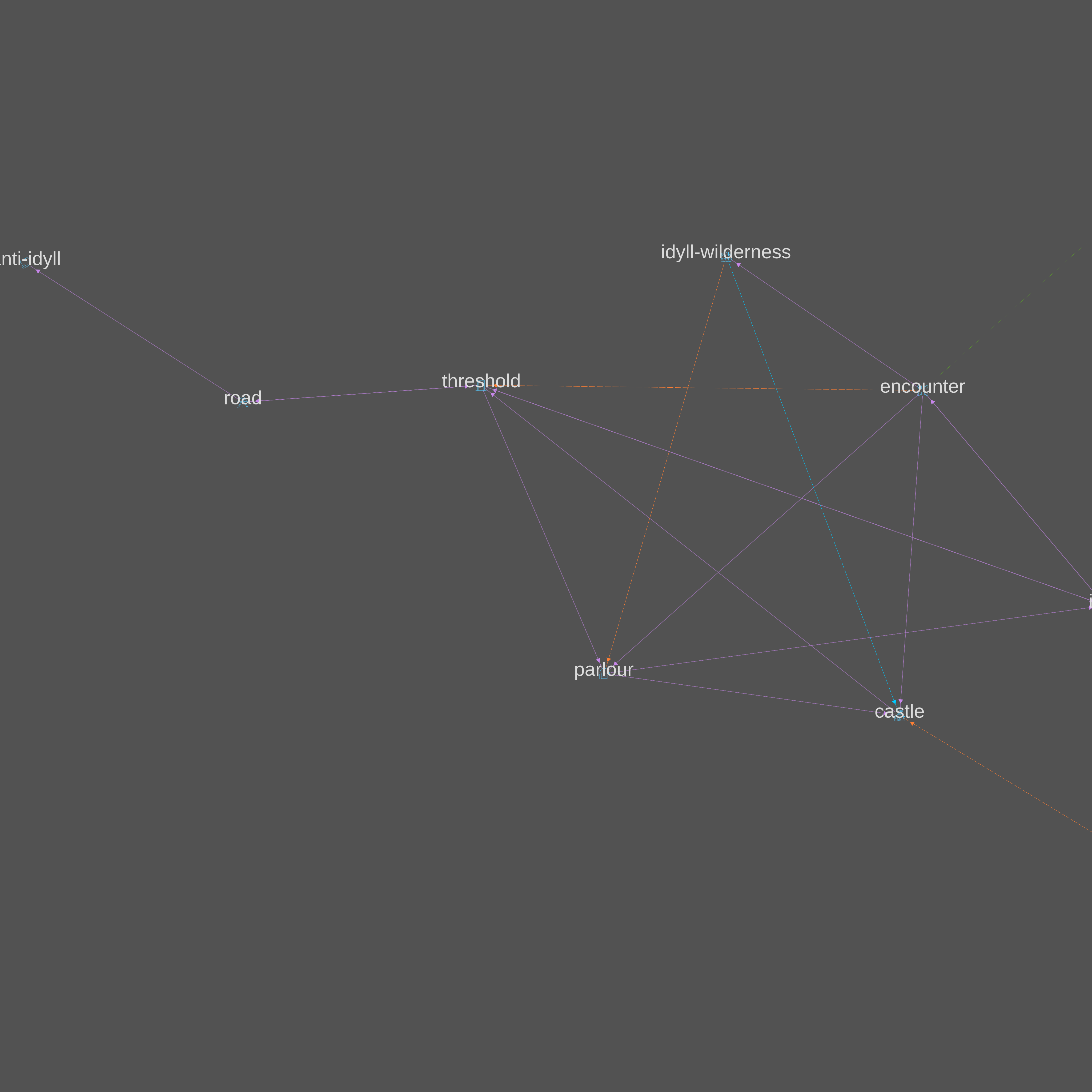
The focal shift in Miner Lewis features the 'idyll' and 'distortion' chronotopes more prominently alongside less direct/physical transitions. This reflects an authorial shift in style to the more dreamlike and fantastic story of the adaptation. 'Fairyland' is the focal centre of this version as it features the most spatial interplay. In Harrison it is the 'Green Chapel' that holds this position as the site is given the most narrative attention and is subject to the most changes in chronotopic type. As this place is presented in a more fixed manner in Lewis it is marginalised by the addition of 'Fairyland'.
Harrison - Deep Chronotopic Map
The Gawain poem contains the first use of the word 'pentangle', (for a five-pointed star), in the English language. The pentangle is also the design on Gawain’s shield and represents the knight in a range of ways, symbolically. For this reason, it seems almost incredible that the most striking aspect for the chronotopic map of the spatial types of Harrison is the automated generation of a pentangle shape between key sites. But here it is. The pentangle is created by the relatively limited spatial arenas of the text which are nonetheless tightly interconnected.