Chronotopic Cartographies
Swallows and Amazons
Place in Swallows and Amazons is layered and composite. This is felt right from the outset in the authorial sense of place as a kind of mosaic, as described by Arthur Ransome: 'The lake is not altogether Windermere, though Rio is of course, Bowness, because I had to take a good deal from Coniston. No island on Windermere has quite so good a harbour as that among the rocks at the south end of Peel Island on Coniston . . . But Cormorant Island is Silverholme on Windermere' ('A Letter to the Editor', 3-5). Within the book the children themselves use a real map to create their own, which corresponds to the way they deliberately double place by renaming places and people as a vital part of their act of imaginative repossession. At a third level the younger children spatialise and play within this second space in ways linked to earlier books (e.g. Treasure Island) – re-enacting literary events out of sight of the older children.
Syuzhet Map
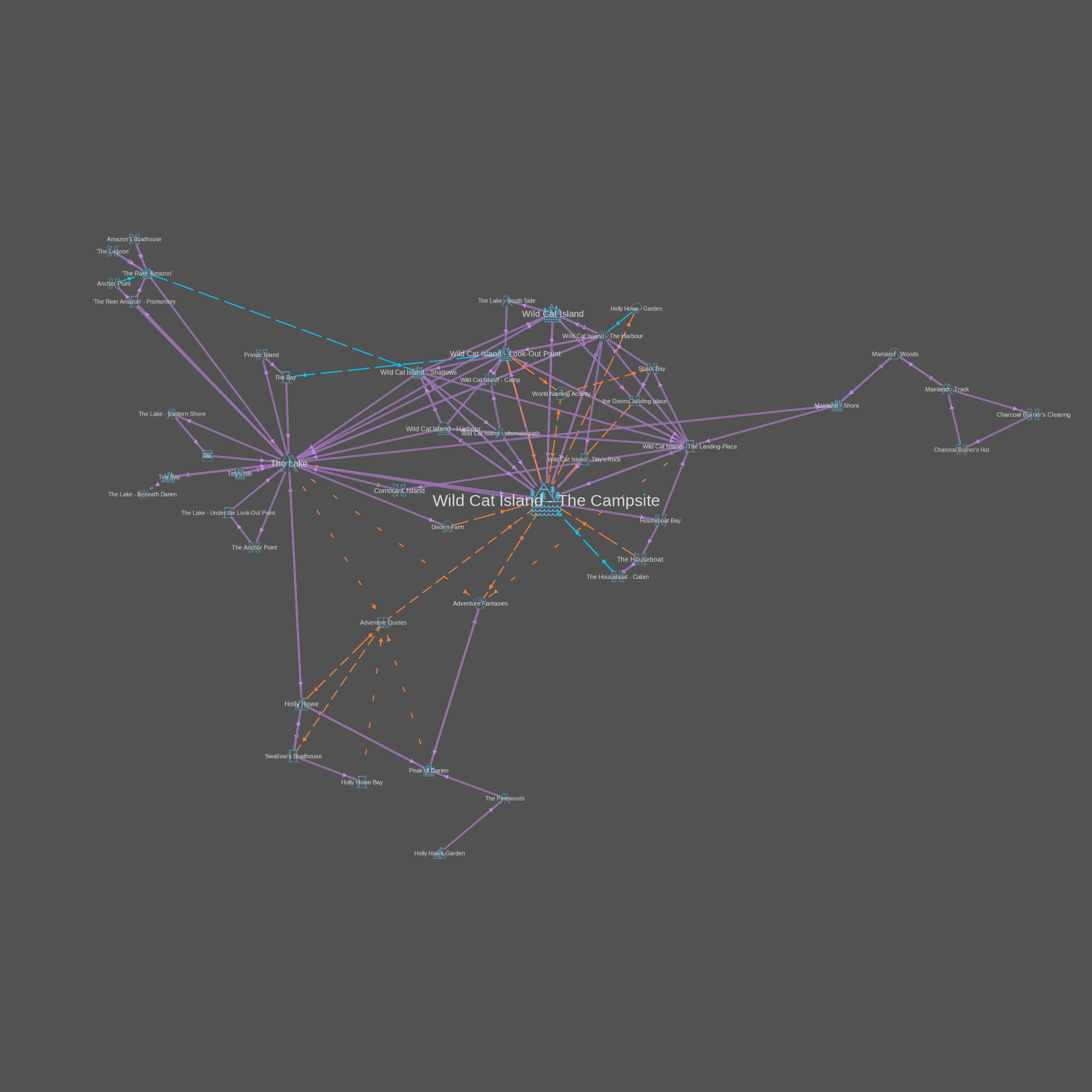
The central site of the map (and book) is unequivocal for this visualisation: the campsite on Wildcat Island dominates and provides the centre for independent play for the children. Naming and owning different local sites around the camp itself, but still on the island, creates a diamond-like core of possessive imagination in the centre of the map. On the left of this shape the landing place of the harbour on the island forms a hub of activity as we would expect.
Around this island core, three other key sites unfold. One of these, on the left of the map, provides the link to the children’s playmates and so remains enfolded within imaginary geography: situated up the 'River Amazon'. The two others represent important links to the realist landscape of the represented Lake District. To the left and centre are sites on the mainland, as well as Dixon’s Farm from which they get regular supplies. At the bottom we see locations in and around Holly Howe where their mother and younger sister are staying. This marginal site actually anchors and secures everything else – allowing the children to play independently, yet securely, nearby. Treating the Lake as a separate entity (although of course the island is on the lake) was a deliberate choice by the coder, but as the Swallows & Amazons series is famously accompanied by a detailed endpaper map of the imaginary region, with the lake at its centre, this is appropriate. The reader is provided the means to trace out routes and particular areas as part of their textual experience.
Toporefs and Chronotopic Archetypes
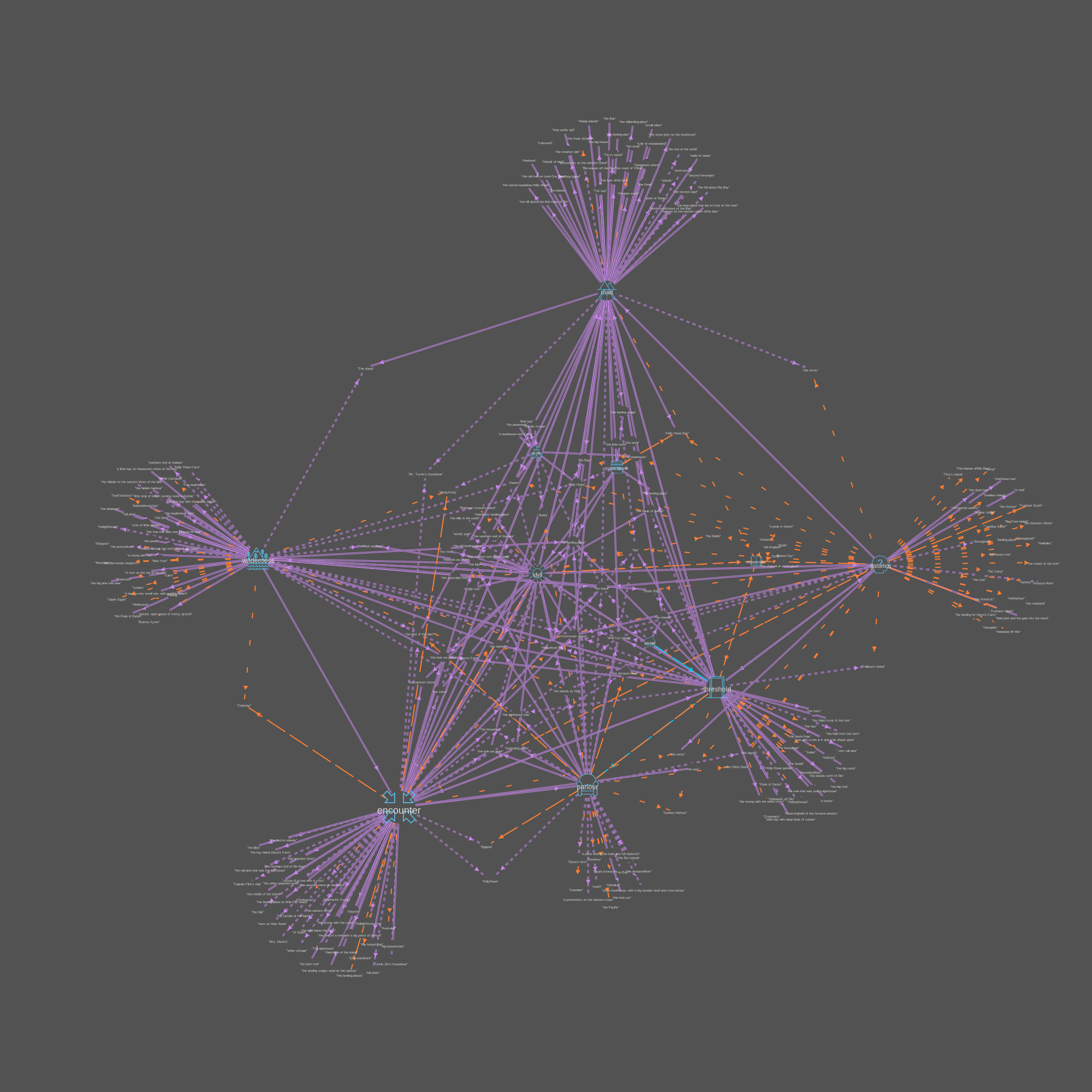
This dense map contains several topological curiosities, the most notable of which is the use of the children’s adventure fantasies as bridging points between various chronotopic types, creating a wheel that defines their 'reality'. 'Holly Howe', 'The Island', 'Sydney Harbour', 'The Arctic', and 'Treasure Island' are all worlds apart – literally – but come together to create a comprehensive world of imaginative play. The constant shifts in their focus and style of play results in a number of spots changing their name over the course of the narrative, and a core component is their re-naming of the region to better fit their vision. Thus generic spaces often become charged with personal meaning as the tale progresses. The landing-place stands at the heart of this map, as it forms the key to all of their adventures – their means of accessing the island, and of all the imaginative opportunities that allows. This visualisation shows the extent to which a lot of descriptions take place across a relatively small region, but are approached from a variety of creative engagements (and interpretations). There are a few unavoidable repeated entries that connect only to one chronotope in their individual guises as the same spot is often encountered in radically different contexts. The form of play constantly shifts and their small world takes on a new form and meaning each time, hence the high level of interconnection and juxtaposed separation.
Deep Chronotopes Map
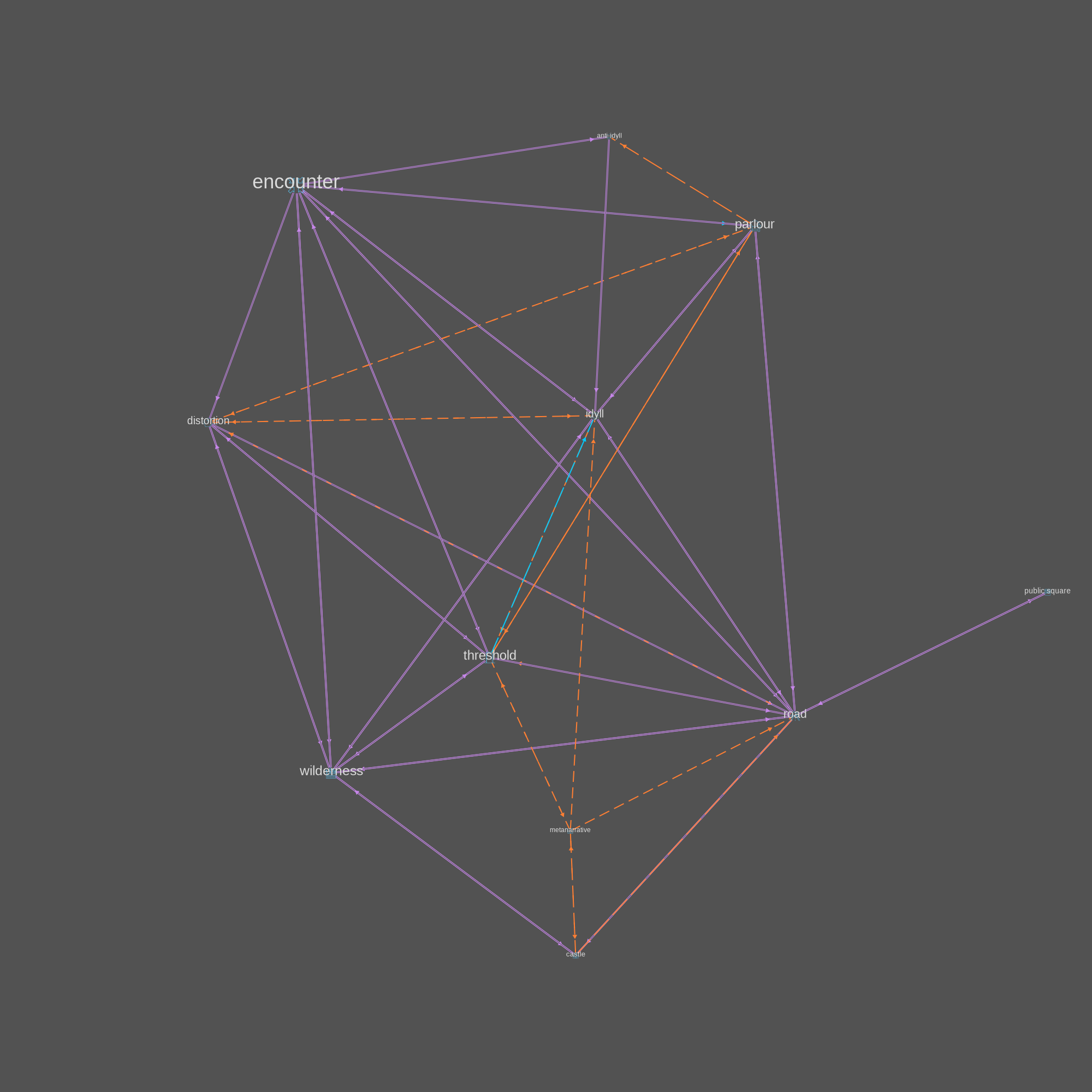
Given the focus on play and living out an exciting fantasy in relative freedom, it is unsurprising that the 'idyll', 'threshold', 'road', and 'encounter' chronotopes feature so heavily in this map. The 'public square' type is the significant outlier, which corresponds nicely with the Walker children's desire to keep their adventures private and to keep contact with other inhabitants ('natives') to the bare minimum (except when following their mother’s orders for daily contact and collect fresh dairy provisions). The few times this chronotope occurs is when they are forced to temporarily break character and interact with the world outside of their playful fantasies. The island is initially seen as a 'wilderness' (to the Walker children’s imaginations as it represents everything removed from society), but quickly shifts into an 'idyll' as their fantasies shift from exploring and naming an unknown place to spirited competition with another group of children.