Chronotopic Cartographies
Through the Looking Glass
Through the Looking-Glass and What Alice Found There (1872) is the sequel to Lewis Carroll’s Alice in Wonderland. Like Wonderland, the Looking-Glass world is a dream-scape but one which is also underpinned by the rigid structures and gridded form of a chessboard that determines the frame-names for different sections of the narrative as mapped here. Although strictly a bridge text – the narrative begins and ends in the ‘drawing-room’ – Through the Looking-Glass can be understood as a fantasy novel in that it contains a purely imaginative realm or what Bakhtin defines as an ‘abstract-alien’ world (‘Forms of Time and the Chronotope in the Novel’, p. 101) with its own ‘peculiar consistency and logic’ (p. 102). Alice moves across the board-as-landscape to become a Queen and this breaks up the sections of the narrative which implicitly concern her moves across each square (although within each of these spaces little spatial logic seems to apply). For the most part, because she is 'through the looking-glass' Alice is confronted with a back to front world with only her own experience as an anchor to the real: ‘in OUR country’, said Alice [...] ‘you'd generally get to somewhere else--if you ran very fast for a long time’. ‘A slow sort of country!’ the Queen replies. ‘Now, HERE, you see, it takes all the running YOU can do, to keep in the same place’ (Looking-Glass, 200). The maps given here present a relative mapping of the spaces of the narrative as Alice moves, as well as a shaping of that relative map onto the underlying layer of a chessboard (as given by Carroll at the front of the book).
Topoi Map
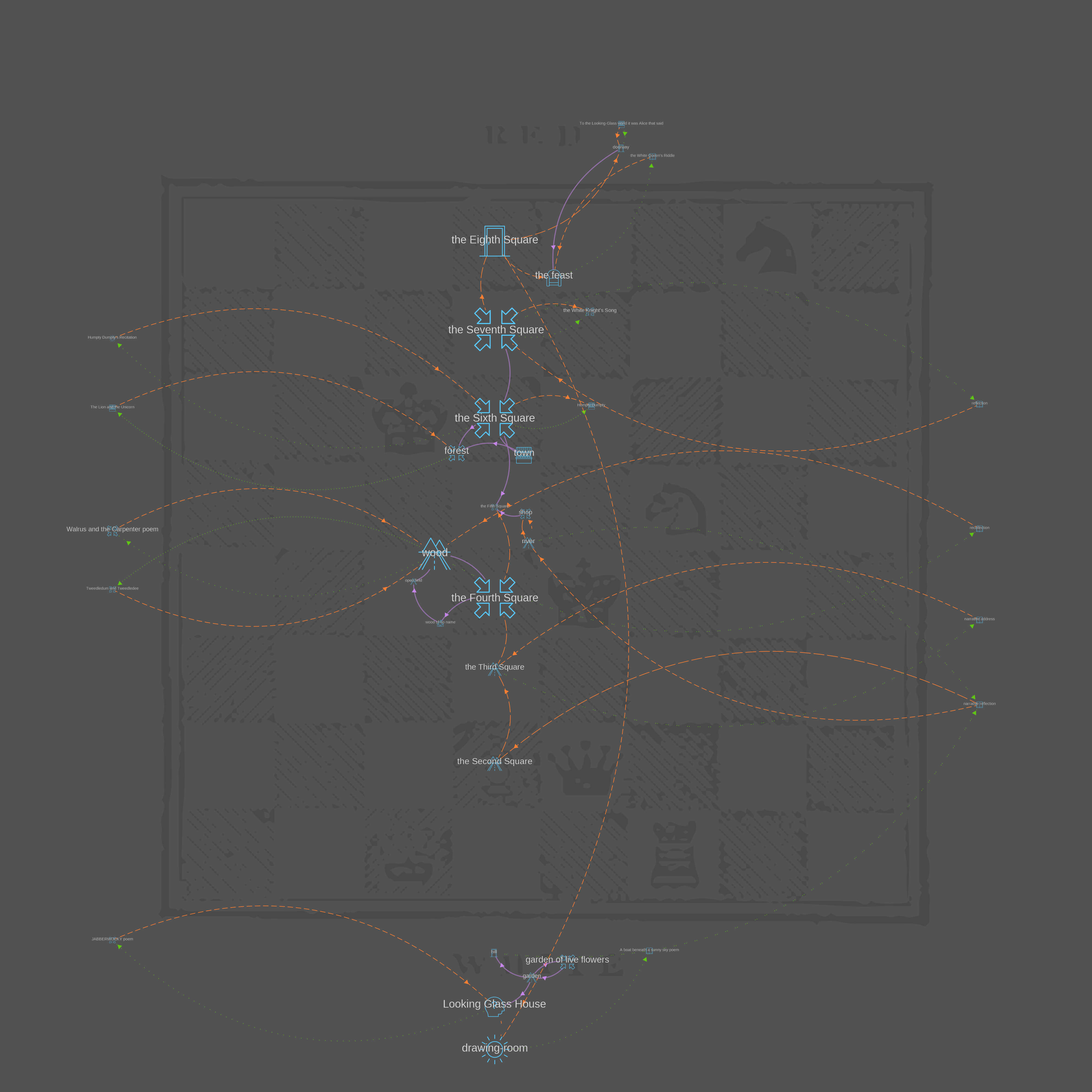
In this visualisation we have layered the topoi map over a plan view of the chess game as given by Lewis Carroll at the start of the 1872 first edition. This makes Alice's own movement across the board explicit and shows that this is simply that of a straight line, since she is playing as a pawn. It also shows how much the metatextual elements (often relating to nursery rhymes) face 'outwards'. These topoi are placed beyond the margins of the board to the left and right and linked to Alice's forward movement (in purple) by orange lines that signal the intertextual jumps. In this visualisation we map referentially as if to the real, but the base layer is an early literary map rather than a geographic location in the world.
Complete Map
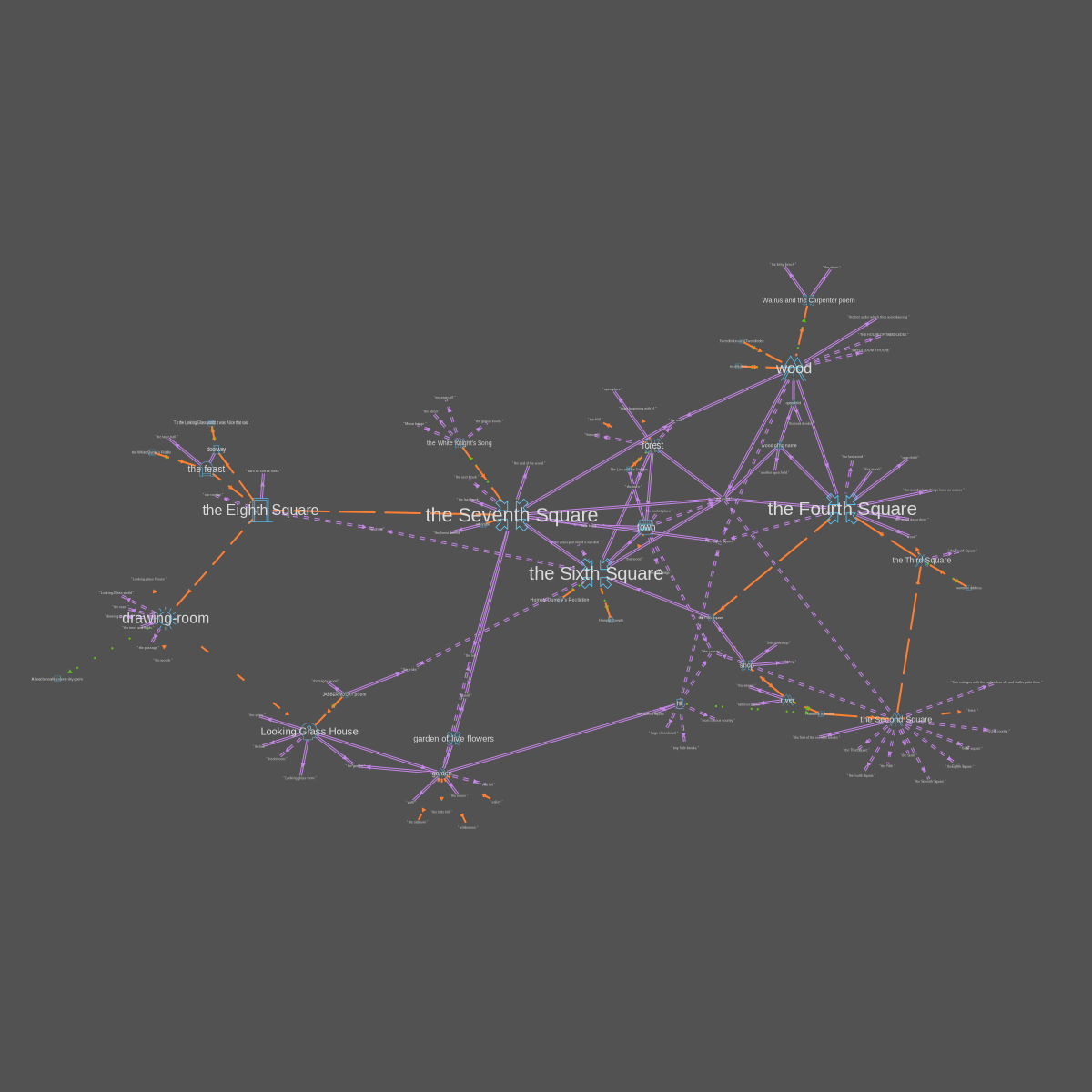
The complete map shows how the spaces of the narrative occupy discrete sections related to the square on the board that Alice now occupies. Within each square she encounters characters moving across a landscape in a highly intertextual form. The place names (toporefs) – 'the wood', 'the forest', the 'brooks' – are often iterations of the topoi. Like the mirror, then, the text looks in on itself. The dark forest also sets up a relationship with other imagined and fantastic spaces and characters of childhood: riddles, nonsense poetry, fairy tales and nursery rhymes. So, as the complete map makes clear, the world Alice finds through the looking-glass is one of play and of story.
Syuzhet Map
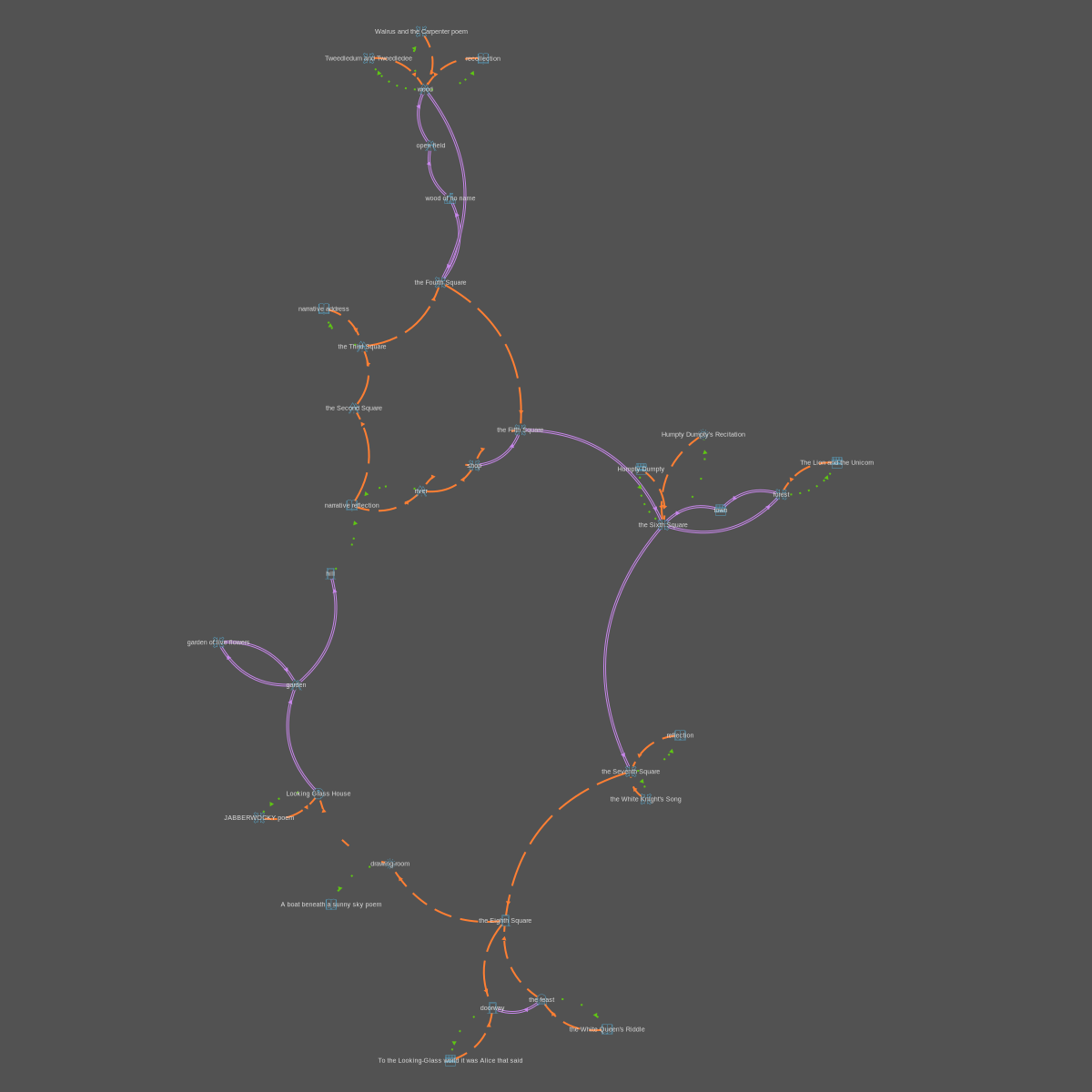
In contrast to the topoi map, which when given in overlay effectively provides an aerial view, the syuzhet map can be seen as representing Alice’s journey through the text from her perspective, moving with her immersively from space to space. Beginning in the ‘drawing-room’ Alice’s movement can be traced through the main loop of key spaces – from square to square – and around the micro settings contained within them (‘shop’, ‘river’, ‘wood of no name’) then back out of the mirror into the 'drawing-room'. The smaller loops demonstrate the ways in which Alice’s progress is intermittently interrupted by spatio-temporal digressions that divert her path through Looking-Glass world. Overall, despite the underlying gridded form of the chessboard, the ring topology registers the book’s circular narrative – ending where it begins and not really going anywhere.
Deep Chronotopes Map
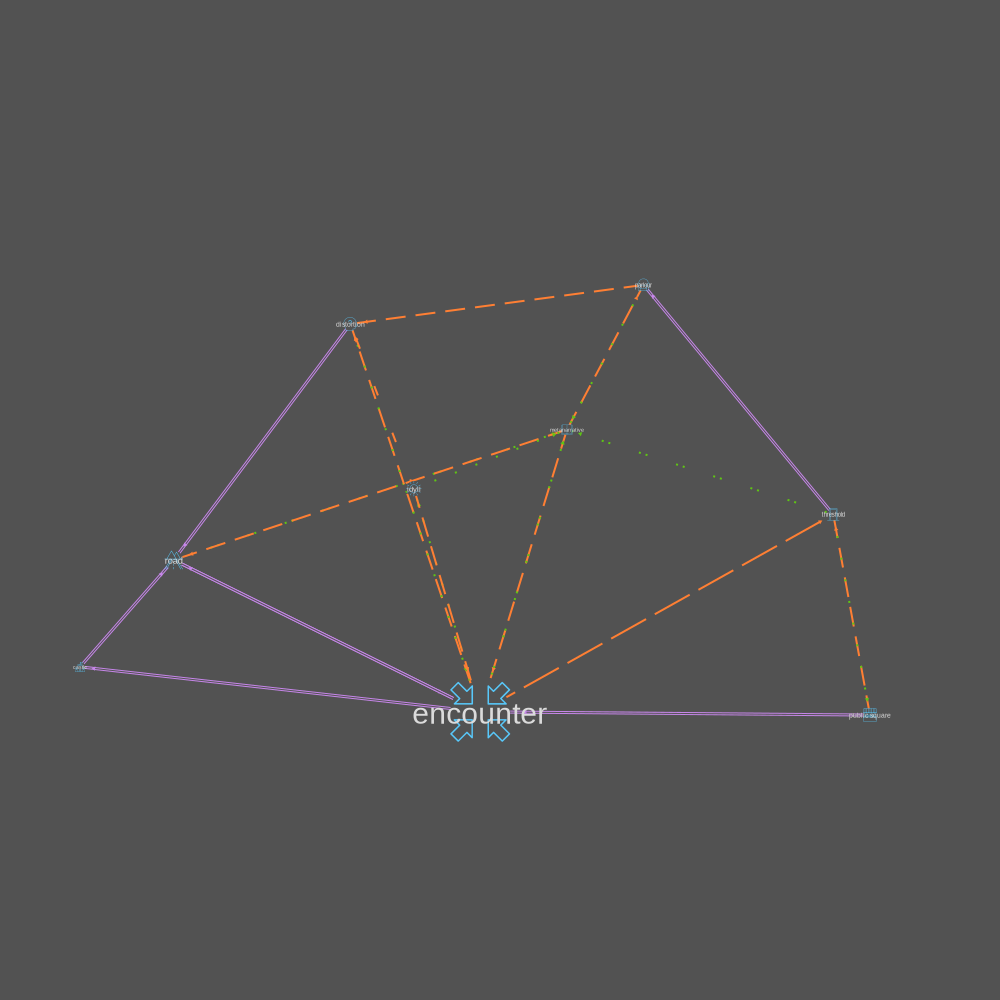
The distinctive fan-shape for Through the Looking-Glass displays a deep chronotopes map in which all sub-chronotopes are connected to encounter. As well as being the most connected node, it is also the largest, making clear that it dominates the novel. The spatio-temporal mood of the whole is born of the chance meetings Alice has on her journey through the looking-glass and across the chessboard (of the 9, 'parlour' is the only chronotope not connected the 'encounter'). Overall, the range of chronotopes speaks for the novel’s mixed character, combining travel (the 'road'), fairy tale (the 'castle', the 'idyll') and fantasy ('distortion'). Only in a fantasy setting, perhaps, could the cerebral time-space of 'distortion' connect directly to the physical, goal-directedness of the road.