Chronotopic Cartographies
Treasure Island
Robert Louis Stevenson’s Treasure Island is a highly spatial text, and is notable for the way in which mapping was integral to its composition. In an essay accompanying the text, Stevenson wrote: ‘as I pored upon my map of Treasure Island, the future characters of the book began to appear there visibly among imaginary woods; and their brown faces and bright weapons peeped out upon me from unexpected quarters, as they passed to and fro, fighting and hunting treasure, on these few square inches of a flat projection.’ (‘My First Book’, in Robert Louis Stevenson, Treasure Island, Works (London: Heinemann, 1924).
Complete Map
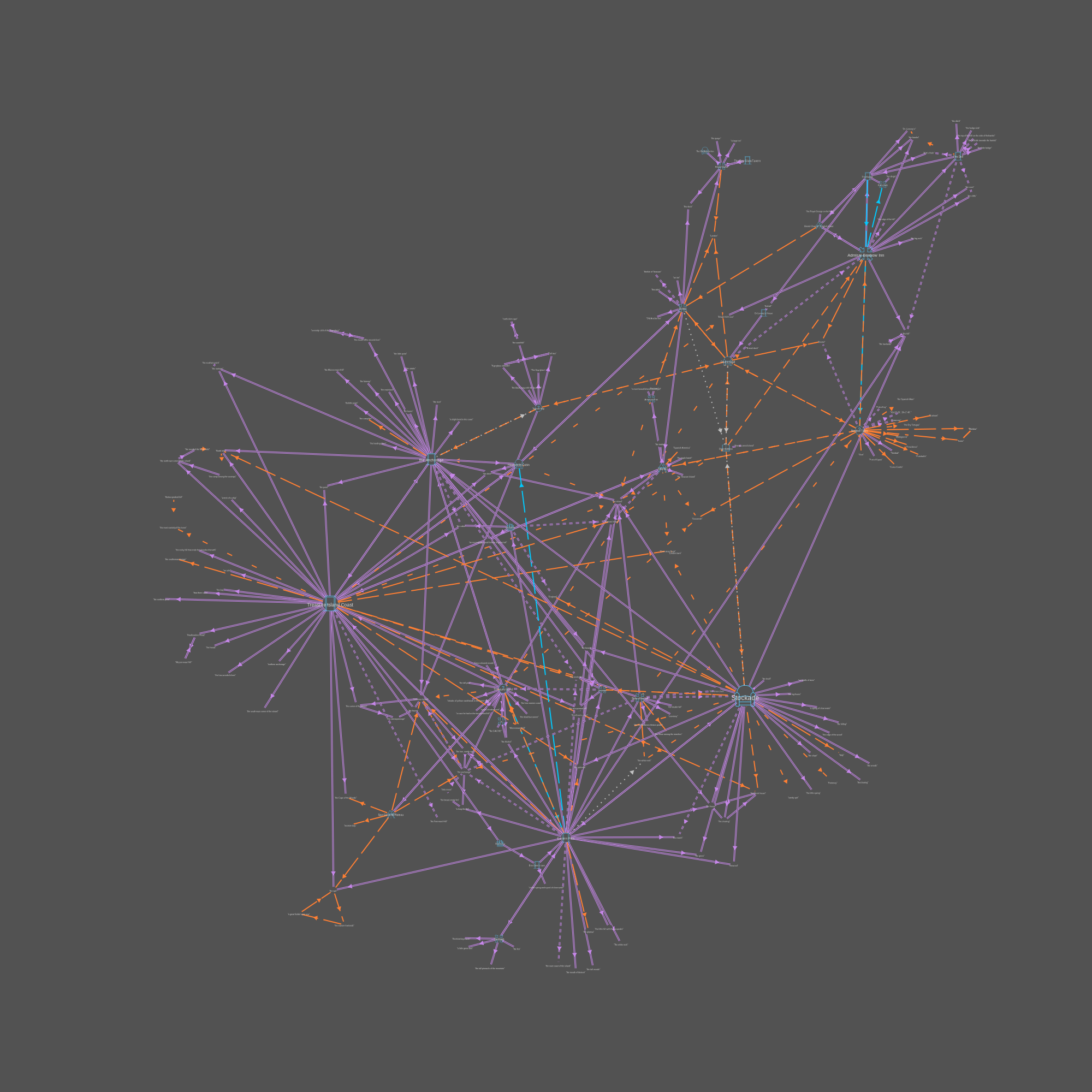
The complete map with all places and toporefs shows how the text often works outward from within interior spaces that represent home. So it moves from the 'Admiral Benbow Inn', via the 'Hispaniola cabin' to the 'Stockade' on the island. The spaces of the island are determined both from within and from the sea around it – with the 'Anchorage' forming a focal point as well as 'Treasure Island Coast'. Of course this largely reflects the experiences of the boy narrator, Jim Hawkins, and his movement upon and then around the island. If we were to map by character rather than by narrative voice then a different sense of space would emerge – the doctor for example would be far more static than Jim, whereas Long John Silver would be moving around a lot within the island in his attempts to gain control and find the treasure.
Syuzhet Map
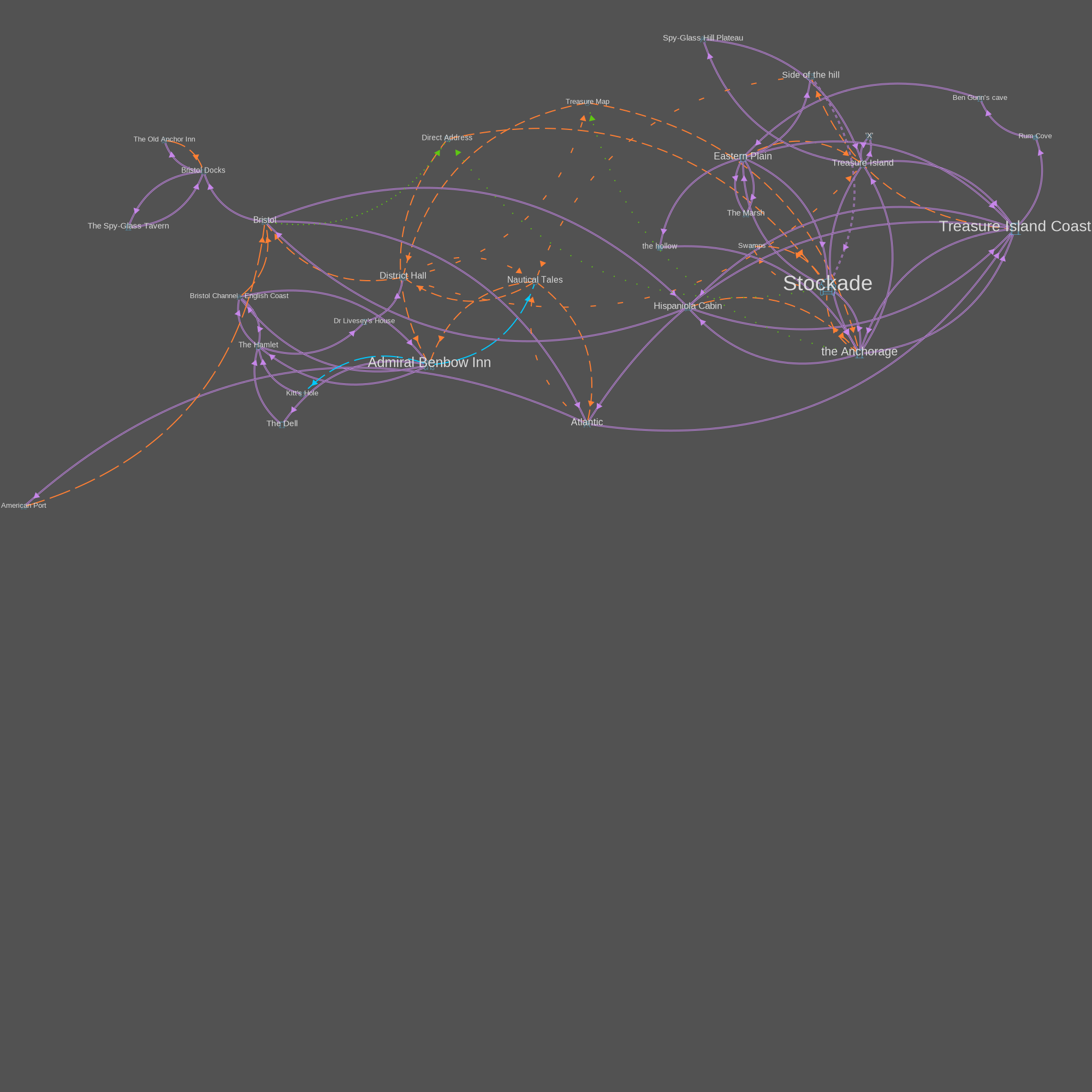
For Treasure Island the syuzhet map (the order of the narrative as told) follows Jim's discovery, first of the map that leads to the island and then of the island itself, across various treks and escapades. In the topological form the England-based places appear to the left and the island-based frames to the right-hand side of the graph, conveniently following Western reading tradition. At the heart of this map is a long, thin figure of eight that moves between 'Bristol', the 'Hispaniola' and 'Treasure Island' itself. This form thus connects the three core chronotopic spaces of adventure: Home – the transition / journey – Away. The figure of eight means that the narrative loops out and safely back home again. At the same time as the narrative depicting actual physical movement (in purple) moves one way, imagination and memory (depicted in orange) move the other.
Deep Chronotopes Map
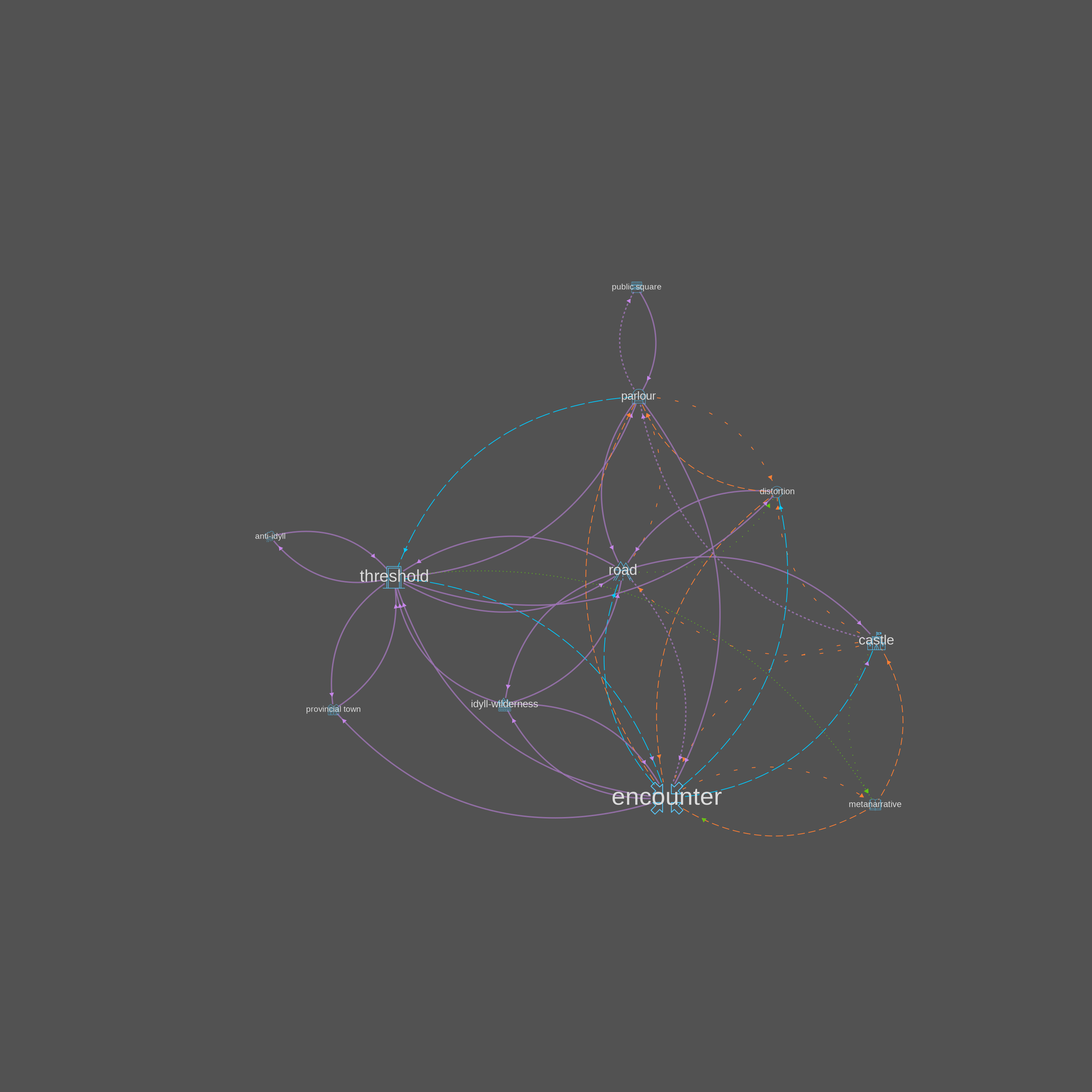
This attractive deep chronotopes map for Treasure Island emphasises the central role of journeys as 'roads' across the narrative – which intersect with the other two dominant chronotopes of 'threshold' and 'encounter'. Of course, these three chronotopic types are those we would expect to find in any adventure story – denoting the anticipation and potential of change, of travel far from the familiar home, and of unexpected encounters and challenges that arise en-route. For this reason it is also unsurprising that 'encounter' is the most dominant chronotope. These real-world adventures (as represented spatially) are shown in purple but the especially high-rate of connections to the 'parlour' in orange is a result of Jim's constant internal longing for home, for the comforts and life he left behind (and which he only fully appreciates once gone).