Chronotopic Cartographies
The Waste Land
The Waste Land
First published in 1922, T. S. Eliot’s ’The Waste Land’ is one of the landmark works of British Modernist poetry. A collage of voices and narrative fragments, the text presents a ‘heap of broken images’ which, despite their discontinuous nature, are themselves highly spatial and cohere to evoke a refracted image of European culture, and of London and the Thames Valley in particular.
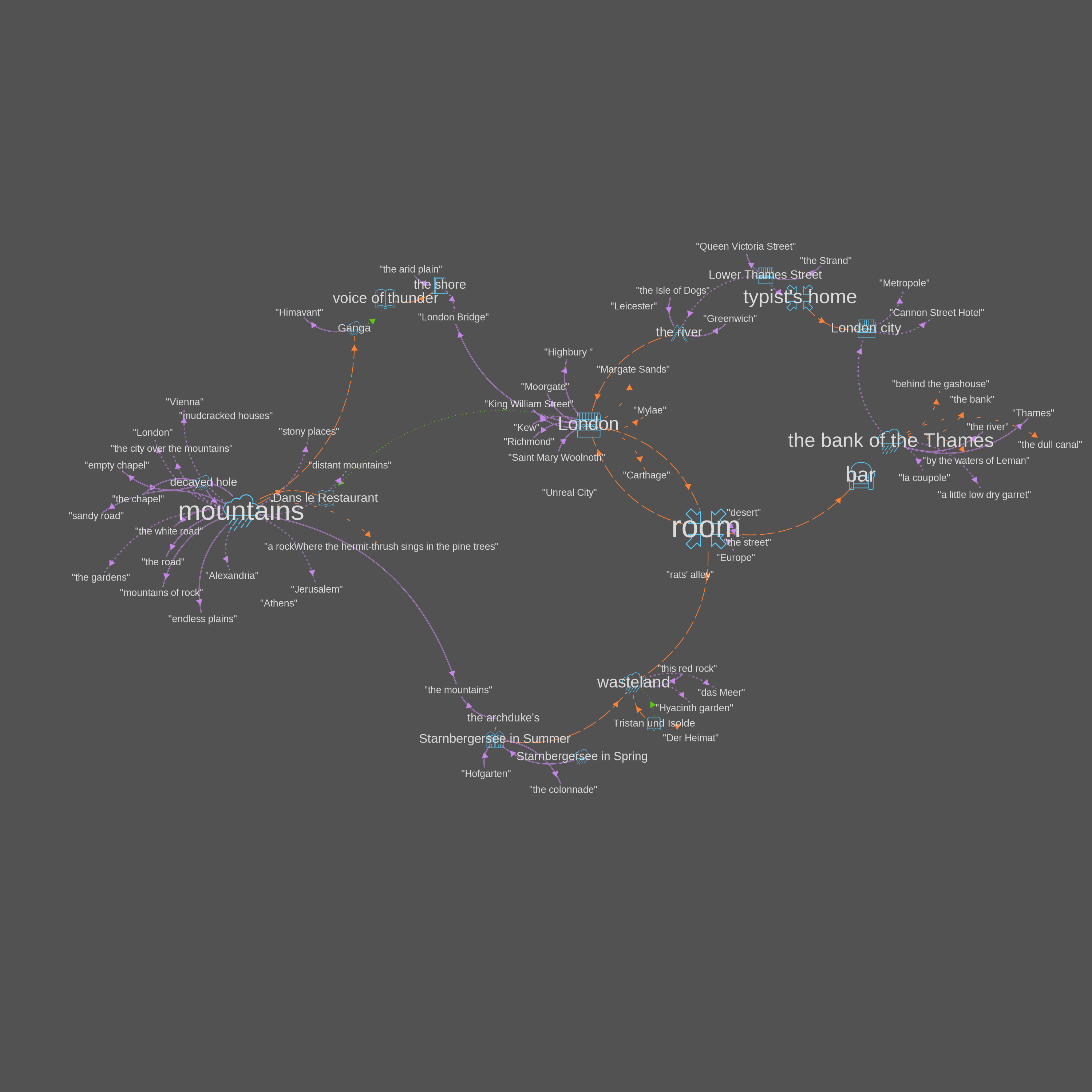
Most of the poetry in Spatial Type Two is taken from the Romantic era, and, given the emphasis placed on formal and stylistic innovation by Modernism—in Ezra Pound’s words, ‘make it new!’—one might expect that the visualisations created from ‘The Waste Land’ would be markedly different from the others. However, although the experience of reading the poem is fragmentary, when we map its contents relatively using the topological form we see that this is not the case visually. The topoi maps shown here share with ‘The Idiot Boy’ and ‘Rime of the Ancyent Marinere’ a looping, figure-of-eight structure, suggesting a shared underlying spatial pattern between this poem and the ballad form which we might not have expected to find.
Complete Map
Readings of Modernist poems tend to emphasise how their allusiveness and fragmentary form demand that they be read in their own terms as fields of symbols rather than as referring to a textual 'outside'. Such reading strategies might appear to make mapping of the sort engaged with on this project superfluous. Yet the chronotopic approach, which emphasises relative spatial form over geographic reference (i.e. how the different spatial frames of a text, whether 'real' or not, relate to one another) allows the mapping of texts without necessarily collapsing readings into literalist or biographical interpretative frames.
Taking the chronotopic values for each spatial frame of this visualisation of T. S. Eliot’s 'The Waste Land', the start of such a symbolic spatial reading emerges with a preponderance towards the urban and the Anti-idyll.
Fragments, Wholes
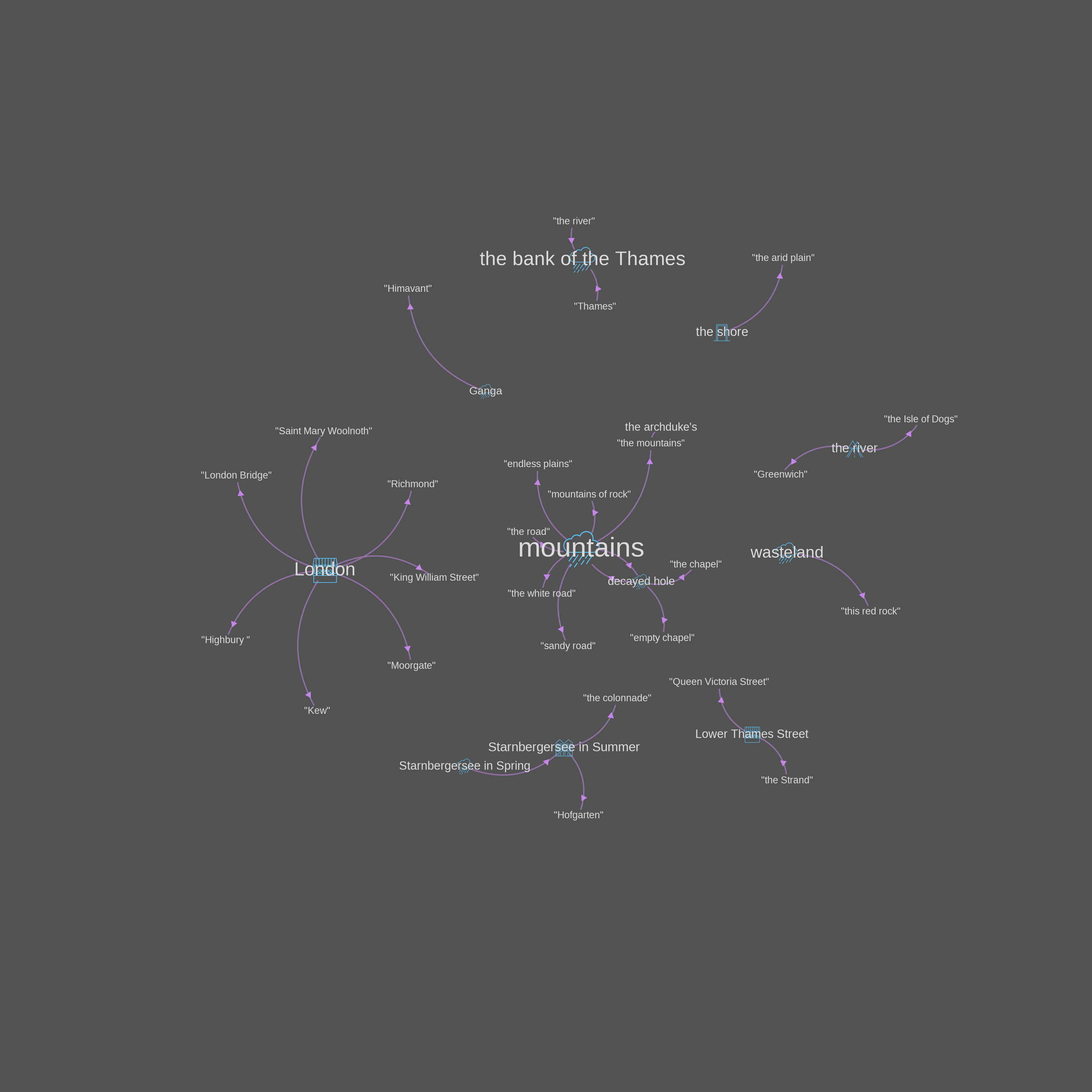
Strikingly, and in contradiction to preconceived expectations, when mapped in its entirety (left), what is most apparent in the spatial structure of 'The Waste Land' is not fragmentation, but coherence. A clear spatial structure–a loose figure of eight the fulcrum of which is 'London'–is evident. This bears comparison with the other poetic maps of 'The Idiot Boy' and 'Rime of the Ancyent Marinere' in this section.
Only when the topoi map is filtered for connections which are direct (right) – spaces which the text describes as being physically connected or reachable from one another – does the fragmentation for which the poem is notorious become visible. Yet clear spatial clusters are nonetheless apparent: mainland Europe ('the Starbergersee', 'the Mountains'); 'London'; 'the Thames' and its reaches.